Korea Federation of SMEs to Announce Survey Results on the 12th
Survey Conducted on 300 Manufacturing SMEs
Eight out of ten small and medium-sized enterprises (SMEs) were found to be unaware of the Carbon Border Adjustment Mechanism (CBAM).
The Korea Federation of SMEs announced on the 12th the results of the ‘CBAM and Carbon Neutrality Response Status Survey’ conducted from the 11th to the 25th of last month, targeting 300 manufacturing SMEs.
The EU CBAM, which primarily mandates carbon emissions reporting for exporting companies, was piloted on the 1st of this month. From 2026, carbon costs are expected to be imposed based on emission volumes, which is anticipated to have a significant impact on SMEs and the entire industrial sector.
According to the survey results, SMEs aware of the EU CBAM were 0.7% ‘very well aware’ and 21.0% ‘generally aware.’ Conversely, 42.3% were ‘generally unaware,’ and 36% were ‘completely unaware.’
Among 142 companies that either have export performance to the EU or plans to enter the EU market, which are directly affected by CBAM, 54.9% responded that they have ‘no specific response plan’ for CBAM. This was followed by ‘monitoring response plans of prime contractors and partners’ (24.6%) and ‘seeking information through government and media reports’ (19.0%).
Only 21.1% of companies were aware of the basic information necessary for CBAM response, the ‘Measurement, Reporting, and Verification (MRV) system’ for carbon emissions.
The most anticipated difficulties due to the strengthening of domestic and international CBAM and carbon neutrality policies were ‘increased manufacturing costs such as raw materials and electricity fees’ at 62.0%. This was followed by ‘strengthened regulations by government and local authorities’ (29.7%) and ‘lack of funds needed for facility conversion’ (26.0%).
Responding companies reported addressing carbon neutrality mainly through ‘reducing energy consumption by improving factories and facilities’ (13.3%), ‘utilizing renewable energy such as solar power’ (11.7%), and ‘obtaining domestic and international eco-friendly certifications’ (6.7%). However, 52.9% of companies answered that they have ‘no measures implemented or in preparation.’
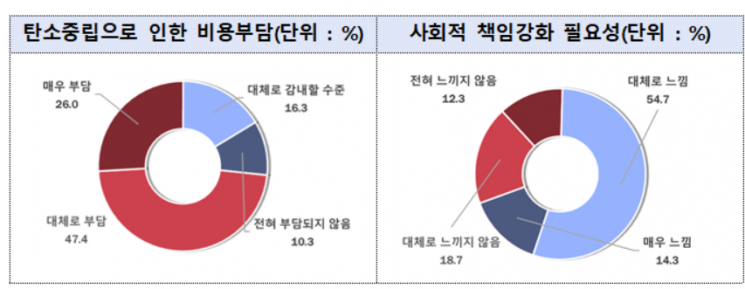
Regarding the additional costs caused by carbon neutrality, 26.0% felt ‘very burdened,’ and 47.4% felt ‘generally burdened.’ Nonetheless, 69.0% of respondents acknowledged the need to strengthen corporate environmental and social responsibility.
The most needed carbon neutrality support policy was ‘reforming energy prices such as electricity and LNG,’ which ranked first at 44.7%. This was followed by ‘expanding financial support such as green finance’ (27.3%) and ‘subsidies for facility replacement such as high-efficiency equipment’ (24.0%).
Yang Chan-hoe, Head of the Innovation Growth Division at the Korea Federation of SMEs, said, “The carbon neutrality bill initiated by the pilot introduction of the EU CBAM is issued not to individual companies but to the entire supply chain. The private sector must enhance the carbon neutrality capabilities across the supply chain through large and small business win-win projects, and the government must closely monitor the progress of CBAM and continue negotiations with EU authorities before the full implementation of the system in 2026 to prevent damage to our companies.”
© The Asia Business Daily(www.asiae.co.kr). All rights reserved.
![Clutching a Stolen Dior Bag, Saying "I Hate Being Poor but Real"... The Grotesque Con of a "Human Knockoff" [Slate]](https://cwcontent.asiae.co.kr/asiaresize/183/2026021902243444107_1771435474.jpg)
















