Gwangju Nam-gu '2023 Sign Language Education' Students Show Enthusiasm
Directly Experience Challenges of Disabled Persons... "Regret Over Uncaring Society"
"Support Needed for Eliminating Information Discrimination and Raising Awareness," Vo
"I am so proud that I have learned sign language and, albeit late, can finally have a real conversation with my hearing-impaired daughter after 30 years."
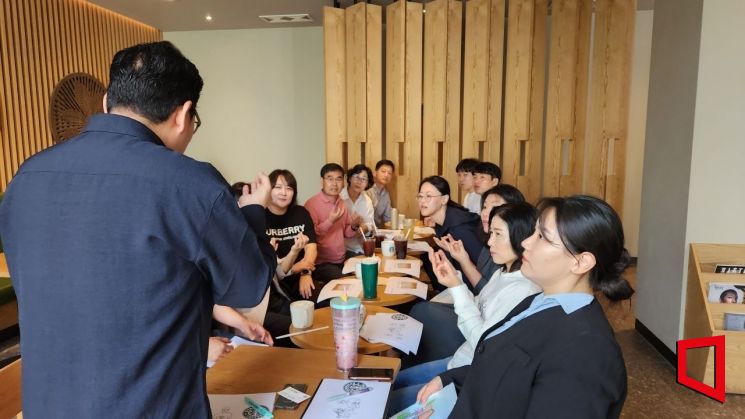 On the morning of the 11th, '2023 Sign Language Education' was held at a cafe in Wolsan-dong, Nam-gu, Gwangju Metropolitan City, where students were diligently following along.
 [Photo by Min Hyun-gi]
On the morning of the 11th, at a cafe in Wolsan-dong, Nam-gu, Gwangju Metropolitan City. Although there were 16 group guests occupying the seats, it was so quiet as if no one was there. Only the sound of songs flowing from the speaker could be heard.
Although no spoken words were heard, they were studying and communicating with each other. With hands, gestures, and facial expressions.
They were 15 students enrolled in the '2023 Sign Language Education' program promoted by Nam-gu, Gwangju. They spoke very little, and most of the conversations were conducted in sign language. This was not only to become more familiar with sign language faster but also to empathize more with the lives of the deaf.
They had to stare intently at the instructor’s hands, faithfully following each movement, repeating over and over so their bodies could remember.
The students, who have been attending sign language classes once a week since last month, came out to a nearby cafe instead of the classroom for the 5th session that day. They tried ordering drinks in sign language at the cafe using what they had learned so far, but when the staff did not understand, they smiled awkwardly and ordered verbally.
The sign language learned that day included phrases such as "What time shall we meet tomorrow?", "What time does the trip start today?", "What time is the meeting?", and "What time is dinner?".
Especially, the students unanimously said that when sign language does not work, deaf people seem to have no other options. For people with hearing impairments, sign language is their mother tongue, and Hangul is a "second foreign language." As staff disappear and kiosks increase these days, the inconvenience felt by the deaf is intensifying.
One might think, "Why not just write it down to communicate?" but according to the Ministry of Culture, Sports and Tourism’s "Survey on the Use of Korean Sign Language," 26.9% of hearing-impaired people were found to not understand or barely understand written text (written communication). Another 42.6% responded that they "somewhat understand," meaning a significant number of deaf people are effectively "illiterate."
Lee Kwon-il (62), who recently retired after working in education in Mokpo, could not hide his joy, saying that after attending sign language education, he can now communicate briefly with his daughter.
Mr. Lee said, "Until now, the only way to communicate with my hearing-impaired daughter was 'oralism,' which involves interpreting lip movements and making her speak verbally, so there were limits to communication. After taking sign language classes, even if it is short sentences or words, I have more time to communicate directly with my daughter, and I feel proud."
Yoon (37), who teaches sports for people with disabilities at the Disabled Sports Association, said he participated in sign language education to break down the language barriers he felt when educating hearing-impaired people.
Yoon said, "At first, sign language felt like a foreign language and was difficult, so I was always intimidated. But after receiving sign language education, I saw how deeply moved the hearing-impaired students were when I used even simple sign language, and I thought I should study harder."
Kim Su-yeon, director of the Deaf Shelter Center in Seo-gu, Gwangju, said, "To outsiders, deaf people may appear physically healthy, but the discomfort they feel is not resolved at all. Especially, to eliminate the information discrimination felt by hearing-impaired people with high illiteracy rates, continuous awareness improvement and support to expand sign language users are necessary."
© The Asia Business Daily(www.asiae.co.kr). All rights reserved.
![Clutching a Stolen Dior Bag, Saying "I Hate Being Poor but Real"... The Grotesque Con of a "Human Knockoff" [Slate]](https://cwcontent.asiae.co.kr/asiaresize/183/2026021902243444107_1771435474.jpg)
















