Additional Tens of Thousands of Won Including Materials and Meal Fees
Number of English Kindergartens Increased from 562 to 840 in 5 Years
"Measures Needed for Overeducation and Educational Inequality"
Amid a surge in private education for young children, the number of academies targeting this age group has steadily increased, with tuition fees for English academies, often called "English kindergartens," approaching an average of 1.24 million KRW per month.
According to data received by Kang Deuk-gu, a member of the National Assembly's Education Committee from the Democratic Party of Korea, from the Ministry of Education on the 11th, the average monthly tuition fee for English academies for young children was recorded at 1,239,000 KRW as of June. The average monthly tuition fees have increased annually from 1.07 million KRW in 2021 and 1.154 million KRW in 2022. This figure is based on academies offering classes for more than 4 hours a day, 5 times a week.
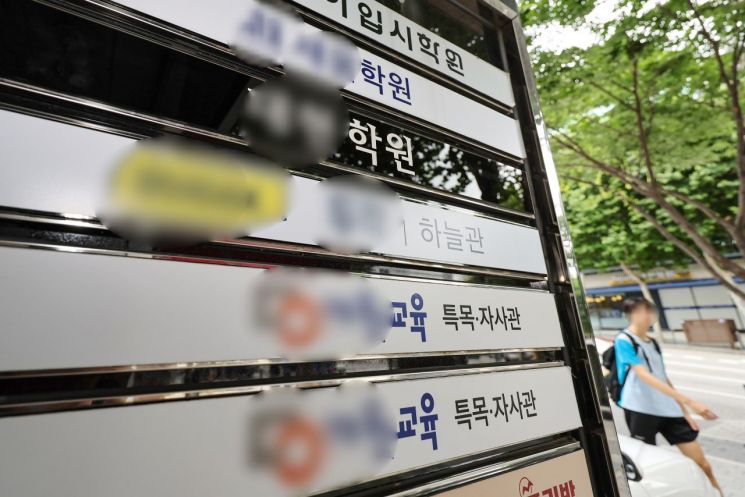 Amid the surge in private education for young children, the number of English academies targeting toddlers is steadily increasing, with tuition fees for these so-called "English kindergartens" rising each year to nearly 1.24 million won per month on average.
 [Photo by Yonhap News]
By region, Sejong had the highest tuition fee at 1.703 million KRW, followed by Chungnam at 1.459 million KRW, Seoul at 1.441 million KRW, and Incheon at 1.426 million KRW.
The tuition fees do not include costs for materials, meals, or transportation, so the actual burden on parents is expected to be higher.
Parents in Gangnam Face Nearly 2 Million KRW Monthly for Young Children’s Academies
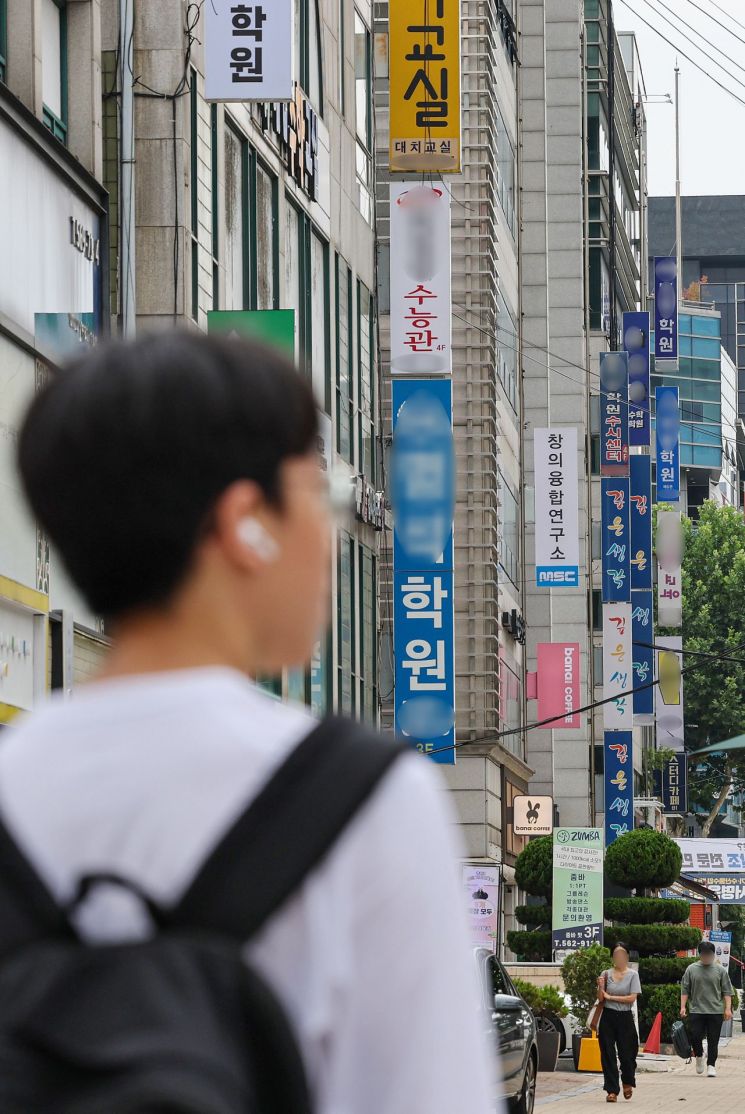 It is easy to find English academies for young children in Gangnam that require nearly 2 million won per month. These academies reportedly charge an additional entrance fee of 400,000 to 500,000 won. The competition for 'level tests' to enroll children in the so-called 'Big 5' or 'Big 10' famous elementary English academies is also intense in the Gangnam area.
 [Photo by Yonhap News]
It is not uncommon to find English academies for young children in Gangnam where parents must pay nearly 2 million KRW per month. These academies reportedly charge an additional entrance fee of 400,000 to 500,000 KRW. The competition for "level tests" to enroll children in well-known elementary English academies, often referred to as the "Big 5" or "Big 10," is fierce in the Gangnam area. As the difficulty of level tests for prospective first graders at these famous elementary English academies increases, the term "7-year-old exam" has even emerged.
As of June this year, the number of English academies for young children reached 840, about 1.5 times the 562 academies in 2018. Seoul (289 academies) and Gyeonggi (221 academies) accounted for more than half of the total. They were followed by Busan (73 academies), Daegu (41 academies), and Incheon (33 academies). The number of students enrolled in English academies for young children reached 41,486 as of the end of March this year.
The burden of private education costs is also cited as one of the main causes of low birth rates, raising concerns.
According to an analysis by Park Jin-baek, a senior researcher at the Real Estate Market Research Center of the Korea Research Institute for Human Settlements, covering 16 metropolitan local governments in Korea from 2009 to 2020, a 1% increase in per capita private education expenses in the previous year corresponded to a decrease of approximately 0.0019 in the total fertility rate.
Regarding this, Assemblyman Kang Deuk-gu emphasized, "The private education market for young children is excessively expanding, causing educational inequality based on parents' backgrounds from early childhood. It is urgent for the education authorities to prepare measures to prevent overeducation of infants and toddlers and to ensure that children can grow healthily according to their developmental stages."
© The Asia Business Daily(www.asiae.co.kr). All rights reserved.
![Clutching a Stolen Dior Bag, Saying "I Hate Being Poor but Real"... The Grotesque Con of a "Human Knockoff" [Slate]](https://cwcontent.asiae.co.kr/asiaresize/183/2026021902243444107_1771435474.jpg)
















