Education Experts Debate Over Reform Plan
Concerns Over CSAT Burden and Decline in School Record Discrimination
Admissions Industry Says "High School Credit System May Lose Its Meaning"
The Ministry of Education announced through the '2028 University Entrance Exam System Reform Draft' that starting from the 2028 academic year, an integrated subject system will be introduced for the College Scholastic Ability Test (CSAT), and high school grades will be changed to a 5-grade system. On the 11th, education policy experts gave varying evaluations of the Ministry's university entrance reform plan. Generally, they agreed with the reform's intention to resolve advantages and disadvantages, but expressed concerns that without concrete measures such as evaluation subjects in the actual CSAT and university entrance reflection methods, the purpose of the system might not be realized.
◆ "Resolving Advantages and Disadvantages" vs "Compromise with Reality" = Professor Jeong Jeyoung of the Department of Education at Ewha Womans University said, "The CSAT reform and high school grade system reform plan appear to be changes in the evaluation system that can move in line with the future education direction promoted by the Ministry of Education and education offices," and positively evaluated that "it can resolve the issue of advantages and disadvantages by elective subjects in the CSAT."
On the other hand, there were criticisms that the Ministry lowered the level of reform and came up with a somewhat compromising plan. Professor Kang Hyunseok of Kyungpook National University, who serves as president of the Korean Curriculum Association, said, "In the field, more fundamental changes were expected, but the reform plan seems to be more about managing the situation," and evaluated, "Normalizing public education and settling the high school credit system are important, and it seems that a compromise between reality and ideals was found." Professor Kang Taehoon of the Department of Education at Sungshin Women's University also analyzed, "It appears to be a realistic plan considering existing concerns from parents and students such as the fairness of standard scores."
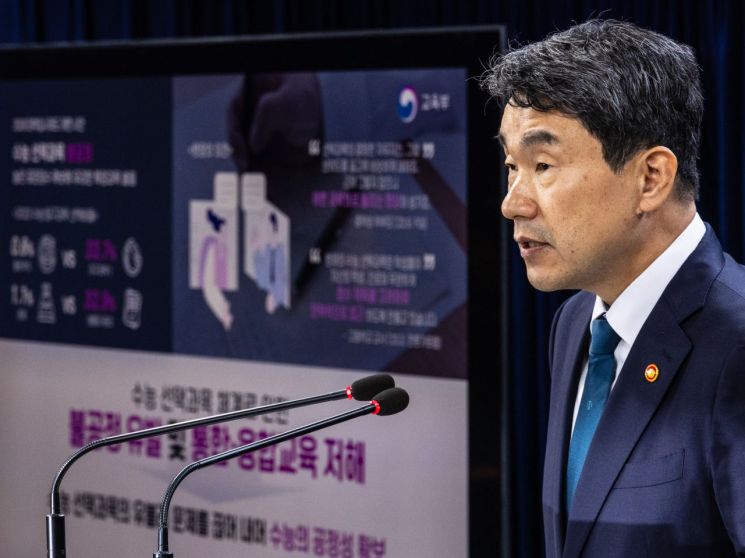
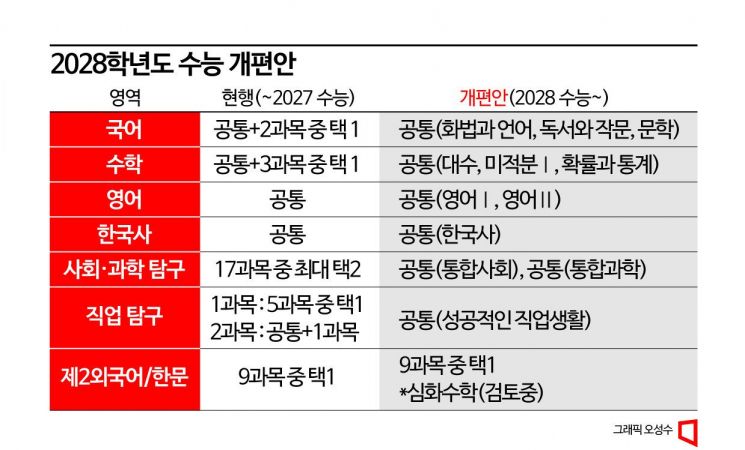
◆ Will the CSAT common subjects increase student burden? = From the 2028 academic year CSAT, examinees will take tests in common subjects rather than elective subjects in areas such as Korean, Mathematics, Social Studies/Science, Vocational Education, and Second Foreign Language/Chinese Characters. Regarding this change, Professor Kang Hyunseok said, "The content and method of questions in common subjects are expected to have a significant impact on the school curriculum," and expressed concern that "if the purpose of common subjects is not properly reflected in the CSAT questions and content, it may only increase students' test burden." He added, "The key is how well the integration as common subjects is implemented."
On the other hand, Professor Jeong agreed with the very purpose of common subjectification, explaining, "The division between humanities and sciences is disappearing, and universities are expanding admission without majors," and said, "Strengthening learning in common subjects is appropriate."
◆ Absolute evaluation of high school grades requires evaluation and university entrance methods = The high school grade evaluation method will change from the current 9-grade system to a 5-grade system, with both relative and absolute evaluation scores recorded. In this regard, some voices express concern that universities' evaluation autonomy may become excessively large. Professor Kang Taehoon said, "If the grade system is changed to an achievement evaluation system, the university's evaluation application method should also be changed accordingly," adding, "Otherwise, problems such as grade inflation may occur." Professor Song Gichang of the Department of Education at Sookmyung Women's University also analyzed, "If absolute and relative evaluations are recorded together, there is a concern that scores may be generously given in absolute evaluation, reducing the discriminative power of evaluation," and said, "Specific guidelines and regulations for absolute evaluation are necessary. Currently, it is a transitional phase toward absolute evaluation."
◆ Entrance exam industry: "The purpose of the high school credit system is undermined" = Meanwhile, voices of concern also emerged from the entrance exam industry on the same day. Lim Seongho, CEO of Jongro Academy, said, "It is the first attempt to remove barriers through the integration of humanities and sciences," but diagnosed, "However, as students focus on subjects directly linked to the CSAT and subjects that are easy to get high grades in internal assessments, the purpose of the high school credit system may be undermined." Lee Manki, director of Uway Education Evaluation Research Institute, said, "The mixing of relative and absolute evaluation in internal assessments not only lacks consistency but also risks score distortion."
© The Asia Business Daily(www.asiae.co.kr). All rights reserved.
![Clutching a Stolen Dior Bag, Saying "I Hate Being Poor but Real"... The Grotesque Con of a "Human Knockoff" [Slate]](https://cwcontent.asiae.co.kr/asiaresize/183/2026021902243444107_1771435474.jpg)

















