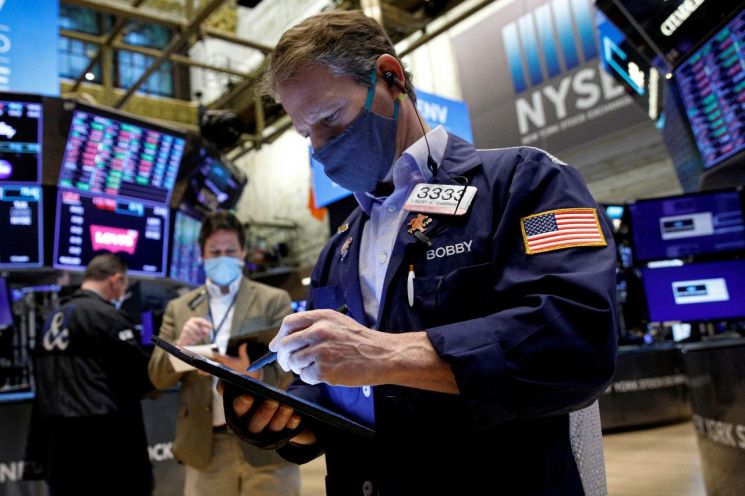
The three major indices of the U.S. New York stock market showed early gains on the 10th (local time), supported by a decline in Treasury yields amid ongoing geopolitical risks stemming from the armed conflict between Israel and Hamas.
At around 10 a.m. at the New York Stock Exchange, the Dow Jones Industrial Average was trading at around 33,673, up 68.84 points (0.20%) from the previous close. The S&P 500, which focuses on large-cap stocks, rose 16.94 points (0.39%) to 4,352, while the tech-heavy Nasdaq index was up 63.31 points (0.47%) at 13,547.
Currently, all sectors except energy within the S&P 500 are rising. Materials, consumer discretionary, and consumer staples sectors are up more than 1%. Palantir Technologies rose more than 3% after news of a $250 million contract with the U.S. Army. Rivian jumped over 5% following an upgrade in its investment rating by UBS. Major energy stocks, which had all risen the previous day due to the Israel-Hamas conflict, are showing mixed movements around the flat line. Similarly, airline stocks such as United Airlines and American Airlines, which had weakened the day before, are rebounding by around 2%. PepsiCo rose more than 1.5% after releasing better-than-expected quarterly results and raising its future guidance.
Investors are awaiting key indicators and corporate earnings releases scheduled for this week while monitoring Treasury yields and oil price movements to gauge financial market uncertainties caused by the Israel-Palestine war. The geopolitical risks originating from the Middle East have strengthened the preference for safe-haven assets, pushing up Treasury prices. Rising Treasury prices mean falling Treasury yields. In the New York bond market, the benchmark 10-year U.S. Treasury yield fell to around 4.68%. The 2-year yield, which is sensitive to monetary policy, dropped to about 4.97%.
Economic media CNBC reported, "The aftermath of the armed conflict between Israel and Hamas continues today, with investors watching whether it will impact the market and the global economy," adding, "Investors are flocking to traditional safe-haven assets like Treasuries, causing Treasury yields to decline." The bond market was closed on Monday due to Columbus Day.
This decline in Treasury yields is acting as an upward pressure on the stock market today. The media pointed out that investors might be overlooking the geopolitical risks from the Israel-Hamas conflict, buoyed by last week's optimistic employment reports and corporate earnings. The three major New York stock indices also closed slightly higher the previous day.
Pierre-Olivier Gourinchas, Chief Economist at the International Monetary Fund (IMF), said regarding the impact of the Israel-Hamas armed conflict on the global economy, "It is too early to make an economic assessment," but added, "There is a risk of an energy supply shock. This could push up oil prices, fuel inflation, and slow growth."
This week, major economic indicators such as the Consumer Price Index (CPI), which influences the Federal Reserve's (Fed) interest rate decisions, and remarks from Fed officials are also scheduled. Wall Street estimates that the September CPI, to be released on the 12th, rose 0.3% month-over-month and 3.6% year-over-year. This would be a slowdown compared to the previous month's increases of 0.6% and 3.7%, respectively. The Producer Price Index (PPI) for September, released earlier, is also expected to have eased. The minutes of the September Federal Open Market Committee (FOMC) meeting will be released on the 11th.
Remarks from Fed officials released the previous day were interpreted as somewhat dovish (favoring monetary easing), helping to ease investors' concerns that had risen amid recent increases in Treasury yields. Fed Vice Chair Philip Jefferson said in a speech to the National Association for Business Economics that "We are aware of the tightening of financial conditions caused by rising Treasury yields and will keep this in mind when assessing future policy directions." Dallas Fed President Lorie Logan, who had previously expressed hawkish views, also mentioned the recent sharp rise in long-term Treasury yields and left open the possibility of both rate hikes and pauses by the Fed.
The market still largely expects a rate hold in November. According to the Chicago Mercantile Exchange (CME) FedWatch tool, as of this morning, federal funds futures reflect an over 85% probability that the Fed will hold rates steady in November. The probability of a "baby step" (a 0.25 percentage point rate hike) stands at around 14%. There are two remaining FOMC meetings this year, in November and December.
Meanwhile, starting this week, earnings announcements from New York-listed companies, led by major banks such as JPMorgan, Wells Fargo, and BlackRock, will begin in earnest. Following PepsiCo today, Delta Air Lines, Domino's Pizza, Walgreens, and others will release earnings this week. If corporate earnings show strength, it is expected to act as upward pressure on the stock market.
On this day, the Chicago Board Options Exchange (CBOE) Volatility Index (VIX), known as Wall Street's "fear gauge," fell more than 3% from the previous close to 17.1. The U.S. Dollar Index, which measures the dollar's value against six major currencies, slightly declined to around 105.8.
International oil prices, which had surged due to Middle East geopolitical risks, are falling today. West Texas Intermediate (WTI) crude oil prices are trading around $85.7 per barrel, down 0.8% from the previous close. Brent crude is also down, trading near $87.5 per barrel.
© The Asia Business Daily(www.asiae.co.kr). All rights reserved.
![Clutching a Stolen Dior Bag, Saying "I Hate Being Poor but Real"... The Grotesque Con of a "Human Knockoff" [Slate]](https://cwcontent.asiae.co.kr/asiaresize/183/2026021902243444107_1771435474.jpg)















