WTI and Brent Crude Both Rise... Key Issue Is Whether Escalation Occurs
Safe-Haven Assets Rebound Amid Spreading 'Geopolitical' Uncertainty
International oil prices surged on the 9th due to the armed conflict between Israel and the Palestinian militant group Hamas. Amid growing uncertainty in the global economy, representative safe-haven assets such as the dollar and gold showed strength.
According to Bloomberg and other sources, as of 3:08 PM (Korea time) on the same day, West Texas Intermediate (WTI) crude oil futures were trading at $85.94 per barrel, up 3.80% from the previous day. WTI futures had rapidly risen the day before, surpassing the $87 mark, and are currently fluctuating around $86.
Brent crude futures also rose more than 3% compared to the previous day, currently trading around $87, showing a similar trend to WTI.
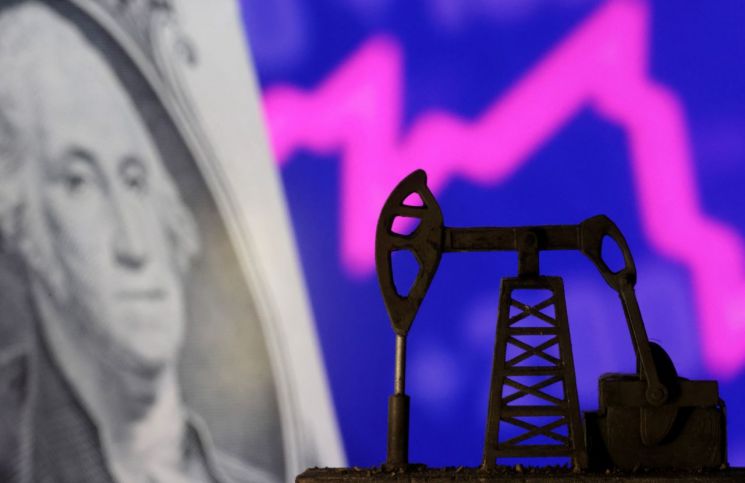
Although Israel and Palestine are not oil-producing countries and thus do not have an immediate large impact on international oil prices, reports that Iran was behind Hamas's attack have raised concerns among traders about the possibility of the conflict escalating into a Middle East war, affecting oil prices. In particular, if other Middle Eastern oil-producing countries become involved in the conflict or if oil production facilities or transportation routes are compromised, oil prices could surge sharply.
The International Finance Center emphasized in its report titled "Outbreak and Assessment of Israel-Hamas Armed Conflict" on the same day that "following the Russia-Ukraine war, the increase in geopolitical risks originating from the Middle East could lead to a sharp rise in international oil prices, raising concerns about heightened uncertainty in the global economy and international financial markets, warranting cautious monitoring."
The center added, "If there is retaliation following Israeli civilian casualties, expanded involvement of Shia militant groups such as Hezbollah, and attacks from Iran, which is presumed to be the backer, the conflict could last longer than expected and the nature of the war could escalate."
According to the BBC, Saul Carbonic, an energy analyst at Credit Suisse, stated, "If Iran, suspected to be behind Hamas's attack, intervenes in this conflict, up to 3% of the world's oil supply could be at risk."
However, looking at past conflicts between Israel and Arab countries, most ended within a short period, and the impact on international oil prices was limited, with prices stabilizing after a short-term spike except during the first and second oil shocks.
Nevertheless, this situation has many unusual aspects, making its development direction uncertain. The International Finance Center explained that the uncertainty stems from factors such as ▲the unprecedented large-scale shelling and border infiltration by Hamas ▲Israel's declaration of war and strong retaliatory threats ▲the involvement of other Shia militant groups (Hezbollah, Houthis) ▲and the fact that it occurred during a period of reconciliation in the Middle East.
The center explained, "With global oil supply and demand tight due to production cuts by Saudi Arabia and Russia, and U.S. strategic petroleum reserves at their lowest level in 40 years, a supply shock originating from the Middle East could further strengthen the recent upward trend in international oil prices."
Meanwhile, as uncertainty from the Middle East spreads and market risk aversion intensifies, safe-haven assets such as the dollar, long-term U.S. Treasury bonds, and gold are showing strength.
The representative safe-haven asset, the U.S. dollar, strengthened, with the Bloomberg Dollar Spot Index rising 0.2%, and the yield on 10-year U.S. Treasury bonds increasing by 0.08 percentage points to 4.80%. Another safe-haven asset, spot gold, also rose 1% to $1,850.52 per ounce. Gold prices had recently been declining, hitting their lowest level since March, but appear to have rebounded due to this situation.
© The Asia Business Daily(www.asiae.co.kr). All rights reserved.
![Clutching a Stolen Dior Bag, Saying "I Hate Being Poor but Real"... The Grotesque Con of a "Human Knockoff" [Slate]](https://cwcontent.asiae.co.kr/asiaresize/183/2026021902243444107_1771435474.jpg)















