Monthly insurance premiums under 50,000 won, over 80,000 people unable to pay due to financial hardship
Denied National Health Insurance benefits at hospitals and pharmacies
Support measures needed to protect health rights
The number of ‘livelihood-type defaulters’ who cannot even pay the health insurance premium of about 50,000 won per month due to financial difficulties is rapidly increasing. As of July, it has already reached 710,000 households, exceeding last year’s total of 708,000 households.
Among them, it has been confirmed that about 80,000 people are effectively unable to receive health insurance benefits when visiting hospitals, clinics, or pharmacies due to restrictions on insurance benefits. There are calls for measures to support households with long-term livelihood-type health insurance premium arrears, which are a representative sign of risk for vulnerable households.
According to data submitted by the National Health Insurance Service to Jeon Hye-sook, a member of the National Assembly’s Health and Welfare Committee from the Democratic Party of Korea, the number of households that have defaulted on health insurance premiums for more than six months was counted at 931,000 as of July this year.
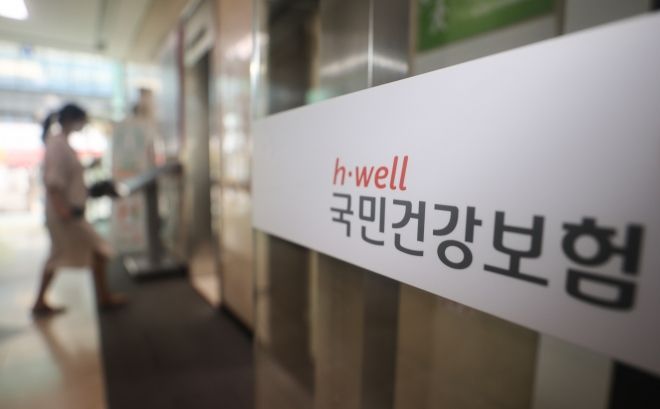 A citizen is visiting the Yeongdeungpo Southern Branch of the National Health Insurance Service in Yeongdeungpo-gu, Seoul.
 [Photo by Yonhap News]
Among these, 710,000 households could not even pay premiums below 50,000 won per month, accounting for 76% of all defaulting households.
Analyzing the annual income of the 710,000 livelihood-type defaulting households, 75% (532,000 households) earned less than 1 million won per year, making up the majority. Households with annual income exceeding 1 million won but less than or equal to 3 million won numbered 74,000, those exceeding 3 million won but less than or equal to 5 million won were 45,000, and those exceeding 5 million won but less than or equal to 10 million won were 55,000, while only 3,000 households earned more than 10 million won.
Livelihood-type defaults have increased every year. The number was 685,000 households in 2021, rising to 708,000 households in 2022. This year, it has already been confirmed at 710,000 households, more than last year. The unpaid premiums of these low-income households amount to 899.5 billion won, accounting for 60% of the total long-term arrears of 1.5031 trillion won.
In particular, among the livelihood-type defaulters, 82,720 people are effectively unable to receive health insurance benefits when visiting hospitals, clinics, or pharmacies due to restrictions on health insurance benefits.
By period, the number of people restricted from health insurance for less than six months was 26,599; from six months to less than one year and six months was 15,534; from one year and six months to less than two years and six months was 16,849; and from two years and six months to less than three years and six months was 18,444. Among them, 5,294 people have been unable to receive health insurance coverage for more than three years and six months. In the case of the ‘Suwon three mothers,’ who passed away last year due to illness and hardship, health insurance premiums were in arrears for one year and six months.
According to Article 53 of the National Health Insurance Act, if health insurance premiums are not paid for more than six months, a notice may be issued restricting eligibility for health insurance benefits. If arrears continue after that, health insurance benefits cannot be received.
 (Photo is not directly related to the article.) Alley in the jjokbangchon under the scorching sun [Photo by Yonhap News]
Even if premiums are in arrears, hospital use is possible, but later the National Health Insurance Service recovers the medical expenses (the portion borne by the Service) for treatment received under health insurance, so the defaulter ultimately bears the full medical cost.
Many defaulters with restricted health insurance benefits, as well as a significant number of livelihood-type defaulters, are psychologically discouraged and often reluctant to visit hospitals even when ill.
Assemblywoman Jeon said, “The number of medically vulnerable groups who cannot go to hospitals due to lack of money even when sick is increasing,” and added, “National support measures for livelihood-type health insurance premium defaulters must be prepared to protect the health rights of citizens on the brink of crisis.”
Meanwhile, the National Health Insurance Service has gradually expanded the exemption system for unpaid premiums to guarantee medical benefits for low-income and vulnerable groups. Previously, only households with an annual income of less than 1 million won and no members in their 30s or 40s were exempted from unpaid premiums through debt relief, but since last September, the annual income criterion has been relaxed to 3.36 million won or less. Households can now receive debt relief regardless of the age of household members.
© The Asia Business Daily(www.asiae.co.kr). All rights reserved.
![Clutching a Stolen Dior Bag, Saying "I Hate Being Poor but Real"... The Grotesque Con of a "Human Knockoff" [Slate]](https://cwcontent.asiae.co.kr/asiaresize/183/2026021902243444107_1771435474.jpg)
















