376 times and 36 times.
These are the numbers presented respectively by the Democratic Party of Korea and the prosecution when calculating the number of searches and seizures conducted against Lee Jae-myung, the leader of the Democratic Party of Korea. Some in the legal community evaluate the gap as irrational. They argue that no matter how different the positions are, it is difficult for the calculation difference to be this large.
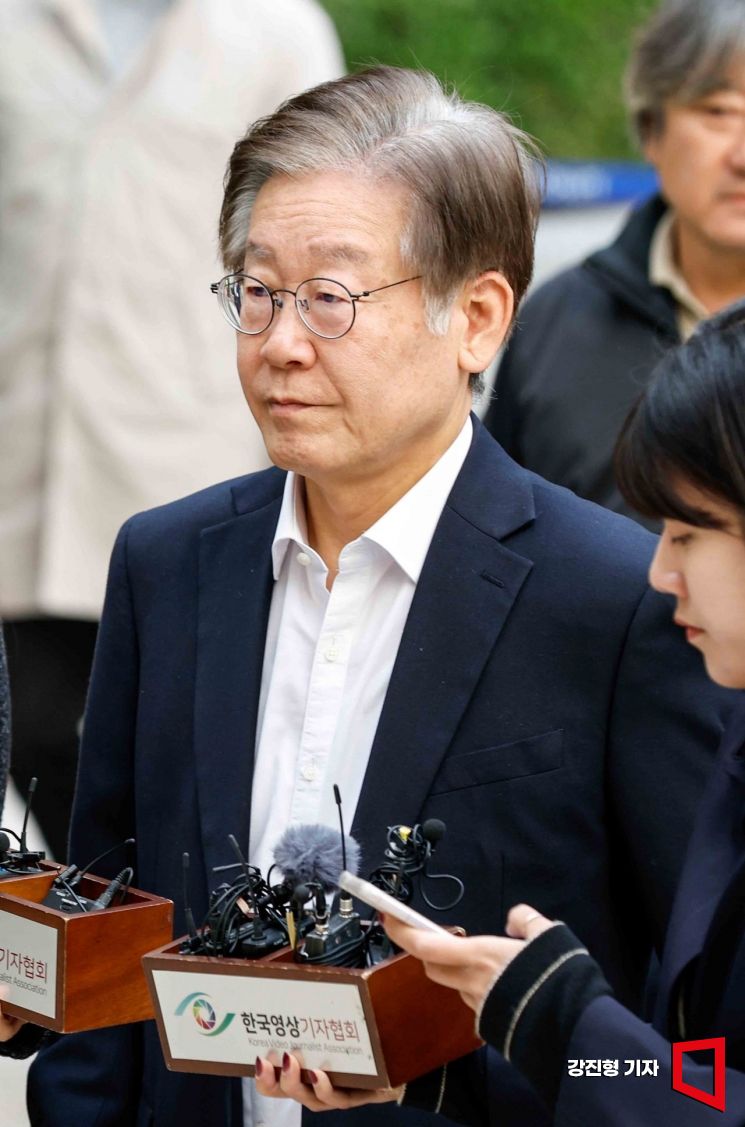 Lee Jae-myung, the leader of the Democratic Party of Korea, who is under suspicion of preferential treatment in the development of Daejang-dong and Wirye New Town, is appearing at the Seoul Central District Court in Seocho-gu, Seoul on the 6th to face trial. Photo by Kang Jin-hyung aymsdream@
The number of searches and seizures is expected to have considerable influence in court as well. At the first trial regarding the Daejang-dong scandal held on the 6th at the Seoul Central District Court, Lee claimed, "They deployed dozens of prosecutors and conducted hundreds of searches and seizures." This is interpreted as a strategy to leave the impression on the court that the prosecution conducted coercive investigations targeting Lee in an organized and intentional manner. The prosecution, which countered that only 36 searches and seizures were conducted outside the courtroom, is also likely to respond to Lee’s claims in court soon.
Why is there such a large difference in the number of searches and seizures? According to explanations from political and legal circles on the 8th, the difference of more than tenfold appears to be due to differing calculation criteria between the Democratic Party and the prosecution.
First, the prosecution counted the number of searches and seizures based on the warrants received from the court. After the presidential election and the reorganization of the investigation team in June last year, they confirmed by checking the actual warrants issued and executed that the number was 36. This includes 10 times related to the Daejang-dong and Wirye cases, 11 times related to Ssangbangwool and North Korea remittance cases, 5 times related to lawyer fee payments, 5 times related to the Baekhyeon-dong case, and 5 times related to the Seongnam FC case. The prosecution usually conducts searches and seizures targeting multiple locations or items listed on a single warrant, but this time they calculated one search per warrant without reflecting multiple targets. The prosecution’s position is that this is similar to how a business trip visiting multiple locations is counted as one trip, not multiple trips.
On the other hand, the Democratic Party viewed that if dozens of places were searched on the same day, each location should be counted as a separate search and seizure. Even if they returned to the same location to continue the search, it was counted as a separate case. They also confirmed and calculated the searches and seizures based on media reports.
Regarding whether to include police searches and seizures, the two sides reportedly had differing standards. The Democratic Party included police searches and seizures, reasoning that since the police are under the control of the prosecution, which has the authority to request warrants, there is no reason to exclude them from the calculation.
In contrast, the prosecution considers the Democratic Party’s claim to be incorrect. Since the prosecution’s investigative authority over the police was already abolished in 2020 under the Moon Jae-in administration’s prosecution-police investigation authority adjustment, it is inappropriate to claim that the prosecution is responsible for searches and seizures conducted at the police stage. According to the Democratic Party’s logic, since the prosecution requests the search warrants but the court issues them, shouldn’t the court be held accountable instead?
© The Asia Business Daily(www.asiae.co.kr). All rights reserved.
![Clutching a Stolen Dior Bag, Saying "I Hate Being Poor but Real"... The Grotesque Con of a "Human Knockoff" [Slate]](https://cwcontent.asiae.co.kr/asiaresize/183/2026021902243444107_1771435474.jpg)
















