The Hong Kong stock market, with a market capitalization of $4 trillion (approximately 5,400 trillion KRW), remains trapped in a prolonged slump caused by an extreme drought in trading activity.
On the 5th (local time), The Wall Street Journal (WSJ) highlighted the phenomenon and causes of global funds leaving the Hong Kong stock market. WSJ pointed out that the continuous decline in stock trading volume over the past three years in the Hong Kong stock market, once Asia's financial hub, reflects how much global investors' interest has waned. As trading volumes shrink and stock price volatility increases, global companies have also reduced their use of the Hong Kong stock market for initial public offerings (IPOs).
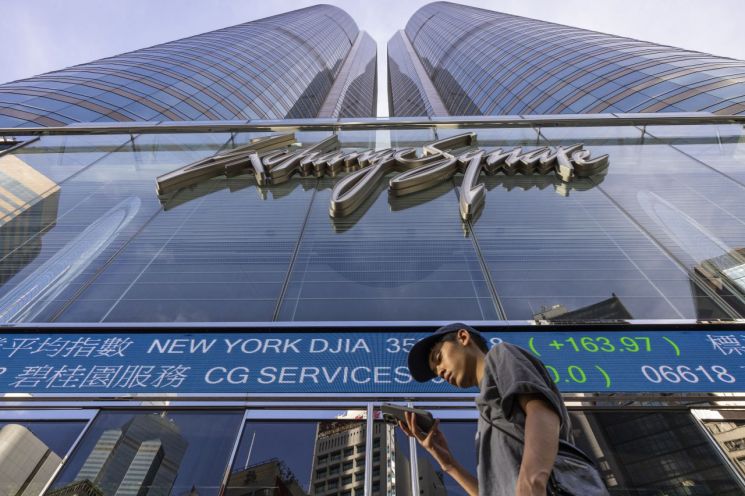
The earnings of companies listed on the Hong Kong stock market are influenced by the Chinese economy, and market liquidity is linked to the U.S. Federal Reserve's (Fed) monetary policy, making it sensitive to economic and policy setbacks between the U.S. and China. A representative from the Hong Kong Stock Exchange explained, "The prolonged high interest rate environment, global economic recession, and deteriorating investor sentiment are acting as causes for the decline in trading."
WSJ analyzed that the crisis in the real estate market, which emerged after China's reopening (economic restart), has triggered structural pessimism about the Chinese economy, accelerating the outflow of foreign capital from China and the trend of de-Chinafication. Global investors no longer view Hong Kong as a safe investment destination distinct from China.
Geopolitical factors such as U.S.-China conflicts and de-Chinafication also contributed to worsening investor sentiment. Among major Asian stock markets, the Hong Kong stock market has the highest proportion of foreign and institutional investors, making it sensitive to global liquidity. WSJ noted, "The movement of Western and other overseas investors withdrawing funds from the Chinese stock market for geopolitical reasons has also impacted the Hong Kong stock market."
The Hang Seng Index, the representative index of the Hong Kong stock market, closed at 17,263.88, down 4.57% from the previous session, marking the lowest level this year. The Hang Seng Index has fallen 13% year-to-date and has plunged nearly 24% from its January peak of 22,688.90. On an annual basis, the index has not escaped a downward trend for four consecutive years.
The market capitalization of companies listed on the Hong Kong stock market has decreased by more than one-third over two years compared to the peak during the pandemic boom in 2021. To absorb the shock caused by the outflow of overseas funds, mainland Chinese capital through the Stock Connect program has steadily purchased Hong Kong stocks. According to WSJ, about one-third of the buying flow in the Hong Kong stock market comes from mainland Chinese capital.
James Fletcher, founder of Ethos Investment Management, explained, "In recent months, it has become difficult to execute stock sell trades in the Hong Kong stock market," adding, "This is due to the overwhelming dominance of sell demand compared to buy demand."
Experts maintain a pessimistic outlook on the restructuring of China's real estate industry and economic recovery prospects, forecasting that the Hong Kong stock market's sluggishness will continue for the time being. Jasmine Duan, chief investment strategist at RBC Wealth Management, said, "Overseas investors want to see more signals confirming that the Chinese economy is recovering."
© The Asia Business Daily(www.asiae.co.kr). All rights reserved.
![Clutching a Stolen Dior Bag, Saying "I Hate Being Poor but Real"... The Grotesque Con of a "Human Knockoff" [Slate]](https://cwcontent.asiae.co.kr/asiaresize/183/2026021902243444107_1771435474.jpg)















