France to Provide EV Subsidies Based on Carbon Emissions in Production Process
Weakening Competitiveness of EVs Produced in Asia Including China and Korea
Acts as Non-Tariff Barrier, Requires Response to Risk of Domestic Industry Hollowing Out
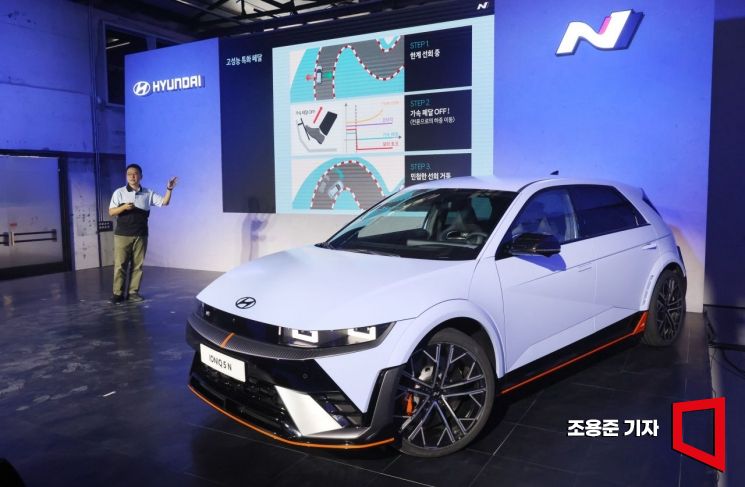 On September 14th, the Ioniq 5N was exhibited at the 'Hyundai Motor Ioniq 5N Tech Day' held at Layer11 Studio in Mapo-gu, Seoul. Photo by Jo Yongjun jun21@
With the strengthening of protectionist measures under France's Green Industry Act confirmed last September, a national research institute has warned that the domestic electric vehicle (EV) industry ecosystem could face the risk of hollowing out. The existing Korean business model of 'domestic production followed by export' may shift to a 'local production followed by local sales' model. It is pointed out that the domestic industry must respond swiftly to the restructuring of the global EV supply chain.
On the 6th, the Korea Institute for Industrial Economics & Trade (KIET) advised in its report titled "The French Version of the Inflation Reduction Act (IRA), Contents and Implications of the EV Subsidy System" that the EV industry ecosystem is at high risk of being reorganized around major markets such as the United States and Europe, and that the domestic industry should prepare for the risk of hollowing out.
France's Green Industry Act is a concrete implementation plan for the European version of the IRA, known as the Carbon Neutral Industry Act. Its main contents include tax credits to attract foreign investment, administrative reforms to shorten the time required to establish factories, and revisions to EV subsidies considering carbon footprints. Among these, the EV subsidy revision is closely related to Korean companies.
The U.S. IRA provides subsidies for EVs based on the location of production and parts procurement. The main conditions are assembly of the final product and procurement of key parts within the U.S. or under Free Trade Agreements (FTA). In contrast, France grants subsidies based on the carbon emissions during the EV production process. The new subsidy system calculates a carbon footprint score by summing carbon emissions from production and transportation to the consumption site, then derives an environmental score by considering recycling scores, and determines subsidy eligibility based on this.
This approach acts as a non-tariff barrier to Asian countries, potentially negatively impacting export competitiveness. Europe has a higher proportion of renewable energy-based electricity and shorter transportation distances to consumption sites compared to Asian countries.
Specifically, the environmental score used as the subsidy eligibility criterion consists of carbon footprints generated in six major processes: steel, aluminum, other raw materials, EV assembly, battery, and transportation. The carbon emission coefficients applied to each process vary by production region, ultimately favoring production within Europe.
In the case of aluminum, using aluminum produced in China for vehicle production is set to emit more than twice the carbon compared to Europe. Also, assembly in Asia?including China, Korea, and Japan?is calculated to produce about three times the carbon emissions compared to France. Regarding transportation, the logistics system and distance to France are considered, which is disadvantageous for relatively distant Asian countries.
KIET views France's new EV subsidy system as likely to enhance the competitiveness of EVs produced in France and Europe compared to Asia, including China, thereby influencing the location of EV production and related supply chains.
Vehicles produced in China are assigned high carbon emission ratings in most categories, reducing their eligibility for subsidies. The battery, which accounts for the largest share of the EV production carbon footprint, is also expected to face subsidy disadvantages if imported from Asia, promoting a shift toward production within Europe.
The biggest cause of regional differences in carbon emissions during EV production is the energy mix. Therefore, production activities in countries relying heavily on coal and gas with high carbon emissions, such as China, Korea, and Japan, are expected to be disadvantaged in obtaining environmental scores.
KIET pointed out that the subsidy scheme based on carbon emissions during production acts as a non-tariff barrier similar to the European Commission's Carbon Border Adjustment Mechanism (CBAM), which could lead to hollowing out of the domestic industry.
The problem is that regulations like France's Green Industry Act could spread to other European countries. The European Union (EU) has introduced the Carbon Neutral Industry Act and the Critical Raw Materials Act in response to the U.S. IRA. France is the first individual country to announce the Green Industry Act, and other countries may adopt similar systems. The report noted, "Non-tariff barriers are expanding from intermediate goods to final goods, such as from semiconductors to smart devices using semiconductors, and from secondary batteries to EVs," and warned, "Attention should be paid to the expanding scope of protectionist measures through non-tariff barriers."
Researchers Kim Gyehwan and Kang Jihyun, who authored the report, stated, "With the expansion of advanced countries' domestic-centered industrial policies and protectionist measures, Korean companies' overseas market entry strategies will inevitably shift from the 'Korean production followed by export' model to strengthening the 'local production followed by local sales' model," adding, "Urgent policy responses are required to prepare for the risk of domestic industrial hollowing out."
© The Asia Business Daily(www.asiae.co.kr). All rights reserved.

















