Leading the Local Era: Composed of 3 Major Strategies, 12 Core Tasks, and 69 Action Items
Busan City, Ulsan City, and Gyeongsangnam-do have jointly established the “Busan-Ulsan-Gyeongnam (Bu-Ul-Gyeong) Super Metropolitan Area Development Plan (2023?2027),” which embodies the vision of “Leading the Local Era with the Development of Eight Major Northeast Asian Metropolitan Economic Zones.”
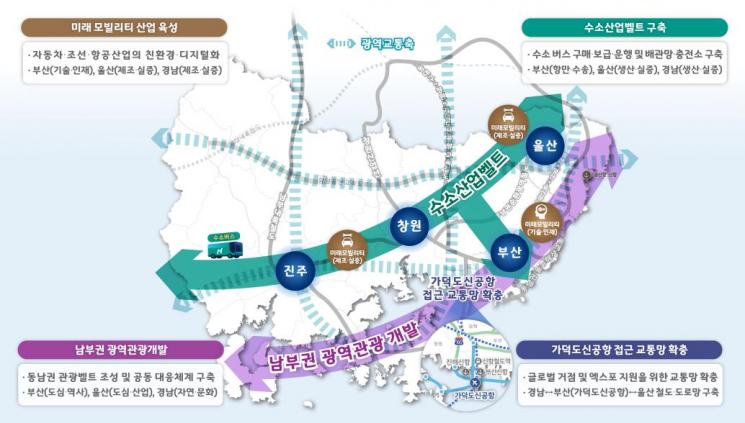
The “Bu-Ul-Gyeong Super Metropolitan Area Development Plan (2023?2027)” is a newly formulated five-year mid-term statutory plan following the enforcement of the “Special Act on Local Autonomy and Regional Balanced Development (hereinafter referred to as the Local Decentralization and Balanced Development Act)” in July.
Centered on the Bu-Ul-Gyeong Super Metropolitan Economic Alliance Promotion Team, launched in March, the metropolitan local governments of Bu-Ul-Gyeong, along with research institutes and technoparks from the three cities and provinces, participated in the formulation of this plan. Additionally, after consulting with the Korea Institute for Industrial Economics and Trade and through inter-ministerial discussions, the finalized “Bu-Ul-Gyeong Super Metropolitan Area Development Plan” was approved in its original form by the local era committees of all three cities and provinces, with Busan City being the last on the 4th.
The Bu-Ul-Gyeong Super Metropolitan Area aims to achieve an average annual economic growth rate of 3%, a one-hour daily commute time across the metropolitan area, and a life satisfaction score of 7.5 among the residents of Bu-Ul-Gyeong.
To this end, the plan includes three major strategies: ① establishing an industrial innovation foundation through the advancement of core industries and fostering cutting-edge new industries, ② building metropolitan infrastructure to meet the expanding commuting demand of the living area, and ③ improving living conditions to enhance the quality of life that residents can tangibly feel. These are supported by 12 core tasks and 69 implementation tasks (projects), with a total project budget of 41 trillion KRW.
① First, to establish an industrial innovation foundation through the advancement of core industries and fostering cutting-edge new industries, four core tasks and 29 implementation tasks will be pursued.
The first core task, “Fostering a Future Mobility Industry Leading Industrial Growth,” includes projects such as establishing a virtual development cooperation center for future mobility parts, developing innovative technologies throughout the lifecycle of eco-friendly ships, creating an aviation ICT convergence cluster, and building a testing and evaluation infrastructure.
The second core task, “Supporting the Co-Growth of Bu-Ul-Gyeong Industries and Fostering the Hydrogen Industry,” includes the construction of a hydrogen pipeline network in Bu-Ul-Gyeong, operation of hydrogen buses, and establishment of hydrogen charging stations.
The third core task, “Promoting the Bu-Ul-Gyeong Energy Alliance,” involves joint efforts to introduce a new nuclear safety grant tax and the prompt implementation of region-specific electricity tariff systems.
Lastly, the core task “Establishing a Foundation for Technology Development Diffusion and Trade Support for Regional Companies” plans to expand the ICT Innovation Square project, promote local innovation projects based on cooperation between local governments and universities, among nine other implementation tasks.
② To build metropolitan infrastructure responding to the expanding commuting demand of the living area, five core tasks and 28 implementation tasks will be pursued.
For “Establishing a Metropolitan Railway Network for One-Hour Living Zones and Industrial Support,” projects include constructing the Busan?Yangsan?Ulsan metropolitan railway, introducing railway transportation infrastructure connecting Ulsan?Busan?Changwon?Jinju, and establishing a new Ulsan branch line on the KTX Gyeongbu high-speed line.
For “Building a Metropolitan Road Network to Expand the Bu-Ul-Gyeong Single Economic Zone,” projects include constructing the Ulsan?Yangsan Expressway, Ulsan?Changwon Expressway, and Gimhae?Ulsan Expressway.
For “Building Access Transportation Networks to Gadeokdo New Airport,” projects include constructing a high-speed railway connecting Dongdaegu?Changwon?Gadeokdo New Airport and establishing a logistics maritime transport corridor in the southeastern region. To “Operate a Metropolitan Public Transportation Network Securing One-Hour Living Zones,” the plan includes building Bu-Ul-Gyeong transfer centers and complex transfer centers, and establishing and operating a metropolitan bus rapid transit (BRT) system. Lastly, to “Strengthen National Advanced Industry Competitiveness by Establishing Global Hubs,” implementation tasks include building a Northeast Asia smart logistics platform and improving the development restriction zone system.
③ To improve living conditions and enhance the quality of life that residents can tangibly feel, three core tasks and 12 implementation tasks will be pursued.
To “Strengthen the Competitiveness of Bu-Ul-Gyeong Cultural Tourism,” projects include establishing a joint response system for the southeastern tourism belt, conducting joint marketing for Bu-Ul-Gyeong metropolitan tourism, and holding special joint performances by Bu-Ul-Gyeong city and provincial art troupes.
To “Secure Healthy and Sustainable Bu-Ul-Gyeong Food Resources,” projects include establishing an agricultural product safety inspection system and operating a Bu-Ul-Gyeong food governance.
Lastly, to “Guarantee Universal Health and Safety Rights for Bu-Ul-Gyeong Residents,” implementation tasks include supporting the operation of Bu-Ul-Gyeong pediatric specialized emergency medical centers, establishing and operating Bu-Ul-Gyeong infectious disease specialized hospitals, and creating a national algae response center.
Bu-Ul-Gyeong submitted this plan to the Presidential Commission on the Local Era after undergoing review and resolution procedures by the local era committees of the three cities and provinces in accordance with the Local Decentralization and Balanced Development Act. The Local Era Commission plans to establish a comprehensive local era plan, including the super metropolitan area development plan, and finalize it after review by the Local Era Commission and the State Council, followed by presidential approval and reporting to the National Assembly.
Mayor Park Hyung-jun stated, “We will ensure that the super metropolitan area development plan established this time does not remain just a desk document, and that the raised tasks proceed without delay through continuous cooperation among Bu-Ul-Gyeong.” He added, “We promise that Bu-Ul-Gyeong will unite its strength to create an opportunity to leap forward as one of the eight major Northeast Asian metropolitan economic zones and establish itself as a new growth engine for the Republic of Korea.”
© The Asia Business Daily(www.asiae.co.kr). All rights reserved.

















