Winnibini, Flying Tiger Copenhagen, and Other Foreign Retailers Lead Marketing
Among Domestic Companies, Artbox Conducts Campaigns
Daiso Reduces Related Products by 40%
No Separate Marketing or Events at Large Marts
Four Convenience Store Chains Do Not Sell Related Products at All
"It hasn't even been a year since the Itaewon tragedy..."
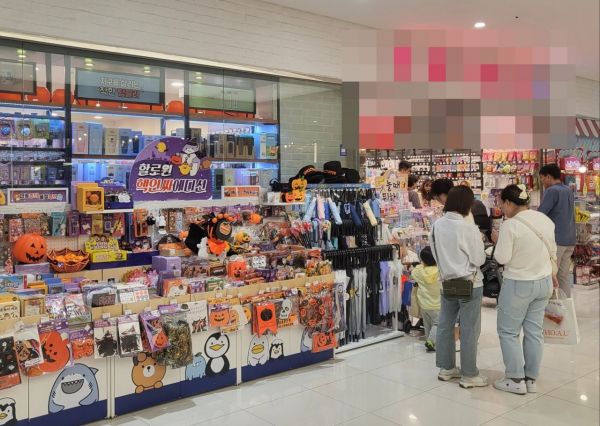 At the right side of the entrance of a stationery store in Seoul, there is a display filled with Halloween-related products. Photo by Seongpil Jo gatozz@
On the afternoon of the 3rd, in front of a specialty office and fancy goods store in downtown Seoul, a display named "Halloween Hype Edition" was set up. It was filled with Halloween items featuring pumpkin baskets, sun catchers, skulls, and witch characters. On one side of this display, which appeared to be about 3 meters wide, there was also a sign that read "Beware of Shock, Beware of Sold Out." A passerby commented with a bitter smile, "They don't seem to care about the (Itaewon) tragedy."
Halloween has returned to some retailers. Halloween is an American harvest festival where children dress up as demons or monsters and go door-to-door collecting candy or chocolate. In Korea, as exposure to American culture has increased and companies have used it as a marketing opportunity to boost consumption, it became popular mainly among the MZ generation (Millennials + Generation Z). However, after the Itaewon tragedy last year, where 159 citizens lost their lives while enjoying Halloween festivities on the streets, social perception has cautiously shifted. Yet some retailers have returned to using Halloween as a "money-making item" less than a year after the tragedy.
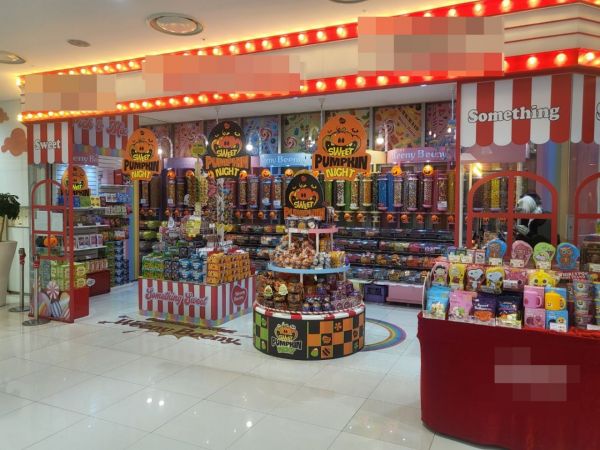
This year's Halloween marketing is mainly driven by foreign retailers. Winnie Beanie and Flying Tiger Copenhagen are representative examples. According to our verification, some of these retailers even transformed an entire store into a Halloween-themed concept. Among domestic retailers, a few have also prominently featured Halloween. For example, Artbox decorated the store entrance with pumpkins, a representative Halloween item, and filled a significant portion of the interior display with related products.
These companies conduct such sales and marketing because Halloween is an important event that opens the door to the peak season leading into Christmas and the year-end. Unlike the first half of the year, which has clear peak seasons like school entrance and Children's Day, the distribution industry explains that there are no significant "events" in the second half of the year except for Halloween.
Another reason cited is that no moral responsibility has been demanded regarding Halloween marketing after the Itaewon tragedy. The MZ generation, who are at the center of domestic Halloween culture, have grown up exposed to Halloween marketing by retailers since early childhood. At this point as adults, they are inevitably free to participate in Halloween events. Last year's Itaewon tragedy also involved many MZ generation individuals who gathered on the streets to enjoy Halloween festivities, which led to a massive crowd crush accident. In fact, most of the victims in the Itaewon tragedy were in their 20s and 30s.
Immediately after last year's Itaewon tragedy, all retailers suspended Halloween marketing and events and joined in mourning. This year, most retailers plan to reduce sales of related products and refrain from marketing and events. Daiso, a household goods store that has held large-scale Halloween promotions every year, considering Halloween the biggest event in the second half of the year before Christmas, decided to eliminate all related marketing this year and reduce the number of products sold by 40%. A Daiso representative said, "This year's Halloween products will be limited to LED decorative lights, garlands, balloons, etc., which can be used as interior decorations at home, daycare centers, and kindergartens," adding, "Most are candy baskets and toy products that can be given as gifts to children." However, despite this, Daiso still carries over 200 items, leading some to criticize it as merely "for show."
Large supermarkets such as Lotte Mart and E-Mart have decided not to conduct separate Halloween marketing or events. They will sell related products, but the number of items handled will be significantly smaller than in previous years, according to these companies. A representative from a large supermarket said, "Public opinion has been unfavorable toward Halloween since the Itaewon tragedy, so there is a cautious tendency." Among large supermarkets, Homeplus has not yet set a policy on Halloween marketing or sales, but the industry expects it to move toward a reduction compared to previous years.
The four major convenience store chains (CU, GS25, 7-Eleven, and Emart24) have decided not to sell Halloween-related products or conduct Halloween marketing this year. These convenience stores plan to skip Halloween and focus on marketing for "Pepero Day" on the 11th of next month. Additionally, most department stores and e-commerce companies are reportedly not planning Halloween events or marketing this year.
© The Asia Business Daily(www.asiae.co.kr). All rights reserved.
![Clutching a Stolen Dior Bag, Saying "I Hate Being Poor but Real"... The Grotesque Con of a "Human Knockoff" [Slate]](https://cwcontent.asiae.co.kr/asiaresize/183/2026021902243444107_1771435474.jpg)












