Deposit interest rates in the financial sector are on the rise. Commercial banks have started offering deposit products with interest rates in the 4% range, while savings banks are increasingly providing rates in the mid-5% range, which is even higher.
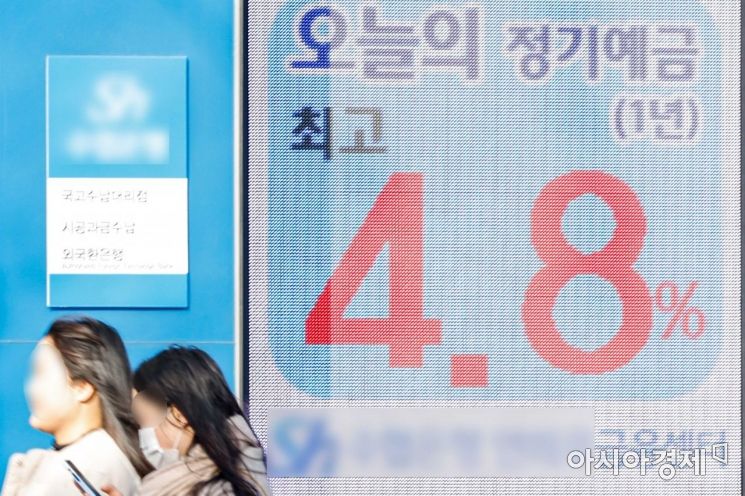 On the 9th, when major commercial banks lowered their fixed deposit interest rates from the 5% range to the 4% range, the fixed deposit interest rate was displayed on the electronic board at the entrance of a bank in Seoul. Photo by Jinhyung Kang aymsdream@
According to the Korea Federation of Savings Banks on the 2nd, the average interest rate for 12-month fixed deposit products at 79 savings banks nationwide was 4.19% as of the previous day. This is an increase of 0.08 percentage points compared to 4.11% on the 1st of last month.
By institution, Dream Savings Bank and JT Savings Bank offer fixed deposit products with preferential conditions at an interest rate of 4.60%. Other banks such as MS Savings Bank (4.55%), Cham and Dongyang Savings Banks (4.52%), and Smart Savings Bank (4.51%) also sell fixed deposit products with rates above 4.5%.
Fixed deposit products with interest rates in the 4% range are also easily found at commercial banks. As of the previous day, the 12-month fixed deposit interest rates at the five major commercial banks (KB Kookmin, Shinhan, Hana, Woori, and NH Nonghyup) ranged from 3.90% to 4.05%, all hovering around 4%.
By bank, SC First Bank’s e-Green Save Deposit and Jeonbuk Bank’s JB 123 Fixed Deposit offer interest rates of 4.20% including preferential rates, while DGB Daegu Bank’s DGB Together Deposit, KB Kookmin Bank’s KB Star Fixed Deposit, and Woori Bank’s WON Plus Deposit apply rates of 4.05%.
The reason commercial and savings banks are competitively raising deposit interest rates is attributed to the rising cost of funding for each institution. As of the 27th, the one-year bank bond rate was 4.052%, up 0.15 percentage points from 3.900% at the end of the previous month, indicating an upward trend in banks’ funding costs.
Another main cause is the maturity of deposit products attracted at high interest rates in the third and fourth quarters of last year. Since the deposit balance in the financial sector increased by nearly 100 trillion won over about four months starting in October last year, a rate competition has begun to reinvest these funds.
A financial sector official explained, "Interest rate hikes to re-attract deposits will continue modestly for the time being," but added, "However, due to the bond market tightening caused by the Legoland incident, a sharp rise like the one seen last year when deposit competition erupted is unlikely to occur."
© The Asia Business Daily(www.asiae.co.kr). All rights reserved.
![Clutching a Stolen Dior Bag, Saying "I Hate Being Poor but Real"... The Grotesque Con of a "Human Knockoff" [Slate]](https://cwcontent.asiae.co.kr/asiaresize/183/2026021902243444107_1771435474.jpg)
















