Among 2,170 Mushroom Species Produced Domestically, Only 493 Are Edible
1,677 Species Are Poisonous or Difficult to Determine Edibility
Commonly Known Poisonous Mushroom Identification Methods May Cause Harm
Seek Immediate Medical Attention If Nausea or Vomiting Occurs After Consuming Wild Mushrooms
The Korea National Arboretum and the National Institute of Horticultural and Herbal Science urge caution against indiscriminate harvesting and consumption of wild mushrooms during the autumn season.
According to the Korea National Arboretum on the 1st, there are a total of 2,170 species of mushrooms found in Korea. However, only 493 of these mushrooms are edible. The remaining 1,677 species are either poisonous mushrooms that are inedible or mushrooms whose edibility is difficult to clearly define.
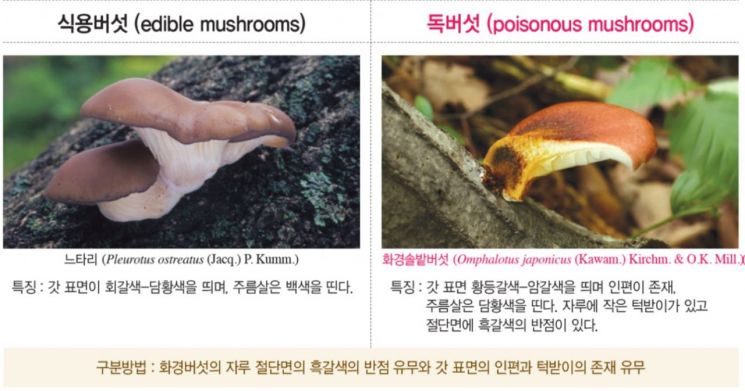
The problem is that many non-experts, who do not have sufficient knowledge about mushrooms, collect and consume wild mushrooms based on unclear information obtained online or from general field guides.
For example, among non-experts, common myths about distinguishing poisonous mushrooms include: "If the color is bright and vivid, it is poisonous," "If the mushroom stem has no ring, it is poisonous," "If insects or bugs do not eat it, it is poisonous," and "If the color changes when touched with a silver spoon, it is poisonous."
Additionally, there are also rumors such as "If it tears easily lengthwise, it is edible," and "(Even poisonous mushrooms) lose their toxicity when boiled."
However, the Korea National Arboretum and others emphasize that all these examples are incorrect, and they strongly advise against relying on such misinformation to distinguish or consume poisonous mushrooms.
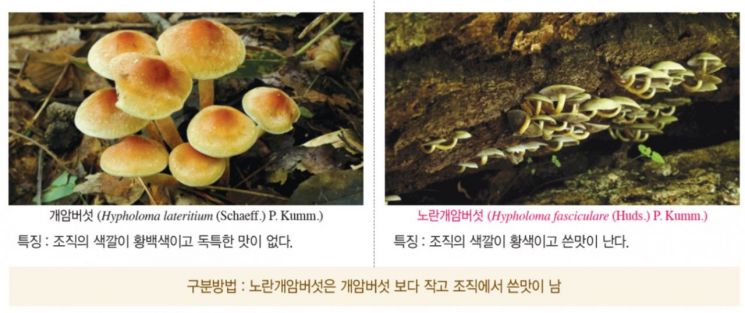
Especially around the Chuseok holiday, the number of wild mushrooms increases rapidly, requiring special caution from visitors to ancestral graves, hikers, and outdoor enthusiasts. Some mushrooms are so toxic that they can threaten life, so the Korea National Arboretum stresses that wild mushrooms should never be harvested or consumed casually while hiking.
Furthermore, if symptoms such as nausea, retching, vomiting, diarrhea, or convulsions occur after consuming wild mushrooms, it is crucial to immediately induce vomiting of the ingested food and go directly to a hospital for treatment.
If there are any leftover mushrooms that the patient consumed, it is advisable to bring them to the hospital. Since poisonous mushrooms contain different toxins depending on the species, treatment methods also vary accordingly.
Han Sang-guk, a researcher at the Forest Biodiversity Research Division of the Korea National Arboretum, and Jang Gap-yeol, head of the Mushroom Division at the Rural Development Administration, said, "There are still many cases where incorrect information about distinguishing poisonous mushrooms is widely believed as fact (common knowledge). Since it is difficult to distinguish whether wild mushrooms are edible, we strongly urge people to refrain from harvesting or consuming wild mushrooms carelessly in the mountains."
© The Asia Business Daily(www.asiae.co.kr). All rights reserved.
![Clutching a Stolen Dior Bag, Saying "I Hate Being Poor but Real"... The Grotesque Con of a "Human Knockoff" [Slate]](https://cwcontent.asiae.co.kr/asiaresize/183/2026021902243444107_1771435474.jpg)
















