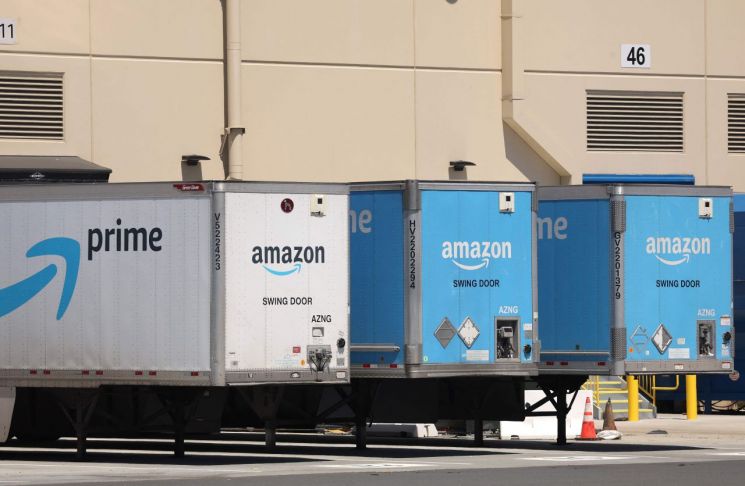
'The boss of bosses.' The New York Times (NYT) evaluated on the 26th (local time) that the lawsuit battle by U.S. regulators against Amazon stems from the abnormal structure in which a single company dominates the U.S. online market economy.
Amazon's size ballooned rapidly as the digital market grew explosively due to the COVID-19 pandemic. The stronger Amazon's dominance over the online market became, the more vicious its unfair practices became, according to U.S. regulators.
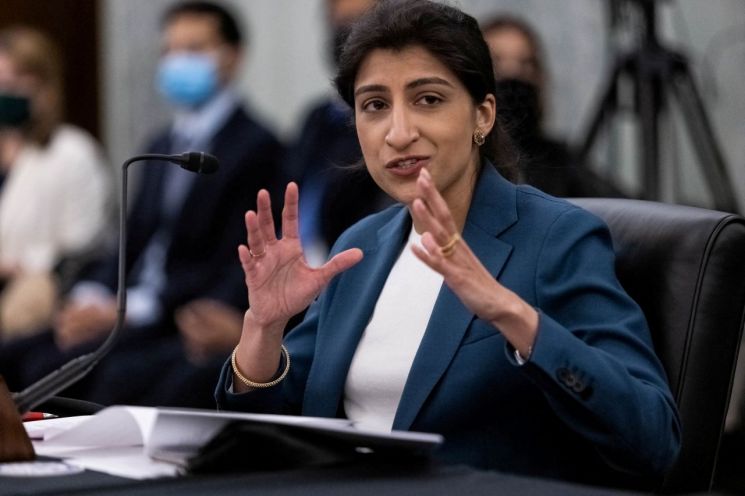
Lina Khan, Chair of the U.S. Federal Trade Commission (FTC), stated in the antitrust lawsuit filed that day in the Seattle Federal Court in Washington state, "Amazon profits in ways that harm tens of millions of American customers who use Amazon and hundreds of thousands of businesses (competitors and suppliers)."
The claim is that Amazon lowered quality for shoppers and charged excessive fees to sellers through its market monopoly.
The FTC pointed out in the 172-page complaint that "Amazon induced unfair contract terms to prevent third-party sellers on the Amazon platform from selling products at lower prices on competitors’ platforms, thereby artificially inflating prices in the online retail market."
It also judged that charging fees to sellers who handle their own shipping constitutes an abuse of market dominance.
The FTC specifically requested the court to consider forcing Amazon to divest assets to prevent ongoing harm to consumers. This aims at a super-strong sanction equivalent to corporate breakup.
In response, Amazon directly rebutted, "If the FTC's claims are true, the number of products consumers can choose from will decrease, prices will rise, delivery speeds will slow, and choices for small businesses will diminish." It avoided commenting on the push for strong sanctions such as asset divestiture.
It is questionable whether this lawsuit will lead to effective sanctions. Foreign media such as Foreign Policy reported that there are no clear legal regulatory mechanisms targeting big tech like Amazon under current laws, making it difficult to prove antitrust harms of big tech under the current system.
The NYT pointed out, "Current sanctions by regulatory agencies like the FTC are based on laws (the Sherman Act) created decades ago." This law was enacted by the U.S. Congress in 1890 to prohibit monopolies in interstate and international commerce, and is considered inadequate to directly target big tech.
Lina Khan, who is leading this lawsuit, also acknowledged these institutional limitations. In a 2017 paper titled "Amazon’s Antitrust Paradox," published in the Yale Law Journal before joining the FTC, she argued that the current antitrust law approach is not suitable for addressing the harms that online platforms like Amazon can cause.
© The Asia Business Daily(www.asiae.co.kr). All rights reserved.
![Clutching a Stolen Dior Bag, Saying "I Hate Being Poor but Real"... The Grotesque Con of a "Human Knockoff" [Slate]](https://cwcontent.asiae.co.kr/asiaresize/183/2026021902243444107_1771435474.jpg)

















