All Local Governments Challenge Innovation Special Zone Contest
Winning Areas Face 'Comprehensive Negative Regulation'
From Medical, Bio, Robot, Hydrogen to Mobility
10 Government Proposals... Fierce Behind-the-Scenes Competition
Local governments are fiercely competing over the government's 'Global Innovation Special Zone' project. If selected, they can enjoy the unprecedented benefit of being the first in the country to implement a 'comprehensive negative regulation' system. As significant economic ripple effects are expected from job creation and corporate investment attraction, behind-the-scenes competition among local governments has intensified.
According to the application forms and business plans for the Global Innovation Special Zone obtained by Asia Economy on the 27th, a total of 14 metropolitan local governments have submitted plans. Considering the regulation that excludes the metropolitan area from designation, virtually all local governments have applied.
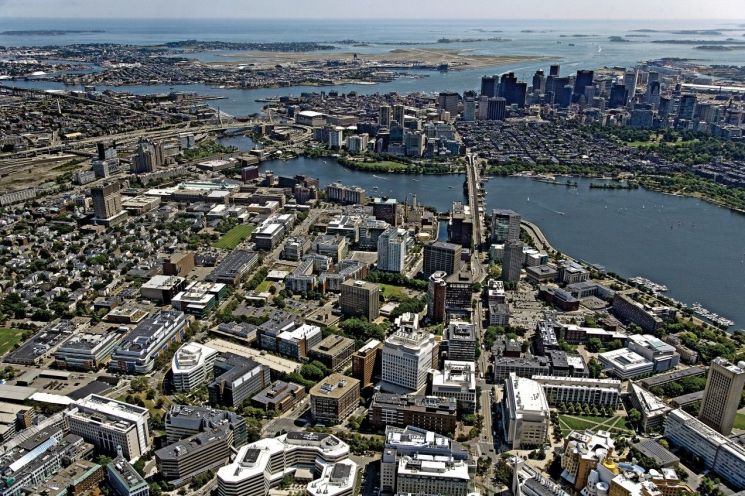 A view of Kendall Square located in the Boston Bio Cluster, USA. It is densely populated with bio-innovation companies and research institutions, known as the "most innovative 1 square mile on Earth." The government plans to designate two similar global innovation districts this year and establish a total of ten by 2027. Photo by Massachusetts Institute of Technology (MIT)
The Global Innovation Special Zone is an advanced version of the existing 'Regulation-Free Special Zone.' It provides comprehensive support for innovation in future advanced technologies, new product development, and overseas expansion. In particular, a comprehensive negative regulation system is applied. Except for pre-listed regulations and prohibitions, all demonstrations using new technologies are possible.
Local governments expect significant benefits once designated, as their ongoing innovative industries are currently hindered by existing laws. An official from a local government preparing for the Global Innovation Special Zone explained, "Comprehensive negative regulation is a very groundbreaking benefit," adding, "It is a golden opportunity not only to develop core technologies but also to gain international recognition."
Most of the application themes were in fields with stringent regulations. Daejeon City plans to establish a special zone for Cell and Gene Therapy (CGT). Although CGT shows a high average annual growth rate of 49.1%, South Korea faces regulatory difficulties in research and development and clinical trials due to the Advanced Regenerative Medicine Act and the Pharmaceutical Affairs Act. Daejeon plans to spend a total of 48.7 billion KRW, including 21.7 billion KRW in national funds, aiming to create 216 jobs and attract 134 billion KRW in investment.
Ulsan City intends to create a hydrogen mobility special zone for construction machinery and ships, centered on the Techno General Industrial Complex and covering the entire city and nearby 4,983㎡ of sea area. Currently, hydrogen energy regulations exist only for vehicles, with no laws in the port sector. Establishing such regulations would take at least several years, but if selected as a special zone, it will be possible to immediately build a hydrogen mobility parts demonstration platform, provide related infrastructure, and establish a support system for overseas certification.
Ten Government Proposals... Even Local Councils Rolled Up Their Sleeves
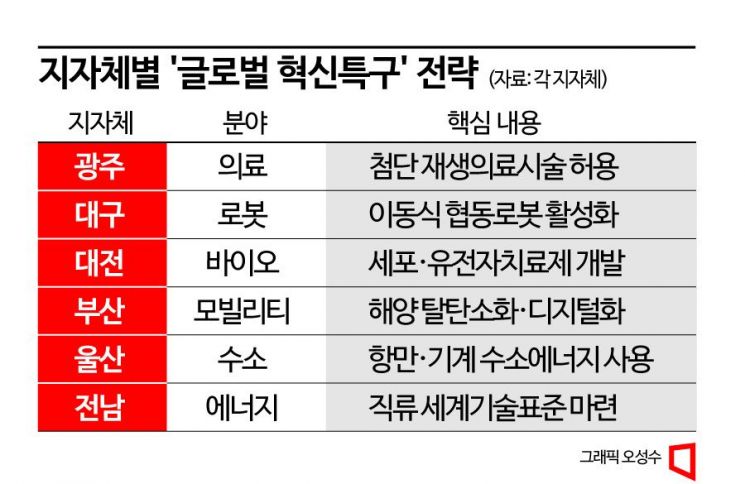
Analyses suggest that the economic ripple effect from the special zone designation could reach tens of trillions of won. Jeollanam-do submitted a plan to establish an energy new industry special zone in Naju City, Yeonggwang County, and Sinan County. It will invest 50 billion KRW in a project to create global technical standards for direct current transmission and distribution. Jeollanam-do estimates that establishing standards through the special zone will generate benefits such as 12 trillion KRW in reduced power conversion losses and 19 trillion KRW in avoided new power facility construction.
Since only two local governments can be selected as innovation special zones as a priority, behind-the-scenes competition is fierce. One local government formed an advisory committee of about 20 members, including private experts, to devise an application strategy. Some local governments have made more than ten proposals to the Ministry of SMEs and Startups, the main ministry in charge, requesting designation as an innovation special zone. They have shown strong determination by signing related business agreements first or having local councils directly urge the government for special zone designation.
The government plans to complete the selection of two places by early December at the latest, after evaluating applications and presentations by local governments. The choice of appropriate fields for the Global Innovation Special Zone, the thoroughness of demonstration management plans, and support plans for SMEs are expected to determine the outcome. The project period is four years from next year to 2027, with a possible two-year extension until 2029.
An official from the related ministry explained, "The concept of the Global Innovation Special Zone is to concentrate investment in a few places that can support numerous companies across various regions, rather than supporting many companies in many regions," adding, "Even after selection, the government will not leave operations solely to local governments but will support business management and connections with overseas clusters."
© The Asia Business Daily(www.asiae.co.kr). All rights reserved.
![Clutching a Stolen Dior Bag, Saying "I Hate Being Poor but Real"... The Grotesque Con of a "Human Knockoff" [Slate]](https://cwcontent.asiae.co.kr/asiaresize/183/2026021902243444107_1771435474.jpg)

















