Interview with Bin Jungil, CEO of Neurofit
Optimized for Prognosis Observation
Target Release in June Next Year
Image Analysis via 'Scale PET'
Reduced from 8 Hours to 15 Minutes
Neurofit will launch ‘Aqua AD,’ a dedicated solution for disease-modifying treatment (DMT) of Alzheimer’s dementia, in June next year.
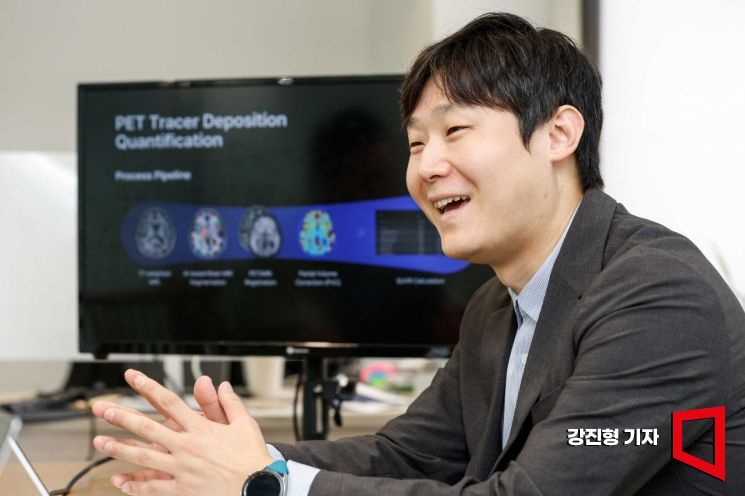 Bin Jun-gil, CEO of Neurofit, is being interviewed on the 8th at Neurofit in Gangnam-gu, Seoul. Photo by Jinhyung Kang aymsdream@
Bin Jun-gil, CEO of Neurofit, said in an interview with this publication on the 27th, "Since we have focused our research on vascular aspects, our technology will be the most advanced in observing the major adverse reaction known as ‘Amyloid-Related Imaging Abnormalities (ARIA).’" Recently, with the emergence of DMTs for Alzheimer’s dementia such as Aduhelm (active ingredient aducanumab), Leqembi (lecanemab), and Donanemab, changes are occurring in the dementia treatment market. Neurofit is determined to develop the overall process including diagnosis and treatment.
Founded in 2016 by CEO Bin and Chief Technology Officer (CTO) Kim Dong-hyun, Neurofit is a company developing AI-based brain disease diagnostic assistance software and electronic medicine for brain disease functional recovery and rehabilitation. CEO Bin chose dementia as his main research area among various brain diseases because of his grandmother. He said, "My grandmother was diagnosed with dementia 15 years ago. My parents took care of her directly, but eventually she entered a nursing home. Dementia is a disease that must be solved, and if it is solved, it would be a great opportunity. That’s why I started thinking about applying computer engineering technology to dementia."
Regarding Alzheimer’s dementia, which accounts for most dementia cases, the main cause is considered to be 'ATN.' Neurodegeneration occurs due to problems such as the entanglement of amyloid-beta (Aβ) protein and tau protein. Neurofit adds 'vascular' to this, referring to it as 'ATNV.' CEO Bin explained, "When Aβ accumulates, it puts strain on blood vessels, causing microbleeds. Since vascular imaging analysis can be used not only for Alzheimer’s but also for vascular dementia, we have been preparing for this since 2021."
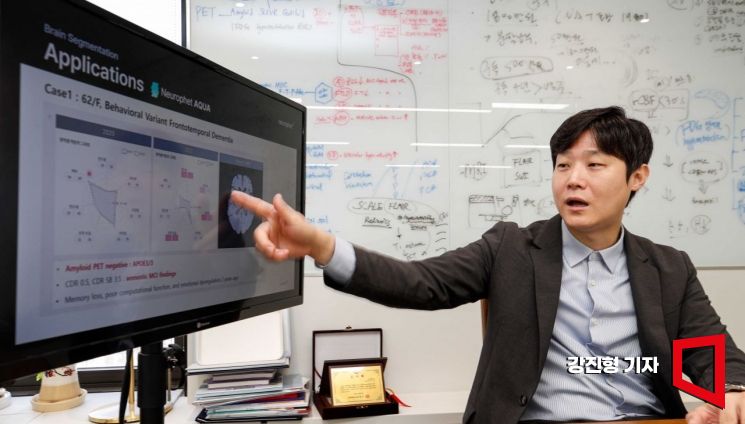 Bin Jun-gil, CEO of Neurofit, is being interviewed on the 8th at Neurofit in Gangnam-gu, Seoul. Photo by Jinhyung Kang aymsdream@
The current standard for dementia diagnosis is to check how much Aβ has accumulated through positron emission tomography (PET). Neurofit developed ‘SCALE PET,’ which can complete PET image analysis, which previously took 8 hours, within 15 minutes. CEO Bin said, "Since images are taken at different times, even a slight difference in angle results in different images. Previously, this had to be done manually by people, but we automated and accelerated it through AI."
Additionally, in magnetic resonance imaging (MRI), Neurofit developed ‘AQUA,’ which analyzes brain atrophy and white matter degeneration to assist in diagnosing various brain diseases. Although PET is the standard, it costs over 1 million won per scan, so initially, AQUA can help differentiate whether it is Alzheimer’s dementia or other diseases such as depression or stroke through MRI diagnosis. CEO Bin said, "Through AQUA, we can understand the degree of atrophy in the hippocampus, the most prominent feature of Alzheimer’s, as well as other brain regions. We are developing Aβ prediction technology using MRI, aiming to increase the current accuracy of 80% to 90%."
While the development of DMT has raised expectations for conquering dementia, the ARIA adverse reaction has also become another opportunity for Neurofit. ARIA occurs when antibody treatments remove Aβ in blood vessels, causing hemorrhages in cerebral blood vessels. CEO Bin explained, "The technologies we have developed can all be applied to ARIA. During DMT administration, MRI images must be continuously monitored to detect lesions, and we can help quantify and quickly review these."
Neurofit plans to launch a dedicated DMT solution using these technologies. CEO Bin said, "We will create a ‘full process’ product for DMT prescription and prognosis monitoring called ‘Aqua AD.’ We aim to release it around June next year, coinciding with the domestic approval of Leqembi." In addition, the MRI-based Aβ prediction solution will be released as ‘Aqua AD+,’ and further plans include solutions to differentiate various dementia types such as vascular dementia and frontotemporal dementia.
Beyond diagnosis, Neurofit is also developing electronic medicine that enhances brain recovery through electrical stimulation. CEO Bin explained, "Although the causes are not fully understood, symptoms are known to manifest when the brain is either underactive or overactive, and electrical stimulation helps regulate this. Secondly, when a brain area dies due to stroke, it does not revive, but other areas compensate through ‘neuroplasticity,’ which we aim to promote." The electronic medicine has completed development through animal experiments and is entering clinical stages.
© The Asia Business Daily(www.asiae.co.kr). All rights reserved.
![Clutching a Stolen Dior Bag, Saying "I Hate Being Poor but Real"... The Grotesque Con of a "Human Knockoff" [Slate]](https://cwcontent.asiae.co.kr/asiaresize/183/2026021902243444107_1771435474.jpg)












