A Much More Advanced Version Revealed Than Initial Release
Flexible Arm Movements Spark 'CG Controversy' Incident
The Tesla humanoid 'Optimus,' which has become much more agile and flexible than when it was first unveiled, is making headlines every day. In fact, in the United States, there was even controversy for a while over claims that the footage of Optimus in action was "CG."
Earlier, on the 24th (local time), Tesla released a new demonstration video of Optimus on the social networking service X (formerly Twitter). In this video, Optimus quickly picks up and moves block toys with its hands and also performs movements requiring flexibility, such as yoga poses.
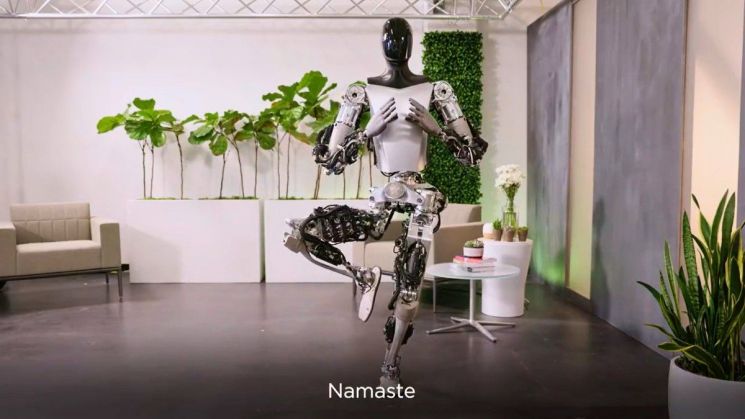
The video attracted attention not only from netizens but also from robotics experts and foreign media. The U.S. electric vehicle specialized media 'Electric' even praised the video, saying it was "so impressive it looks like CG."
There was actually a CG controversy. One netizen slowed the video down to 0.25x speed and claimed to have spotted some blocks being pushed in the opposite direction of Optimus's movement.
The netizen questioned, "Did the Optimus development team invent 'horizontal gravity' instead of a robot?" However, it was later determined that the blocks in the video were pushed by Optimus's previously hidden pinky finger.
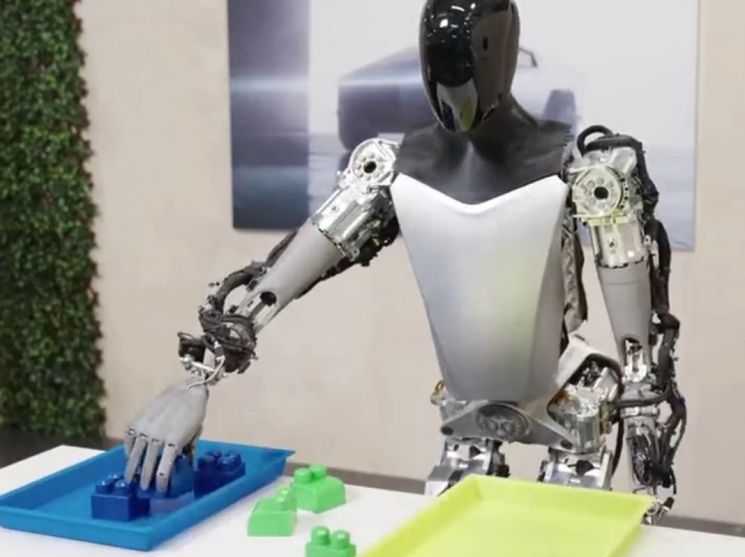 In reality, some claimed that the blocks moved on their own and that the video was CGI. [Image source=X]
The CG controversy also serves as an example of how unbelievably fast Optimus's development has been. Tesla CEO Elon Musk first unveiled Optimus at a company event last September.
At that time, Optimus demonstrated considerable power and stability in areas requiring joint motors, such as lifting heavy objects and walking. However, it was undervalued by the public due to its sluggish movements and stiff actions, which were no different from previously revealed humanoids.
There were even mocking opinions comparing Optimus to the Atlas humanoid demonstrated by Boston Dynamics, a subsidiary of Hyundai Motor Group.
Optimus's rapid evolution has been made possible thanks to advancements in robot control artificial intelligence (AI). Tesla emphasized in the newly released video that "(Optimus) performs tasks solely through computer vision using Tesla's neural network AI" and that "it can control its arms and legs by itself."
© The Asia Business Daily(www.asiae.co.kr). All rights reserved.
![Clutching a Stolen Dior Bag, Saying "I Hate Being Poor but Real"... The Grotesque Con of a "Human Knockoff" [Slate]](https://cwcontent.asiae.co.kr/asiaresize/183/2026021902243444107_1771435474.jpg)

















