U.S. President Joe Biden is making an infrastructure investment worth 54 trillion won in Pacific island countries. This move is interpreted as a strategic measure to block China's expanding influence in the South Pacific region, which is close to the United States.
On the 25th (local time), President Biden announced at a multilateral summit with Pacific island countries held at the White House that the U.S. government is working with Congress to promote an initiative to invest $40 billion (approximately 54 trillion won) in infrastructure in the Pacific island countries.
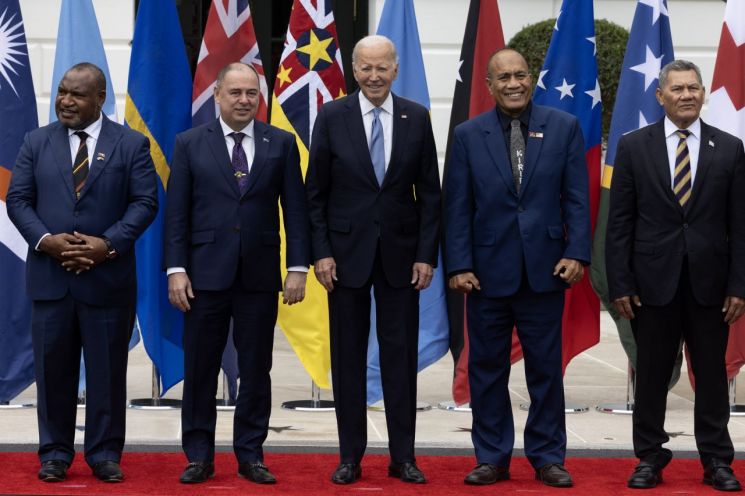
The countries participating in this meeting include the Cook Islands, Palau, the Marshall Islands, Samoa, the Solomon Islands, and Papua New Guinea. This summit with Pacific island countries is the first in a year since the inaugural meeting last September. Additionally, President Biden announced that the U.S. government has decided to establish formal diplomatic relations with the Pacific island countries of the Cook Islands and Niue.
The Biden administration's efforts to strengthen relations with South Pacific island countries are aimed at countering China, which is expanding its influence in the region. China signed a security agreement with the Solomon Islands last year and held a foreign ministers' meeting with 10 Pacific island countries in Fiji, chaired by Foreign Minister Wang Yi, thereby expanding its influence in the South Pacific island countries.
From China's perspective, the strategic value of the South Pacific island countries is significant in breaking through the diplomatic and military "encirclement" against China that the U.S. is expanding through its Indo-Pacific strategy. China is accelerating efforts to strengthen relations with these island nations.
In response, the U.S. invited leaders of Pacific island countries such as Tonga, Palau, Tuvalu, Micronesia, Fiji, the Solomon Islands, Papua New Guinea, the Marshall Islands, Samoa, Polynesia, and the Cook Islands to Washington last September for the first summit.
At that time, President Biden presented a separate "Pacific Strategy" limited to the Pacific island countries and promised economic support worth $810 million (approximately 1.08 trillion won). Subsequently, the U.S. reopened its embassy in the Solomon Islands in February for the first time in 30 years and signed a Defense Cooperation Agreement (DCA) with Papua New Guinea in May.
© The Asia Business Daily(www.asiae.co.kr). All rights reserved.
![Clutching a Stolen Dior Bag, Saying "I Hate Being Poor but Real"... The Grotesque Con of a "Human Knockoff" [Slate]](https://cwcontent.asiae.co.kr/asiaresize/183/2026021902243444107_1771435474.jpg)















