China Bans Imports of Japanese Seafood Immediately After Contaminated Water Discharge
73% of Hokkaido Scallops Exported to China
On the 24th, Japanese media reported that one month after Japan discharged contaminated water from the Fukushima Daiichi Nuclear Power Plant (referred to by the Japanese government as "treated water"), damages caused by China's ban on Japanese seafood have been occurring one after another.
China imposed a complete ban on imports of Japanese seafood starting from the 24th of last month, when Japan began discharging contaminated water into the ocean. The Sankei Shimbun reported that shipments of Hokkaido scallops, a representative seafood export to China, have stopped, delivering a significant blow to the local economy.
It was reported that "scallop stockpiles have piled up to the ceiling of an 8-meter-high refrigerated storage." Hokkaido scallops harvested from the Sea of Okhotsk accounted for 43.4 billion yen (approximately 390.9 billion KRW), or 73% of the total export value last year, exported to China.
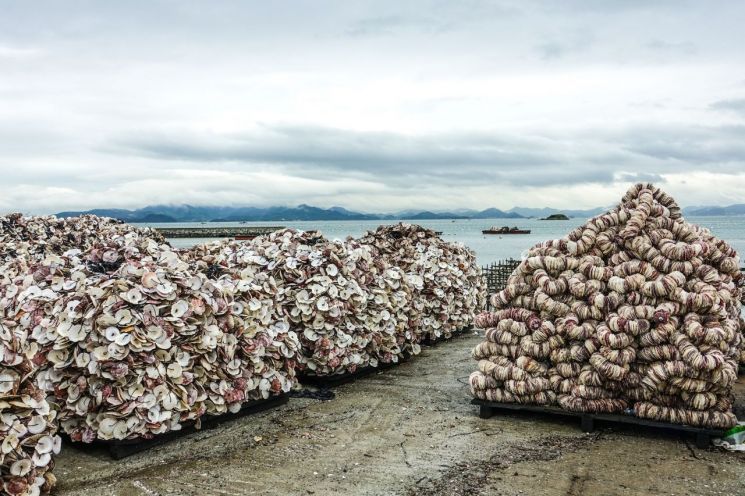
According to the Chinese General Administration of Customs during the same period, imports of Japanese seafood into China decreased by 67.6% to 149.02 million yuan (approximately 27.3 billion KRW). Japanese media analyzed that most of the imported volume appeared to have been imported before the ban was implemented.
The Japanese government has demanded that China lift the seafood import ban, presenting the International Atomic Energy Agency (IAEA) verification results that the contaminated water discharged into the sea has minimal impact on human health or the environment; however, the Chinese government has not responded.
However, the initial anti-Japanese sentiment in China following the contaminated water discharge has subsided, and it has been reported that anti-Japanese protests have not occurred in major Chinese cities. Reports opposing the contaminated water discharge have also decreased in Chinese state media.
The attitude of the Chinese government has also changed. Previously criticizing the issue daily by calling it "nuclear contaminated water," China has shown restraint in criticism on the international stage. In the United Nations General Assembly speech on the 21st, China did not mention the issue of Japan's contaminated water discharge. Experts in Japan interpret this as China possibly moderating its stance with future Japan-China relations in mind.
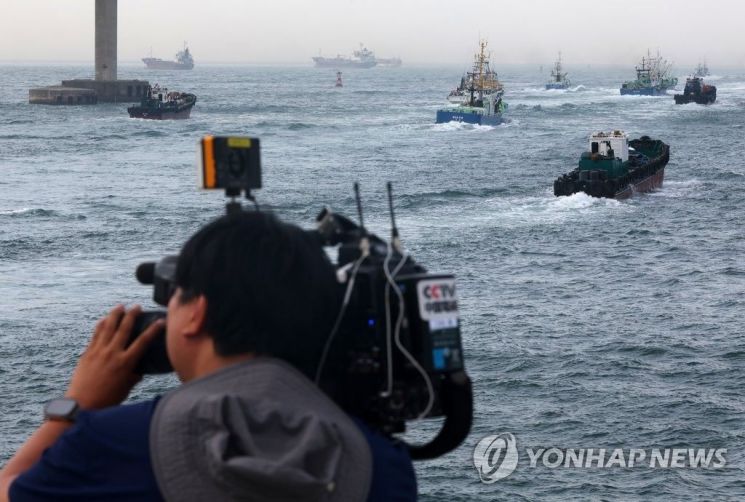 Chinese state-run CCTV is covering the departure of large purse seine cooperative mackerel fishing vessels that have ended the fishing moratorium at Busan Seogu Joint Fish Market.
 [Photo by Yonhap News]
After one month of continuous marine monitoring by Japan, no significant changes have been observed. The Japanese Ministry of the Environment, Ministry of Agriculture, Forestry and Fisheries, and Tokyo Electric Power Company (TEPCO) claimed that the tritium concentration in seawater and fish collected around the nuclear power plant was well below the standard levels.
According to TEPCO, the first phase of contaminated water discharge from the nuclear power plant ended on the 11th. As early as late this month, they plan to discharge 7,800 tons, the same amount as the first phase. TEPCO announced plans to discharge about 31,200 tons, approximately 2.3% of the total contaminated water, by March next year.
© The Asia Business Daily(www.asiae.co.kr). All rights reserved.
![Clutching a Stolen Dior Bag, Saying "I Hate Being Poor but Real"... The Grotesque Con of a "Human Knockoff" [Slate]](https://cwcontent.asiae.co.kr/asiaresize/183/2026021902243444107_1771435474.jpg)
















