With the prolonged tightening expected in the US, domestic market interest rates, along with bank loan and deposit rates, are rising rapidly. However, despite warnings about high interest rates, household loans have increased by more than 1 trillion won just this month, raising concerns that financial consumers are not sufficiently cautious or vigilant about the effects of tightening.
Mortgage Loan Rates Rise by 0.2 Percentage Points in About 20 Days
According to the financial sector on the 24th, as of the 21st, the mixed (fixed) mortgage loan rates (based on 5-year bank bonds) at KB Kookmin, Shinhan, Hana, and Woori Banks range from 3.900% to 6.469% per annum. Compared to the end of last month (3.830% to 6.250% per annum), the upper limit rose by 0.219 percentage points and the lower limit by 0.070 percentage points. The interest rates on unsecured loans (grade 1, 1-year maturity) increased by 0.140 percentage points on both the upper and lower ends to 4.560% to 6.560% per annum in about 20 days.
This is because the 5-year and 1-year bank bond rates, which serve as benchmarks for these two rates, rose by 0.170 percentage points (from 4.301% to 4.471%) and 0.140 percentage points (from 3.901% to 4.048%), respectively, during the same period. Bank bond rates have steadily increased recently due to the prolonged tightening in the US and Korea and the increased issuance volume of bank bonds. After the Federal Open Market Committee (FOMC) meeting on the 20th (local time) showed a distinctly hawkish (tightening-preferred) stance, the rates have been rising more rapidly.
The newly issued COFIX-linked variable interest rates at these banks range from 4.270% to 7.099% per annum, with the lower limit dropping by 0.030 percentage points compared to the end of last month. This is because the COFIX (Cost of Funds Index), the benchmark for variable rates, decreased by 0.030 percentage points (from 3.690% to 3.660%). On the other hand, the upper limit rose by 0.130 percentage points due to adjustments by some banks reflecting market interest rates rather than COFIX for variable rates. Ultimately, recent market interest rates have pushed both fixed and variable rates at major commercial banks higher, with the highest level surpassing 7%. This is the highest level in nine months since the end of last year.
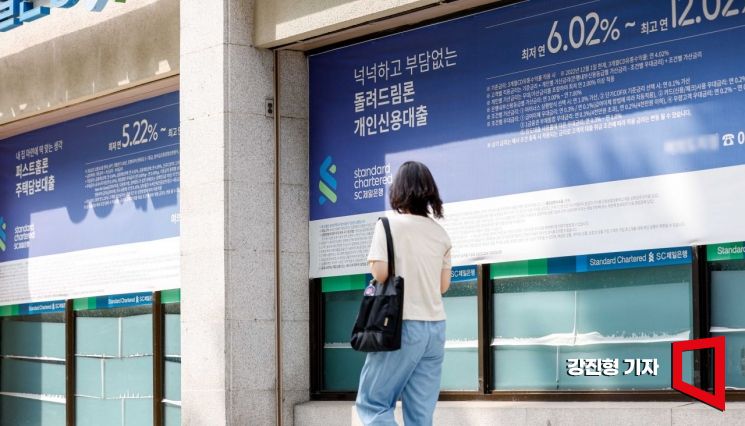 As the average loan interest rate in the banking sector has been rising for two consecutive months, a banner displaying mortgage loan and personal credit loan interest rates is hung on the exterior wall of a commercial bank in Seoul on the 31st. Photo by Jinhyung Kang aymsdream@
Banks Increasing Time Deposits with Interest Rates in the 4% Range
In the banking sector, time deposit products with interest rates in the 4% range are appearing one after another. As market interest rates rise and high-interest time deposits with rates in the 5% range matured in the second half of last year, banks are raising rates to retain customers.
According to the Consumer Portal of the Korea Federation of Banks, among the time deposit products offered by 19 banks, 10 products exceed a top preferential interest rate of 4.00%, including SC First Bank's 'e-Green Save Deposit' (4.20%), Jeonbuk Bank's 'JB 123 Time Deposit' (4.20%), and Jeju Bank's 'J Time Deposit' (4.10%).
The top interest rates on time deposits at the five major commercial banks?NH Nonghyup Bank's 'NH All One e-Deposit' (3.95%), Shinhan Bank's 'Solpyeonhan Time Deposit' (3.95%), Woori Bank's 'WON Plus Deposit' (3.92%), KB Kookmin Bank's 'KB Star Time Deposit' (3.90%), and Hana Bank's 'Hana Time Deposit' (3.90%)?are also approaching 4%.
Growing Concerns Over Household Loan Increases
Despite prolonged tightening and rising interest rates, domestic household loans have been increasing recently. As of the 21st, the outstanding household loans at the five major commercial banks (KB Kookmin, Shinhan, Hana, Woori, and NH Nonghyup) totaled 682.4539 trillion won, up by 1.6419 trillion won from the end of August (680.812 trillion won). This marks five consecutive months of increase since May and surpasses the August increase (1.5912 trillion won) in just about 20 days.
Mortgage loans increased by 1.8759 trillion won (from 514.9997 trillion won to 516.8756 trillion won). Despite the reduction in limits due to age restrictions and adjustments to the Debt Service Ratio (DSR) calculation standards for 50-year mortgage loans introduced this month, demand for housing-related loans remains high.
The overall increase in household loans across the banking and financial sectors is likely to continue for six consecutive months through this month. According to the Bank of Korea and financial authorities, household loans in the banking and financial sectors increased by 6.9 trillion won and 6.2 trillion won, respectively, last month. The banking sector's increase of 6.9 trillion won was the largest in two years and one month since July 2021 (9.7 trillion won).
Bank of Korea Governor Lee Chang-yong warned at a press conference on the 24th of last month about the behavior of borrowing to invest in real estate, stating, "It is unlikely that financial costs will remain as low as nearly 0% or 1-2% for a while as they did over the past 10 years," and advised, "Investors should consider whether they can bear the costs themselves."
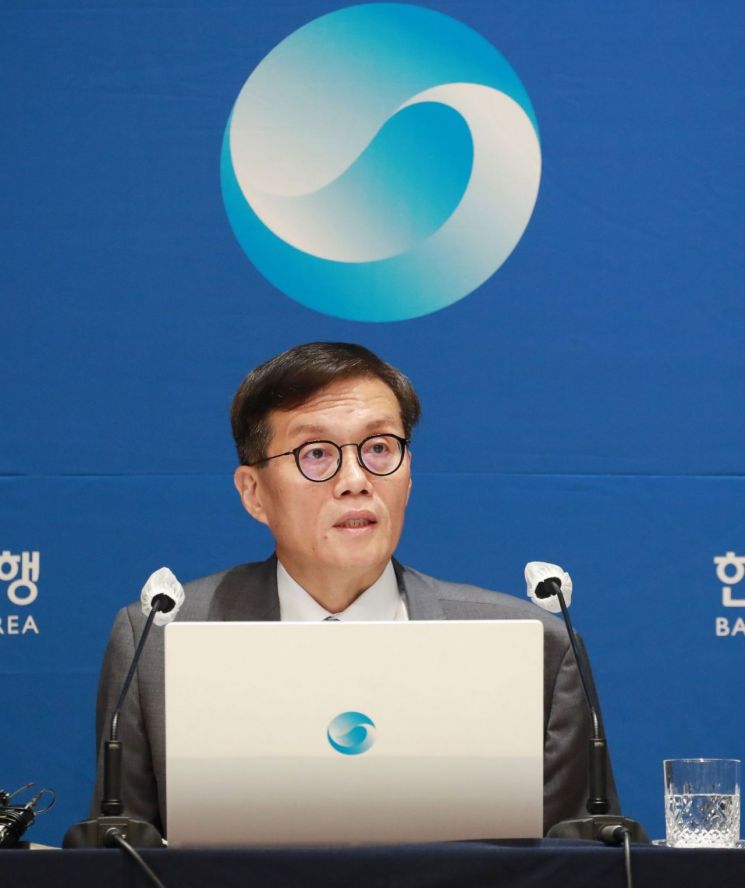 Lee Chang-yong, Governor of the Bank of Korea, is speaking at the Monetary Policy Direction press briefing held on the 24th of last month at the Bank of Korea in Jung-gu, Seoul. Photo by Bank of Korea [Image source=Yonhap News]
© The Asia Business Daily(www.asiae.co.kr). All rights reserved.
![Clutching a Stolen Dior Bag, Saying "I Hate Being Poor but Real"... The Grotesque Con of a "Human Knockoff" [Slate]](https://cwcontent.asiae.co.kr/asiaresize/183/2026021902243444107_1771435474.jpg)
















