No Legal Basis for Crackdown Under Current Law
Ahead of the Busan Fireworks Festival, overcharging practices are once again rampant at shops and lodging businesses near the waters off Gwangalli Beach. This is a recurring issue every year.
On the 23rd, Yonhap News reported that a seafood pojangmacha located on Busan's Gwangalli Beach has started taking seat reservations for the Busan Fireworks Festival period.
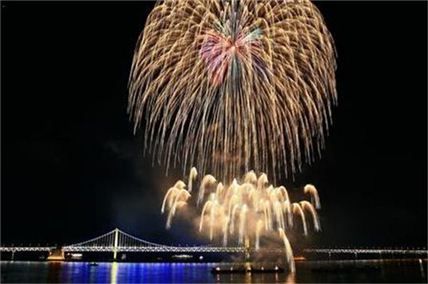 Photo by Suyeong-gu Office, Busan City
The reservation fee is a "seat charge." Food costs are not included at all and must be paid separately. There is even a minimum order amount.
The business stated, "This is the best spot for the Busan Fireworks Festival. All reservation fees are for seat usage, and for meals, at least 100,000 KRW worth of side dishes must be ordered per table."
The reservation fees are set at 850,000 KRW for a 4-person indoor table, 1,000,000 KRW for a 5-person rooftop seat, and 1,200,000 KRW for an 8-person seat.
The festival organizers officially sell paid seats. They are divided into R seats, which come with tables and chairs, and S seats, which provide chairs only. There are 1,000 R seats and 5,000 S seats, with ticket prices of 100,000 KRW and 70,000 KRW respectively.
This business is selling seats at prices more than double the highest price set by the organizers. Kim Dong-gwan, Secretary General of the Suyeong-gu Small Business Association, told Yonhap News, "Every time I meet with business owners, I urge them not to charge excessive seat fees during the fireworks festival period and am making efforts to address this."
Last year, merchants' excessive seat fee demands were also rampant. There were dozens of complaints and reports filed with the 'Unfair Trade Reporting Center for Lodging and Food Services.'
Most complaints involved consumers who made reservations on festival dates being asked for additional fees. Some complaints stated that when they refused to pay the extra charges, their reservations were unilaterally canceled. The resale price of lodging vouchers also soared above 1,000,000 KRW. Hotel vouchers originally priced at 200,000 to 300,000 KRW were traded at up to five times their value.
Cafes and restaurants in so-called "prime spots" were literally priced as high as they wanted. Seats were graded as R, S, and A in order of proximity to the window, and only specific menu items were sold.
Under current law, even if business owners significantly raise prices for festivals or events, there is no legal basis for crackdowns. Prices are formed autonomously in the market, so the government cannot intervene. However, if a business owner fails to notify customers of price increases in advance or demands higher fees after reservations, administrative agencies can take action based on the Public Health Control Act.
© The Asia Business Daily(www.asiae.co.kr). All rights reserved.
![Clutching a Stolen Dior Bag, Saying "I Hate Being Poor but Real"... The Grotesque Con of a "Human Knockoff" [Slate]](https://cwcontent.asiae.co.kr/asiaresize/183/2026021902243444107_1771435474.jpg)















