With the Approval of Lee's Arrest Motion, 89 Bills Fail to Pass in the Plenary Session on the 21st... Likely to Extend into October
Expect Confrontation Between Ruling and Opposition Parties Over Hearings and Controversial Bills
The last regular session of the 21st National Assembly has effectively entered a 'business suspension' phase. This occurred after the arrest motion against Lee Jae-myung, leader of the Democratic Party of Korea, was passed in the plenary session, leading to the suspension of most legislative schedules. The adoption of the personnel hearing report for Supreme Court Chief Justice nominee Lee Yong-gyun, personnel hearings for three ministerial candidates, and the passage of major livelihood bills scheduled for the plenary session have all been postponed one after another. With the Democratic Party's floor leadership declaring a total resignation, making negotiations between ruling and opposition parties difficult for the time being, the political situation could be further shaken depending on the results of Lee's warrant hearing on the 26th, raising the possibility of a prolonged business suspension.
According to the National Assembly on the 23rd, although 93 bills were originally submitted to the plenary session on the 21st when the arrest motion against Lee was passed, 89 bills except for the 'Restoration of Teachers' Authority Four Acts' failed to pass. This was because the plenary session was adjourned immediately after the arrest motion was approved. Both ruling and opposition parties held closed-door party meetings and supreme council meetings, so the plenary session was ultimately not resumed.
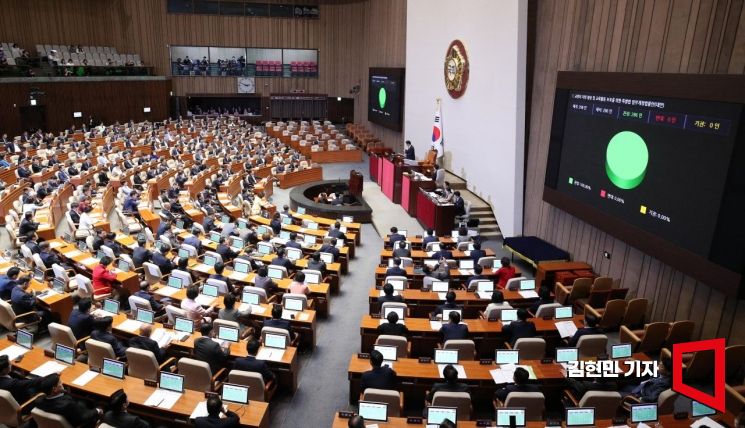 At the 8th plenary session of the 410th National Assembly (regular session) held in the main chamber of the National Assembly on the 21st, the partial amendment bill of the Special Act for the Improvement of Teachers' Status and Protection of Educational Activities was passed. Photo by Hyunmin Kim kimhyun81@
'Mugshot Disclosure Act' Expected to Pass by End of October
Among the bills submitted to the plenary session at that time, many urgent livelihood bills were included. The so-called 'Mugshot Disclosure Act,' which requires the disclosure of personal information of suspects in certain serious crimes, is a representative example. This law aims to disclose photos (mugshots) taken by investigative agencies of suspects in serious crimes and expand the scope of personal information disclosure to include drug-related crimes. The ruling and opposition parties have been promoting this law to expand the personal information disclosure system in response to the recent surge in 'random attacks' and criticisms that the photos of suspects released by the police do not match their actual appearance.
The passage of the Special Act on Protective Birth, which addresses the issue of unregistered infants such as in the 'Refrigerator Infant Abandonment Case,' was also delayed. This act includes provisions for counseling on original family care and protective birth for those who wish to give birth anonymously, and allows requests to view birth certificates of children born through protective birth. Unlike the Birth Notification System passed in June, the Protective Birth System faced disagreements between ruling and opposition parties over detailed provisions. Although it recently passed the Legislation and Judiciary Committee, it ultimately failed to clear the plenary session hurdle.
The amendment to the Insurance Business Act, which would allow patients to claim indemnity health insurance without visiting hospitals to obtain documents, also failed to pass. This law mandates the establishment and operation of an electronic system for indemnity health insurance claims and allows subscribers to electronically transmit related documents to insurance companies upon request. Due to the delay in passing the law, patients' inconveniences are expected to continue for the time being.
The plenary session to handle these bills is unlikely to be held within this month. Originally, the ruling and opposition parties planned to hold a plenary session on the 25th to vote on the adoption of the personnel hearing report for Supreme Court Chief Justice nominee Lee Yong-gyun, but following the approval of the arrest motion against Lee and the total resignation of the Democratic Party's floor leadership, no agreement has been reached on the legislative schedule due to a 'negotiation vacuum.' Floor leader Yoon Jae-ok told reporters at the National Assembly the previous day, "For now, the negotiation partner no longer exists," adding, "We will monitor the situation and try to negotiate and communicate to ensure the regular session can operate normally."
No plenary session will be held during next month's National Assembly audit period, and the nearest plenary session is scheduled for October 31.
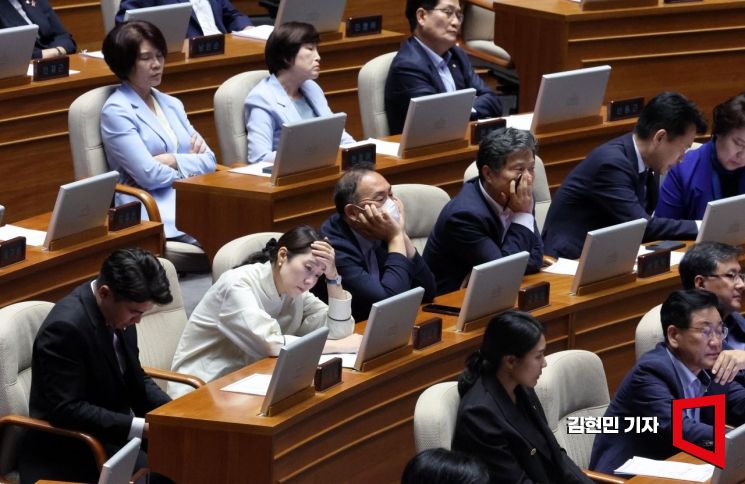 Democratic Party of Korea lawmakers wore somber expressions on the 21st in the National Assembly plenary session hall as the motion to approve the arrest of Representative Lee Jae-myung was passed. Photo by Hyunmin Kim kimhyun81@
Not only the bills deferred in the previous plenary session but also major contentious issues are expected to face difficulties one after another. First, the confirmation vote for Supreme Court Chief Justice nominee Lee Gyun-yong is expected to lead to a vacancy in the Supreme Court as the plenary session schedule for the 25th has not been agreed upon. The personnel hearings are also expected to face obstacles. The ruling and opposition parties have agreed to hold a hearing for Defense Minister nominee Shin Won-sik on the 27th, but the hearing schedules for Women and Family Minister nominee Kim Haeng and Culture, Sports and Tourism Minister nominee Yoo In-chon have not yet been decided.
Moreover, depending on the court's decision on Lee's warrant hearing, confrontation between ruling and opposition parties may intensify. Since the Democratic Party is demanding the withdrawal of all three nominees, the holding of the hearings remains uncertain.
Contentious bill passage is expected to be even more difficult. Bills currently awaiting negotiation between ruling and opposition parties include the National Finance Act pending in the National Assembly's Strategy and Finance Committee, the Special Act on the Aerospace Agency in the Science, Technology, Information and Broadcasting Committee where the agenda adjustment committee has been convened, and the Interest-Free Student Loan Act pending in the Legislation and Judiciary Committee.
There is also speculation that the Democratic Party may engage in 'retaliatory legislation' concerning the Yellow Envelope Act and the three Broadcasting Acts, which they have vowed to pass during the regular session. Democratic Party Supreme Council member Jang Kyung-tae said at the supreme council meeting the previous day, "It is very regrettable that the Broadcasting Act was not submitted to the plenary session yesterday," adding, "We will definitely pass the Broadcasting Act along with the Yellow Envelope Act at the next plenary session to thwart the Yoon Seok-youl administration's attempt to control broadcasting." A political insider commented, "(The Democratic Party) has always been aiming to bring up these two bills," but regarding negotiations on contentious bills, said, "Politics is unpredictable. You only know when you actually get there," leaving room for uncertainty.
Professor Shin Yul of Myongji University's Department of Political Science and Diplomacy said, "By using the Yellow Envelope Act and the Broadcasting Act to induce the opponent's veto, thereby damaging their image, the Democratic Party will try to pass these laws," adding, "While there is internal conflict and fighting among supporters, passing such laws will provoke the ruling party and push internal conflicts below the surface." Regarding the Supreme Court Chief Justice confirmation, he explained, "Since the Democratic Party could face criticism for paralyzing not only the National Assembly but also the judiciary, we need to watch what choice they make."
© The Asia Business Daily(www.asiae.co.kr). All rights reserved.
![Clutching a Stolen Dior Bag, Saying "I Hate Being Poor but Real"... The Grotesque Con of a "Human Knockoff" [Slate]](https://cwcontent.asiae.co.kr/asiaresize/183/2026021902243444107_1771435474.jpg)
















