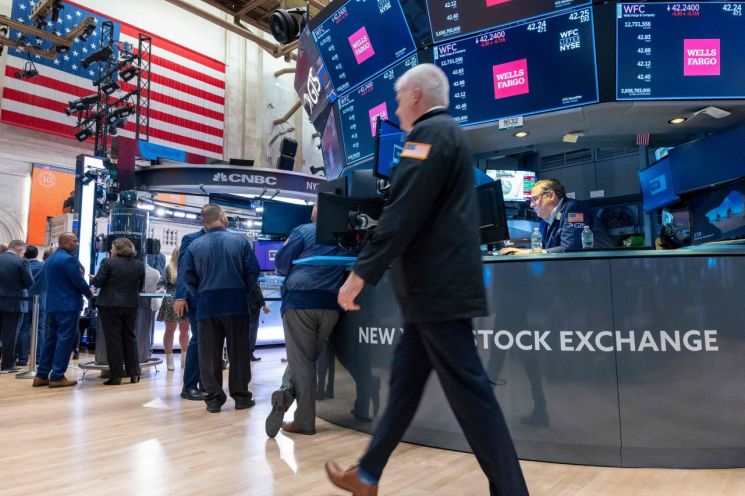
The three major indices of the U.S. New York stock market showed a simultaneous decline early in the session on the 21st (local time) as bond yields rose following the September Federal Open Market Committee (FOMC) meeting the previous day, which signaled a prolonged period of high interest rates.
At around 10:31 a.m. at the New York Stock Exchange (NYSE), the Dow Jones Industrial Average, which focuses on blue-chip stocks, was down 131.54 points (0.38%) from the previous close, standing at 34,309. The S&P 500, centered on large-cap stocks, traded 39.09 points (0.89%) lower at 4,363, while the tech-heavy Nasdaq index fell 153.28 points (1.14%) to 13,315.
Currently, all 11 sectors within the S&P 500 are in decline. Notably, the drops in telecommunications, consumer discretionary, and real estate-related stocks are prominent. Broadcom is down about 3% after reports emerged that Google Alphabet’s management is considering excluding the company as an AI semiconductor supplier. KB Home fell nearly 4% despite better-than-expected earnings. Arm, which went public last week, dropped 2.8%, nearing its IPO price of $51. Cisco fell more than 3% following news of its acquisition of Splunk, while Splunk surged over 20%. FedEx rose more than 4.5% after releasing earnings that exceeded expectations following the previous day’s market close.
Investors are digesting the FOMC results released the previous afternoon and closely watching bond yield movements. As expected, the Federal Reserve (Fed) held the federal funds rate steady at 5.25?5.5% during the meeting. At the same time, the policy statement and Fed Chair Jerome Powell’s press conference clearly indicated that the rate hike cycle is not yet over.
In the subsequent press conference, Chair Powell stated, "If necessary, we could raise rates once more at one of the remaining two meetings this year," adding, "The majority opinion of the FOMC is to raise rates one more time." He said, "We want to see convincing evidence that we have reached a sufficiently restrictive level," and noted, "Inflation has eased, but there is still a long way to go to reach the 2% target." He also expressed caution regarding ongoing uncertainties such as the United Auto Workers strike, the possibility of a federal government shutdown, the resumption of student loan repayments, and high oil prices.
In the dot plot released the previous day, the Fed maintained the median year-end rate forecast for this year at 5.6%, unchanged from before. However, the median rate forecast for the end of 2024 was raised from 4.6% to 5.1%, and the 2025 year-end median rate forecast was increased from 3.4% to 3.9%. This indicates that even after the Fed begins cutting rates, high interest rates are expected to persist longer than previously anticipated. The expected rate cut magnitude next year was also reduced to 0.5 percentage points from earlier projections.
This Fed outlook was considered more hawkish than initially expected, further strengthening risk aversion sentiment. Rising concerns about oil-driven inflation also contributed to market worries. International oil prices are rising again today. West Texas Intermediate (WTI) crude oil prices jumped over 1%, hovering around $90 per barrel. Brent crude also rose to about $94.3 per barrel. The previous day, Goldman Sachs warned of supply shortages in the fourth quarter and forecast Brent crude could rise to $100 per barrel.
The weekly initial jobless claims released today fell to their lowest level in eight months, confirming the labor market remains robust. According to the U.S. Department of Labor, new jobless claims for the week of September 10?16 decreased by 20,000 from the previous week to 201,000, the lowest since the fourth week of January. This figure also beat Wall Street experts’ forecast of 225,000 claims. On the same day, the Philadelphia Federal Reserve’s September manufacturing index came in at -13.5, significantly below the Dow Jones estimate of 0.
In the New York bond market, Treasury yields rose. The benchmark 10-year Treasury yield surpassed 4.48%, reaching its highest level since 2007. The 2-year yield, sensitive to monetary policy, also exceeded 5.19%, the highest since 2006. The dollar index, which measures the dollar’s value against six major currencies, remained steady around 105.2.
There are two remaining FOMC meetings this year, in November and December. Key economic data before the November FOMC include the PCE price index on September 29, the nonfarm payroll report on October 6, the Producer Price Index (PPI) on October 11, and the Consumer Price Index (CPI) on October 12. However, the market still largely expects a rate hold in November. According to the Chicago Mercantile Exchange (CME) FedWatch tool, federal funds futures this morning priced in over a 71% chance that the Fed will keep rates steady in November.
Following the FOMC, several countries, including the UK, have also made interest rate decisions. The Bank of England (BOE) surprised markets by holding rates steady at 5.25%. A 0.25 percentage point increase, known as a baby step, had been widely expected, but the decision to hold came after consumer inflation data released the previous day showed the lowest increase in 18 months.
European stock markets are also down. Germany’s DAX index fell 1.08%, France’s CAC index dropped 1.42%, and the UK’s FTSE index showed slight declines.
© The Asia Business Daily(www.asiae.co.kr). All rights reserved.
![Clutching a Stolen Dior Bag, Saying "I Hate Being Poor but Real"... The Grotesque Con of a "Human Knockoff" [Slate]](https://cwcontent.asiae.co.kr/asiaresize/183/2026021902243444107_1771435474.jpg)















