On the 21st, the Fair Trade Commission Applies 'Abuse of Superior Bargaining Position' to Broadcom
The Korea Fair Trade Commission (KFTC) has decided to impose a fine of 19.1 billion KRW on Broadcom, a U.S. semiconductor company, for forcing Samsung Electronics into long-term contracts for smartphone components. The KFTC judged Broadcom’s act of leveraging Samsung Electronics’ absolute dependence on its components at the time to force a contract favorable only to itself as an "abuse of superior bargaining position."
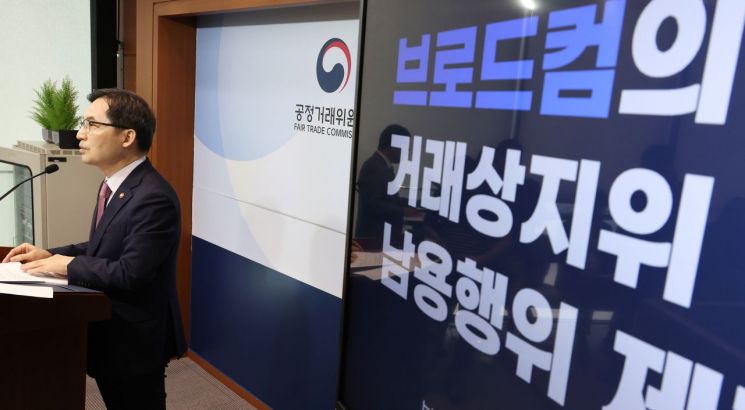
On the 21st, the KFTC decided to issue corrective orders and impose a fine of 19.1 billion KRW on Broadcom (collectively referring to Broadcom Inc. (U.S. headquarters), Broadcom Corporation (U.S.), Avago Technologies International Sales Private Limited (Singapore), Avago Technologies Korea Co., Ltd. (Korean branch), etc.) for forcing Samsung Electronics into long-term contracts through unfair means such as halting component shipments to prevent Samsung from switching to competing suppliers. Broadcom is a semiconductor company with an overwhelming market share in cutting-edge, high-performance wireless communication components used in smart devices such as smartphones and tablet PCs.
According to the KFTC, Samsung Electronics was heavily dependent on Broadcom for most of the advanced, high-performance components installed in its premium, high-priced smart devices at the time. When competition began in some components from 2018, Broadcom established a long-term agreement (LTA) strategy in December 2019 to prevent Samsung Electronics from switching to competitors and to guarantee long-term sales by leveraging its monopoly in component supply.
Before the LTA negotiations, Broadcom informed Samsung Electronics that it planned to stop transactions and notified during the first LTA negotiation that it would reconsider the supply of Samsung’s smart device-related components in the future. After the negotiations began, Broadcom also stopped accepting purchase orders from Samsung Electronics. Feeling pressured by the continued suspension of purchase order approvals, Samsung Electronics expressed willingness to agree to an LTA for some components, but Broadcom strongly demanded including additional components.
Broadcom also exerted strong pressure by halting shipments of all components supplied to Samsung Electronics. Eventually, Broadcom was able to conclude the LTA contract as it desired. The core content of the LTA was that from 2021 for three years, Samsung Electronics would purchase at least $760 million worth of Broadcom components annually, and if the actual purchase amount fell short of $760 million, Samsung would compensate the difference. KFTC Chairman Han Ki-jung explained, “The investigation considered applying provisions on abuse of market dominance and abuse of superior bargaining position, but since the victim company was limited to Samsung Electronics, the abuse of superior bargaining position provision was applied.”
The KFTC stated, “Samsung Electronics was at a significant disadvantage in negotiations due to Broadcom’s shipment suspensions and other measures, and was in a desperate situation where it had no choice but to accept Broadcom’s unilateral demands.” To fulfill the LTA forced by Broadcom, Samsung Electronics had to switch from initially adopted competitor products to Broadcom components. Although Samsung planned to equip the Galaxy S21, released in 2021, with competitor components, it ultimately had to abandon this plan and adopt Broadcom’s components, making it impossible to continue its component supply diversification strategy. Additionally, Broadcom’s components were more expensive than competitors’, causing financial disadvantages due to price increases.
The KFTC judged Broadcom’s actions as an abuse of superior bargaining position over its trading partner. Chairman Han said, “Broadcom’s competitors were deprived of a fair opportunity to compete based on product price and performance, and in the long term, the lack of incentives for component manufacturers to invest will hinder innovation, ultimately harming consumers.” He added, “This KFTC action is significant in that it curbed leading semiconductor companies like Broadcom from using their superior position to disadvantage trading partners and restrict competition in related markets, thereby establishing a fair trade order.”
© The Asia Business Daily(www.asiae.co.kr). All rights reserved.
![Clutching a Stolen Dior Bag, Saying "I Hate Being Poor but Real"... The Grotesque Con of a "Human Knockoff" [Slate]](https://cwcontent.asiae.co.kr/asiaresize/183/2026021902243444107_1771435474.jpg)















