Expiration Date Extended from 2030 to 2035
"Considering Household Burden... Should Not Burden the Common People"
Car Companies and Ruling Party Also Oppose... "Biggest Mistake"
The UK government has decided to postpone the ban on the sale of new internal combustion engine vehicles from 2030 to 2035, delaying it by five years. While maintaining the goal of achieving carbon neutrality by 2050, the government announced that it will slow down its climate change response in consideration of households facing increased living costs due to recent rises in energy prices and inflation.
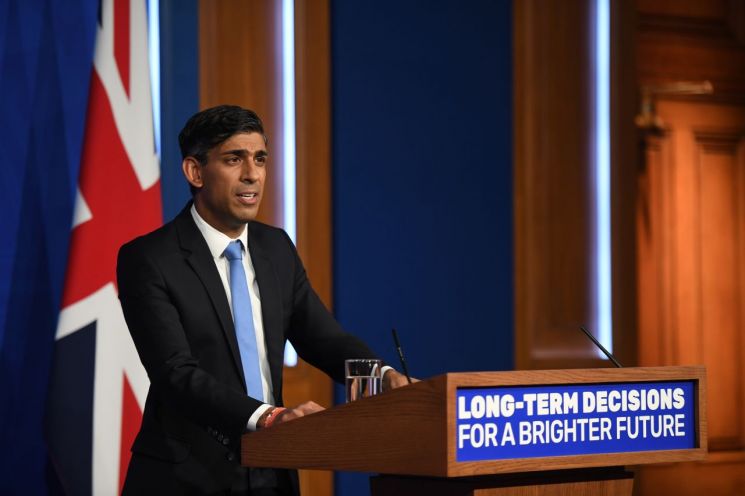
According to Bloomberg and other sources on the 20th (local time), UK Prime Minister Rishi Sunak announced that the ban on the sale of new petrol and diesel cars will be postponed from 2030 to 2035. He also stated that the trading of used petrol and diesel cars will still be allowed after that. Sunak explained that this timeline aligns with countries such as Germany, France, and some US states like California and New York, and that by around 2030, electric vehicles will become dominant without direct government intervention.
As part of other climate change measures, Sunak said the plan to phase out gas boilers in homes would be relaxed and that there would be no mandatory switch to heat pumps. He emphasized, "At least for now, the government will not enforce this but allow consumers to make their own choices."
The UK was the first major country to legally bind itself to the 2050 carbon neutrality target. Sunak denied that this move dilutes climate change policies. He also added that he will attend the 28th UN Climate Change Conference of the Parties (COP28) held in Dubai.
However, he pointed out that the previous government set the pace of climate change response too fast without securing public support, warning that this could lead to backlash and the failure to achieve the goals. He said that the increased costs of inflation and interest rates would impose a huge burden on UK households and that a different approach is needed.
Sunak said, "I believe most people want to do the right thing regarding climate change and are prepared to make sacrifices, but it is not appropriate to impose such burdens on those struggling." He added, "The UK needs to move in a more balanced way," and evaluated that "the debate on climate change policies is filled with emotion and lacks clarity."
Following media reports on the related content the day before, the UK government quickly held a cabinet meeting and a press conference to announce this. Foreign media have assessed that Sunak is acting this way because slowing down the pace of climate change policies could help capture swing voters expected in next year's general election.
The automotive industry, which invested in electric vehicle production in line with the UK government's policy direction, has expressed opposition. Lisa Brankin, head of Ford UK, criticized, "We want ambition, commitment, and consistency from the UK government, and this move undermines all three." Mike Hawes, chairman of the Society of Motor Manufacturers and Traders, also emphasized, "The government must provide clear and consistent messages, attractive incentives, and charging infrastructure to build trust rather than anxiety."
Environmental groups, opposition parties, and even some Conservative Party figures including former Prime Minister Boris Johnson have criticized the decision. Johnson criticized that the announcement increases uncertainty, making it harder to cope with. Conservative MP Chris Skidmore called it "the biggest mistake Sunak has made so far" in an interview with BBC.
© The Asia Business Daily(www.asiae.co.kr). All rights reserved.
![Clutching a Stolen Dior Bag, Saying "I Hate Being Poor but Real"... The Grotesque Con of a "Human Knockoff" [Slate]](https://cwcontent.asiae.co.kr/asiaresize/183/2026021902243444107_1771435474.jpg)















