Sikh Issue Shouting 'Independence from India' Sparks Controversy
Indian PM Modi: "Canada Tolerates Anti-India Actions"
The Canadian government strongly criticized the Indian government last June, accusing Indian officials of being behind the assassination of a Sikh leader on Canadian soil. Amid this unprecedented public condemnation and the rapid deterioration of bilateral relations, concerns are growing that the conflict between the two countries will not be easily resolved, especially as trade negotiations, resumed after 10 years, have also been suspended.
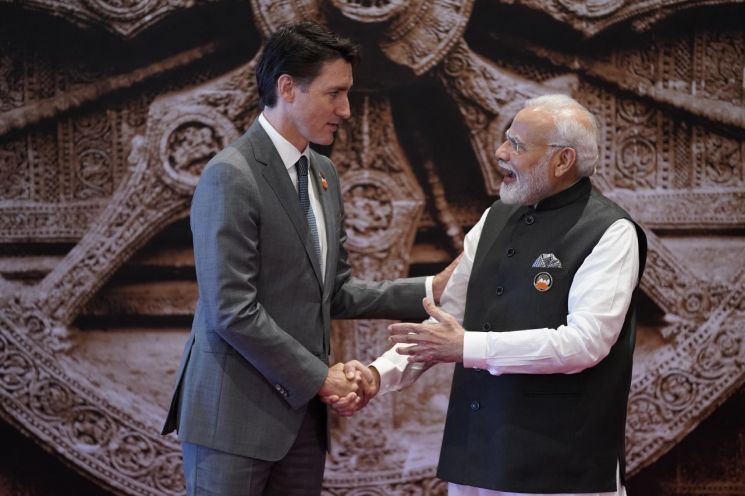 On the 9th, in New Delhi, India, where the G20 summit was held, Canadian Prime Minister Justin Trudeau (left in the photo) and Indian Prime Minister Narendra Modi are greeting each other. [Image source=AP Yonhap News]
Why Did Canada Expel an Indian Diplomat?
On the 18th (local time), according to Bloomberg News and CNN, Canadian Prime Minister Justin Trudeau stated in a message to the House of Commons that credible claims have emerged implicating Indian government officials in the assassination of Sikh leader Hardeep Singh Nijjar, which occurred last June in front of a temple in Surrey, British Columbia.
At the time, Nijjar was shot and killed by masked armed assailants who were in a truck outside the Sikh temple.
Prime Minister Trudeau said, "Over the past few weeks, Canadian security agencies have been actively investigating a potential link between Indian government officials and the murder of Canadian citizen Hardeep Singh Nijjar," adding that the government will make every effort necessary to apprehend the suspects.
He further stated, "Canada has expressed deep concerns to senior Indian intelligence and security officials," and that he conveyed this to Indian Prime Minister Narendra Modi during his recent visit to New Delhi for the G20 summit. He emphasized, "Foreign government involvement in the killing of a Canadian citizen on Canadian soil is an unacceptable violation of sovereignty," calling it "a very serious matter."
Following Trudeau's announcement, the Canadian Ministry of Foreign Affairs announced the expulsion of a diplomat, who was the head of a foreign intelligence agency stationed in Canada.
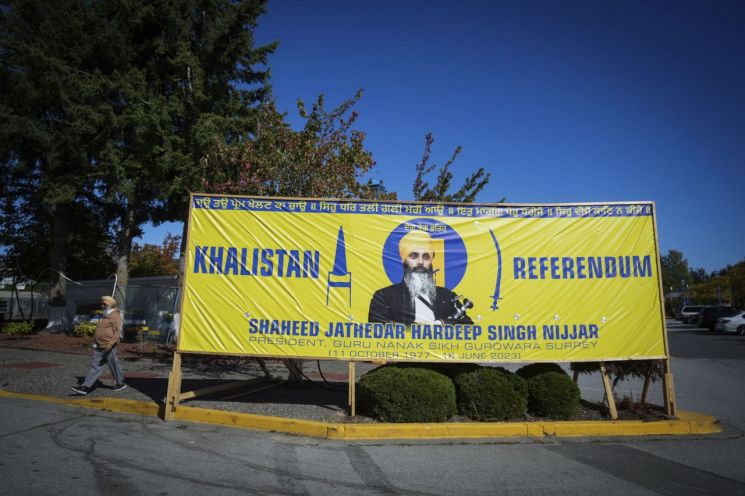 A banner featuring a photo of Sikh leader Hardip Singh Nijjar is hung outside a Sikh temple in Surrey, British Columbia, Canada.
 [Image source=AP Yonhap News]
Sikhs Calling for 'Independence from India'... Modi Protests to Trudeau
The conflict between India and Canada stems from the recognition of Sikhs within Canada. Sikhism is a religion that developed in the Punjab region of India between the 15th and 18th centuries. India is sensitive to this religion because Sikh radicals advocate for the establishment of an independent state separate from India, centered in the northern Punjab region.
Sikhism, which blends Hindu and Islamic beliefs, is estimated to have about 30 million followers worldwide. The Indo-Canadian population is estimated to be between 1.4 and 1.8 million, most of whom are Sikhs. Apart from Punjab in India, Canada is the place where Sikhs are most densely concentrated.
The assassination victim, Nijjar, was a prominent Sikh leader in British Columbia who advocated for the creation of Khalistan (meaning 'Land of the Pure' in Punjabi), an independent Sikh state that would include parts of the Indian Punjab where Sikhism originated. India had listed him as a terrorist several years ago.
Since Nijjar's assassination, Sikhs have gathered on the streets of Toronto since July to protest against the Indian government. Prime Minister Modi has protested to Prime Minister Trudeau multiple times, but Trudeau has maintained a stance of "protecting freedom of expression, conscience, and peaceful protest." In response, Modi publicly criticized Trudeau for "tolerating anti-India activities by Canadian extremists."
Trade Negotiations Resumed After 10 Years Also Suspended
As the situation worsened, India and Canada have suspended trade negotiations that had resumed after 10 years.
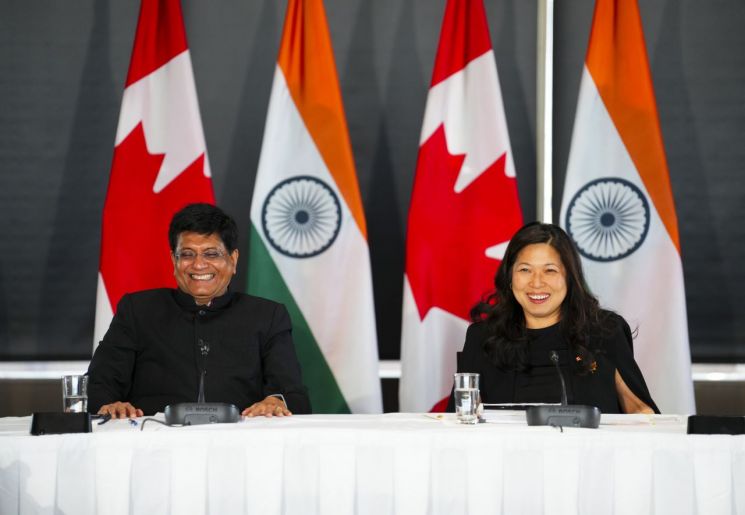 In May, the commerce ministers of India and Canada, who discussed the Free Trade Agreement (FTA), are sitting side by side with smiles. [Image source=AP Yonhap News]
India and Canada resumed free trade agreement (FTA) negotiations in March last year after a 10-year hiatus and continued talks until July. In May, Indian Commerce Minister Piyush Goyal visited Canada and expressed optimism about concluding an initial agreement focused on certain industries rather than the entire economy, saying, "It won't take years to finalize."
During this period, bilateral trade volume increased from $7 billion in the 2021?2022 fiscal year (April 2021?March 2022) to $8.16 billion in the 2022?2023 fiscal year (April 2022?March 2023).
However, recently, India and Canada announced that their FTA negotiations have been suspended for political reasons. The Canadian government stated that it is postponing the visit of the FTA negotiation team to India scheduled for next month. Although neither side specified detailed reasons, foreign media have assessed that the Sikh issue was the trigger.
Prime Ministers Modi and Trudeau also engaged in a tense exchange during the G20 summit held in India on the 10th and 11th. While Modi held bilateral meetings with most leaders during the G20 summit hosted by India, he did not hold a separate meeting with Trudeau.
© The Asia Business Daily(www.asiae.co.kr). All rights reserved.
![Clutching a Stolen Dior Bag, Saying "I Hate Being Poor but Real"... The Grotesque Con of a "Human Knockoff" [Slate]](https://cwcontent.asiae.co.kr/asiaresize/183/2026021902243444107_1771435474.jpg)


















