If earnings decline causing cash to vanish, it's a problem
But reducing cash by repaying debt or increasing investment is positive
Companies expand future investments despite difficulties

It was revealed that the top 30 domestic companies increased their investments by 10 trillion won in the first half of the year, despite a decrease of 20 trillion won in cash holdings.
The cash equivalents (including short-term financial products) of the top 30 companies (excluding Mirae Asset Securities, a financial investment company, and Joongheung Construction, Booyoung, and Hoban Construction, which did not submit business reports) stood at 191.7146 trillion won as of the end of June, down 9.7% from 212.2327 trillion won at the end of last year. Samsung Electronics decreased by 15.4%, from 114.7836 trillion won to 97.0099 trillion won. The largest decreases followed in POSCO Holdings (8.0531 trillion → 6.3051 trillion won, -21.7%), LG Energy Solution (5.938 trillion → 4.8602 trillion won, -18.2%), and GS Caltex (3.3611 trillion → 2.4226 trillion won, -27.9%).
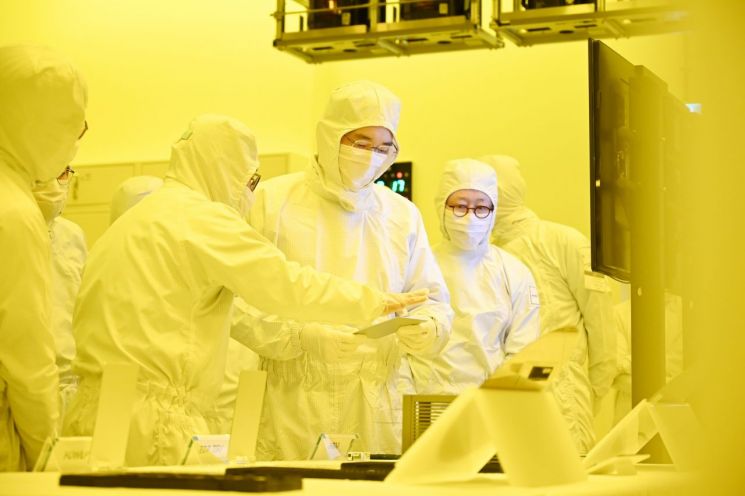 Samsung Electronics Chairman Lee Jae-yong inspecting equipment at the Samsung Electronics Cheonan Campus site on February 17.
 [Photo by Yonhap News]
A decrease in cash holdings is unwelcome news from a corporate perspective, as it means reduced investment capacity and insufficient funds to repay debts. Accounting academia generally cites the following reasons for a decrease in corporate cash: ▲ an increase in accounts receivable and inventory due to declining performance ▲ a decrease (repayment) in short-term borrowings ▲ an increase in investments. An increase in accounts receivable and inventory is usually interpreted negatively, as it indicates a recession and weakening cash flow for companies. Accounts receivable refer to sales made on credit rather than cash. Even if a product worth 100 won is sold, the company does not immediately receive 100 won in cash. An increase in accounts receivable means slower cash turnover. When product competitiveness declines or the business environment worsens, the turnover rate of accounts receivable decreases. An increase in inventory means that due to sluggish business conditions, customer and consumer demand has decreased, causing products to pile up in warehouses.
On the other hand, a decrease in short-term borrowings or a reduction in cash due to increased investments is interpreted positively. It is advisable not to hastily conclude that a decrease in corporate cash is solely due to economic downturns or weakening corporate fundamentals, but rather to examine changes in borrowings and investments through consolidated financial statements.
Although accounts receivable and inventory increased in the first half for the top 30 companies, the increase was minimal compared to the decline in operating profit. Accounts receivable of the top 30 companies rose 1.7% from 96.6241 trillion won at the end of last year to 98.2059 trillion won in the first half. Inventory increased 4.2% from 140.0387 trillion won to 145.8546 trillion won during the same period. Operating profit sharply declined by 77.9%, from 65.2506 trillion won to 14.3884 trillion won. This means that compared to the significant drop in performance, the increase in accounts receivable and inventory was not substantial.
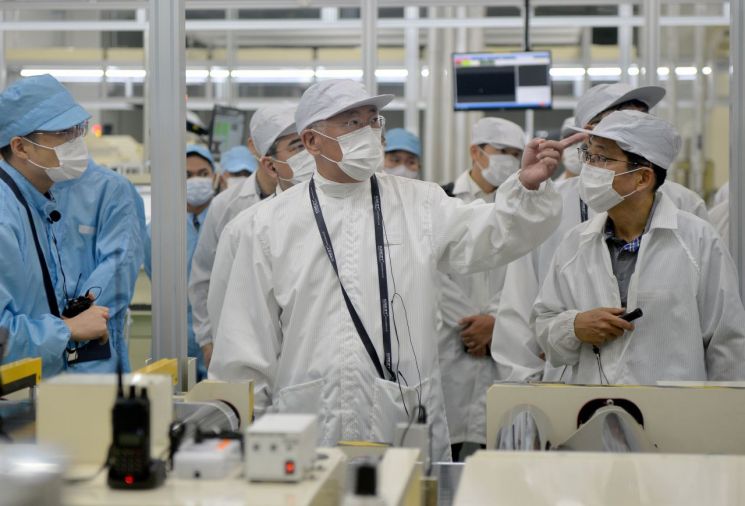 Hyundai Motor Group Chairman Chung Euisun visited the Hyundai Motor Group and LG Energy Solution Indonesia battery cell joint factory 'HLI Green Power (Hyundai LG Indonesia Green Power)' on the 7th (local time) and closely examined the detailed processes of each stage.
 [Photo by Yonhap News]
Experts analyzed that the decrease in cash in the first half was not necessarily due to poor performance. Rather, attention should be paid to the significantly increased investment figures. The investment amount of the top 30 companies rose 18.2% from 50.9602 trillion won in the first half of last year to 60.2139 trillion won in the first half of this year. Short-term borrowings increased 2.6%, from 64.347 trillion won to 66.0027 trillion won. Here, investment refers to money spent on facilities, real estate, etc., for more than one year. It is very rare for companies to borrow short-term loans to invest. Even if cash is insufficient and borrowings are used, investments are mostly financed through long-term borrowings with a maturity of 12 months or more. In other words, the top 30 companies increased facility investments by nearly 20% in the first half without recklessly borrowing short-term loans to avoid crisis.
Companies that significantly increased facility investments included Samsung Electronics (20.2519 trillion → 25.2593 trillion won, 24.7% increase), POSCO Holdings (6.8594 trillion → 12.7505 trillion won, 85.9% increase), Hyundai Motor Company (3.0179 trillion → 4.458 trillion won, 47.7% increase), and LG Energy Solution (2.6977 trillion → 4.1742 trillion won, 54.7% increase). Despite difficult circumstances, Korea’s leading companies opened their wallets and invested more. Joo In-ki, honorary professor at Yonsei University and former president of the International Federation of Accountants (IFAC), said, "A decrease in cash due to increased facility investments is very good news for companies and the Korean economy," adding, "It means companies expect to generate profits in the future and have invested in assets accordingly."
© The Asia Business Daily(www.asiae.co.kr). All rights reserved.
![Clutching a Stolen Dior Bag, Saying "I Hate Being Poor but Real"... The Grotesque Con of a "Human Knockoff" [Slate]](https://cwcontent.asiae.co.kr/asiaresize/183/2026021902243444107_1771435474.jpg)

















