Partner Company Rani Therapeutics
Starts Phase 1 Dosing of 'RT-111'
Uplima Also Pursues Formulation Improvement
Under the Goal of '50 Trillion KRW New Drug Sales by 2030'
Developing ADC, Bispecific Antibodies, and Microbiome
Celltrion's new drug development, aiming to become a comprehensive global big pharma encompassing new drugs, biosimilars (biopharmaceuticals), and synthetic drugs (chemical drugs) with an annual sales target of 12 trillion KRW by 2030, has officially set sail. Chairman Seo Jung-jin of the Celltrion Group presented the goal of raising new drug sales to 5 trillion KRW by 2030, and the development of improved drugs that convert existing antibody drugs into oral treatments has taken its first step.
On the 18th (local time), US-based Rani Therapeutics announced that the first patient dosing in Phase 1 clinical trials of the oral drug 'RT-111', containing ustekinumab, was conducted in Australia. This clinical trial is being conducted on 55 subjects to evaluate pharmacokinetics, safety, and tolerability. The subjects are divided into three groups: two groups receive RT-111 at doses of 0.5 mg or 0.75 mg respectively, and the remaining group serves as the control, receiving a 0.5 mg subcutaneous (SC) injection of ustekinumab. The top-line clinical results are expected in early Q1 next year.
RT-111 is a drug that converts Celltrion's ustekinumab biosimilar 'CT-P43' into an oral medication using Rani Therapeutics' oral capsule platform 'RaniPill'. In January, Celltrion signed a collaboration agreement with Rani Therapeutics for the development of RT-111, agreeing to exclusively supply CT-P43 needed for preclinical and Phase 1 clinical trials, and secured the right of first negotiation for global development and sales rights in the future.
RaniPill is a platform technology that enables oral administration of protein and antibody drugs that are typically administered via SC or intravenous (IV) injection. Currently, ustekinumab is only used in SC formulations, but if the development of RT-111 succeeds, it will be possible to administer it orally in the future. The RaniPill capsule dissolves in the small intestine, and the drug is delivered to the bloodstream via dissolvable microneedles inside the capsule. Although it is an oral drug, it is designed to deliver the drug similarly to an injection through microneedles, and animal studies have confirmed bioavailability comparable to SC formulations.
In particular, developing oral drugs is expected to greatly improve patient convenience and also significantly contribute to the company's revenue generation. Celltrion's infliximab biosimilar 'Remsima SC' was the first and only infliximab drug, which was previously only available in IV form, to be improved into an SC formulation. The US Food and Drug Administration (FDA) highly valued this and proactively recommended Celltrion to proceed with approval as a new drug named 'Zimpenetra'. If the formulation change to an oral drug is recognized as a new drug, it can command higher prices than biosimilars and enable long-term exclusive sales through patents. Additionally, the US Centers for Medicare & Medicaid Services (CMS) recently recognized drugs converted from existing drugs to SC formulations as new drugs, reducing concerns about price cuts under the Inflation Reduction Act (IRA).
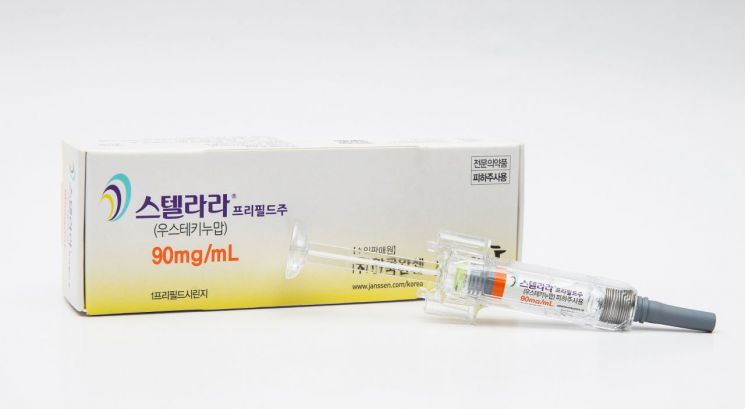 Johnson & Johnson Innovative Medicine (formerly Janssen)'s autoimmune disease treatment 'Stelara' (generic name 'Ustekinumab')
Ustekinumab's original drug is 'Stelara', developed by Johnson & Johnson (J&J) Innovative Medicine (formerly Janssen). It is a blockbuster product in the autoimmune disease treatment field as an interleukin (IL)-12, 23 inhibitor. According to IQVIA, a pharmaceutical market research firm, the global ustekinumab market size reached $17.713 billion (approximately 23.5 trillion KRW) last year. Celltrion has completed the development of the biosimilar 'CT-P43' and has applied for approval in Korea, the US, Europe, Canada, Australia, and other countries since May.
Talat Imran, CEO of Rani Therapeutics, said, "This is an important milestone bringing us one step closer to realizing oral drugs for autoimmune disease patients." He added, "Since the RaniPill capsule technology is a drug-agnostic platform, RT-111 will provide opportunities to convert other injectable antibody therapies into oral drugs."
In addition, Celltrion signed a collaboration agreement in June for the development of the oral drug 'RT-105' containing adalimumab. This also involves exclusive supply of Celltrion's biosimilar 'CT-P17' (product name Uplima), and depending on the Phase 1 clinical results, Celltrion will have the right of first negotiation for global development and sales rights.
Adalimumab's original drug is 'Humira', a blockbuster autoimmune disease treatment that recorded sales of $21.237 billion (approximately 28 trillion KRW) last year. Particularly, in the US market, considered the largest market, it recorded sales of $18.619 billion (approximately 24.6981 trillion KRW), accounting for over 87% of global sales. Uplima (CT-P17) is currently sold in Europe and the US. Adalimumab is also currently used in SC formulations.
Collecting All 'Hot Modalities'... ADC, Bispecific Antibodies, Microbiome
To establish itself as a 'new drug development company,' Celltrion is also continuing open innovation with domestic and international companies in various fields such as antibody-drug conjugates (ADC), bispecific antibody therapeutics, microbiomes, and oncolytic virus platforms.
First, regarding ADCs, Celltrion directly invested in UK-based ADC specialist Iksuda Therapeutics and, together with Mirae Asset Group through a new growth fund, secured a 47.05% stake, becoming the largest shareholder. Additionally, in October last year, Celltrion signed an option contract to introduce ADC linker-payload platform technology with domestic biotech company Pinobio. This grants the right to use Pinobio's ADC platform for up to 15 targets. If all options are exercised, the total contract value could reach as high as $1.2428 billion (approximately 1.6486 trillion KRW), making it a major contract.
In the bispecific antibody therapeutic area, Celltrion focuses on cancer development. Using a two-track strategy that combines in-house development and external product technology acquisition, it aims to rapidly build a pipeline and strengthen its cancer drug portfolio, which has been centered on antibody therapeutics. Celltrion signed a joint development agreement with US biotech Abpro for the bispecific antibody therapeutic 'ABP102' targeting HER-2 positive breast cancer and has begun active therapeutic development. The company plans to build a long-term partnership through additional equity investments and collaborate on commercialization and other activities.
Celltrion is also advancing the development of microbiome therapeutics, another promising modality. The term microbiome is a combination of 'micro' (microorganisms) and 'biome' (ecosystem), referring to the trillions of microorganisms and their genes residing in the human body. It is known that a 70 kg adult carries about 38 trillion microorganisms inside their body. Various diseases such as psoriasis, gastroesophageal reflux disease, obesity, colitis, and cardiovascular diseases have been linked to individual microbiomes, leading to new therapeutic approaches aimed at curing diseases through microbiome modulation.
Accordingly, in February, Celltrion signed a joint research and development contract with domestic microbiome new drug developer Rescuere Biosciences for a microbiome-based Parkinson's disease treatment. Earlier, in March last year, Celltrion also signed a joint research and development contract with GobioLab for microbiome-based treatments for irritable bowel syndrome and atopic dermatitis.
Celltrion is also developing oncolytic virus platform technology with Jinmedisin. This technology induces selective death of cancer cells using viruses and overexpresses therapeutic genes in tumors. In February, Celltrion signed a joint research and development contract with Jinmedisin for a systemic administration oncolytic virus platform technology using the trastuzumab biosimilar 'CT-P6' (product name Herzuma).
© The Asia Business Daily(www.asiae.co.kr). All rights reserved.
![Clutching a Stolen Dior Bag, Saying "I Hate Being Poor but Real"... The Grotesque Con of a "Human Knockoff" [Slate]](https://cwcontent.asiae.co.kr/asiaresize/183/2026021902243444107_1771435474.jpg)

















