Reduced Nickel Content and Enhanced Performance in Mid-Nickel Strengthening
"Late Entry into LFP... Competing with What We Do Best"
Crisis Amid Rapid Advances of Chinese Battery Companies in the Global Market
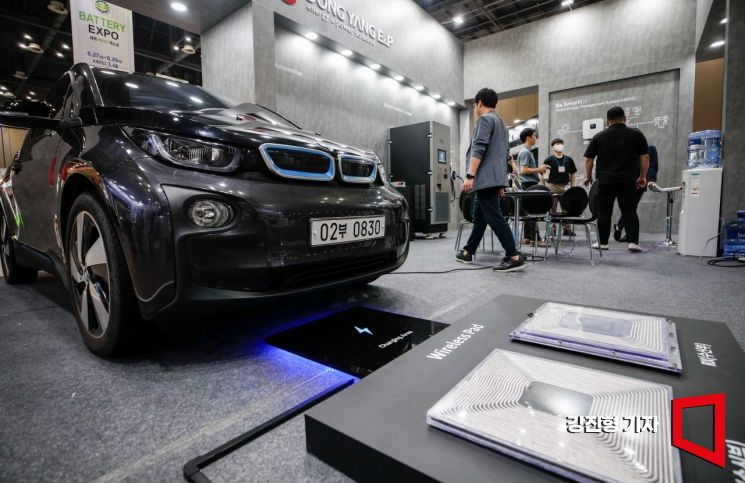 On June 27, a wireless electric vehicle charger was exhibited at the '2023 World Battery & Charging Infrastructure Expo - 2023 World Solar Energy Expo' held at KINTEX in Goyang, Gyeonggi Province. Photo by Jinhyung Kang aymsdream@
Recently, as China is expanding its global market with lithium iron phosphate (LFP) batteries that address previous shortcomings, domestic companies are solidifying their response strategy with mid-nickel (Mid-Nickel) batteries that reduce nickel content while enhancing performance.
Until now, domestic battery companies have focused on so-called high-nickel (High-Nickel) products that increase the proportion of nickel in cathode materials to raise energy density. High-nickel batteries offer good performance but are relatively expensive and less stable.
However, as price competition intensifies in the global electric vehicle market, demand for LFP batteries is increasing. As a result, the market share of Chinese battery companies is growing globally, creating a need for domestic companies to respond.
In this regard, at the 'Korea Advanced Battery Conference (KABC) 2023' hosted by energy market research firm SNE Research on the 14th, the three domestic battery companies attending commonly stated that they plan to counter Chinese LFP batteries with mid-nickel products that reduce nickel content.
Choi Seung-don, Executive Vice President and Head of the Automotive Battery Development Center at LG Energy Solution, said, "Price and safety are emerging as key factors in the future electric vehicle market," adding, "Reflecting this trend, we are focusing on high-voltage mid-nickel NCM (Nickel-Cobalt-Manganese) batteries that lower the proportions of nickel and cobalt while increasing voltage." He also mentioned, "We are in discussions with customers to supply products by 2025."
LG Energy Solution expects to target the mid-to-low price electric vehicle market with mid-nickel NCM batteries. They are developing this battery with a goal of achieving an energy density of 670 watt-hours per liter (Wh/L). This performance enables driving 500 to 600 km on a single charge. The charging cycle is expected to reach about 2,500 cycles. Assuming 500 km per charge, the battery life would last up to 1.25 million km.
Additionally, this product is expected to reduce heat generation by 30 to 40% compared to existing high-nickel products, thereby lowering the risk of fire. At the same time, the price will be set 8 to 10% lower than that of existing high-nickel NCM batteries. Since batteries account for 40% of the price of electric vehicles, lowering battery costs will reduce vehicle prices accordingly.
Samsung SDI has introduced NMX (Nickel-Manganese) and LMFP (Lithium-Manganese-Phosphate) batteries without cobalt in the cathode material as products targeting the mid-to-low price market. Rather than entering the LFP battery market where Chinese companies have already secured competitiveness, their strategy is to compete with products they excel at.
Ko Ju-young, Vice President and Head of Strategic Marketing at Samsung SDI’s Medium and Large Battery Business Division, said on the day, "It is already too late to enter the LFP market, so even if we start now, we cannot be competitive," adding, "Samsung SDI will respond to Chinese LFP batteries with NMX and LMFP batteries that we can do well."
Hwang Jae-yeon, head of technology development at SK On, also stated, "We plan to target the mid-to-low price market with less cobalt or cobalt-free batteries," adding, "We are also developing LFP batteries." Less cobalt and cobalt-free batteries are concepts similar to the mid-nickel and NMX batteries proposed earlier by LG Energy Solution and Samsung SDI.
Regarding solid-state batteries, Hwang said, "We are building a solid-state battery pilot line at the Daedeok Research Complex," and "It is scheduled to be completed by the end of next year."
In the first half of this year, excluding China, Chinese battery companies held a 32.9% market share in the global market (according to SNE Research data). The market share of batteries produced directly by Chinese automakers such as BYD also recorded 11.8%.
In the global electric vehicle battery market excluding China, LG Energy Solution, the world’s number one, holds a 28.7% share, narrowing the gap with China’s CATL at 27.2% to just 1.5 percentage points. Including China, CATL’s share of the global electric vehicle battery market is 36.8%, surpassing the combined share of the three domestic battery companies (23.8%).
Kim Kwang-joo, CEO of SNE Research, said, "Chinese companies are rapidly expanding their market share," and added, "Korean companies must respond to Chinese companies through various attempts."
© The Asia Business Daily(www.asiae.co.kr). All rights reserved.

















