The Cryogenic Society of Superconductivity Reveals New and Additional Reproduction Results from 3 Laboratories
None of the 6 Laboratories Show Superconducting Properties in Reproduction Experiments
The verification work by the domestic academic community on 'LK-99,' which claimed to be a room-temperature and ambient-pressure superconductor, has ultimately concluded negatively.
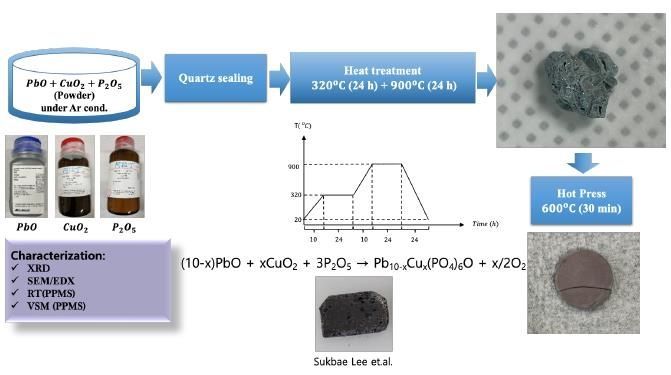
The LK-99 Verification Committee of the Korean Society of Superconductivity and Cryogenics announced on the 14th that three institutions?Kyung Hee University Energy Materials Quantum Properties Laboratory, Pusan National University Quantum Materials Laboratory, and Korea Research Institute of Standards and Science?conducted additional LK-99 reproduction experiments but failed to confirm superconductivity. First, the Kyung Hee University Energy Materials Quantum Properties Laboratory synthesized samples using the LK-99 paper’s manufacturing method and samples using another method expected to reduce impurities. However, the samples reproduced by the paper’s method contained many copper sulfide impurities, similar to the paper, and were insulators at room temperature, showing weak paramagnetic properties. The samples synthesized by the other method had no copper sulfide impurities but exhibited insulating characteristics at room temperature and weak diamagnetic properties under low magnetic fields.
The Korea Research Institute of Standards and Science also conducted LK-99 synthesis experiments according to the publicly disclosed synthesis method but did not obtain samples exhibiting superconductivity. The institute noted that there are too many materials besides the LK-99 substance that need to be specified, requiring a process to re-explore the manufacturing conditions. In experiments on the synthesis method showing the lead-phosphate present in LK-99, a sintering process was performed at 730?900°C for 10 hours to form particle agglomerates, resulting in a material exhibiting ferromagnetism but electrically behaving as an insulator.
The Pusan National University Quantum Materials Laboratory released additional measurement data following the first research results announced on the 31st of last month. They succeeded in synthesizing two types of samples?one with impurities and one nearly impurity-free?but both showed semiconductor characteristics in electrical resistance measurements.
Earlier, the Verification Committee disclosed reproduction results from four institutions?the Hanyang University High-Pressure Laboratory, Seoul National University Complex Materials State Research Group, Pohang University of Science and Technology Department of Physics, and Pusan National University Quantum Materials Laboratory?on the 31st of last month, but none showed superconducting properties.
The Verification Committee plans to continue reproduction experiments at participating institutions until the end of this month. They will also review foreign papers and experimental results, domestic reproduction research, and related papers to finalize the verification next month and publish it as a white paper.
Meanwhile, a domestic venture, 'Quantum Energy Research Institute,' published a paper on July 22 on the preprint site arXiv claiming to have developed 'LK-99,' a superconductor exhibiting zero electrical resistance and levitation phenomena at room temperature and ambient pressure. If true, this material could revolutionize the energy sector, enabling ultra-low power maglev trains, among other applications. This sparked a global wave of verification efforts for LK-99, but by the end of last month, the international journal Nature published an article concluding that it is 'practically not a superconductor,' leading to a negative consensus.
© The Asia Business Daily(www.asiae.co.kr). All rights reserved.
![Clutching a Stolen Dior Bag, Saying "I Hate Being Poor but Real"... The Grotesque Con of a "Human Knockoff" [Slate]](https://cwcontent.asiae.co.kr/asiaresize/183/2026021902243444107_1771435474.jpg)
















