As domestic demand in China declines due to an economic slowdown, the country is exporting steel products, which are in an oversupply situation, overseas at low prices. Governments and related companies around the world are busy preparing countermeasures. Our companies and government are also closely monitoring the damage caused by the large-scale distribution of Chinese products domestically and plan to develop response measures.
The Indian government has decided to extend the anti-dumping duty of $613 per ton on Chinese steel wheels (flat steel mainly used for tires), which has been imposed since 2018, for another five years, according to the Indian daily The Times of India. The Indian Ministry of Finance stated that the reason for extending the duty is that "Chinese steel companies are exporting steel products to third countries at dumping prices." From April to July this year, China sold 600,000 tons to India, a 62% increase compared to the same period last year.
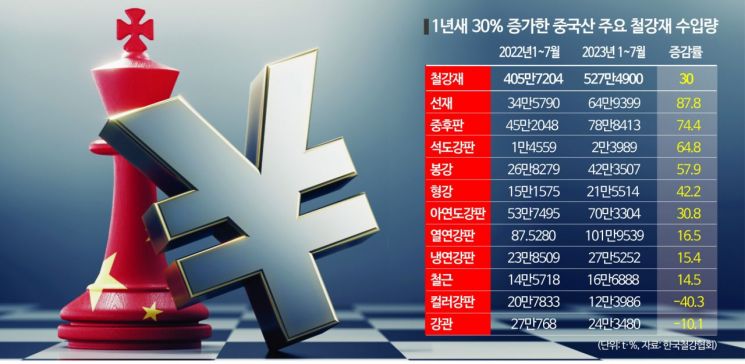
As the sluggish domestic market in China shows little sign of recovery, steel exports surged sharply in the first half of this year. According to data from the Steel Association, imports of Chinese steel products into the domestic market from January to July reached 5,234,900 tons, a 30% increase compared to 4,067,204 tons in the previous year. The item with the largest increase was wire rod, which rose 87.8% year-on-year. Wire rod is spring-shaped steel used in construction bolts and nuts, automobile parts, and bridges. Imports of heavy plates (74.4%), coated steel sheets (64.8%), and bars (57.9%) also increased significantly. In terms of volume, hot-rolled steel sheet imports (1,019,539 tons, a 16.5% increase) were the largest.
The United States and the European Union (EU) are working on creating the 'Global Sustainable Steel Agreement (GSSA),' which imposes high tariffs targeting China's overproduction.
Previously, during former President Donald Trump's administration in 2018, the U.S. took regulatory measures against China as its steel price competitiveness deteriorated due to China's overproduction. Applying Section 232 of the Trade Expansion Act, the U.S. imposed an additional 25% tariff on imported foreign steel. Although this measure was largely aimed at China, South Korea, the EU, and others were also affected. At that time, a tariff dispute arose as the EU retaliated with tariffs on U.S. imports.
Then, in October 2021, during President Joe Biden's European tour, the U.S. and EU agreed to temporarily suspend high tariffs on each other and to create a 'new agreement' to replace them by October 2023. This is the 'GSSA.'
With less than two months remaining until the October deadline to finalize the agreement, South Korea, another party, has not had the opportunity to express its views. Go Joon-sung, a senior researcher at the Korea Institute for Industrial Economics and Trade, said at 'Steel Korea 2023,' hosted by the Steel Association on the 12th at the POSCO Center in Gangnam-gu, Seoul, "This is a very unique negotiation taking place confidentially between the U.S. and the EU," adding, "If the GSSA is concluded, it will directly affect steel-producing and exporting countries like South Korea and Japan, but there is no opportunity to reflect their positions during the negotiation process." He pointed out, "From South Korea's perspective, it can only watch like a bystander, but if it is actually concluded, it will become our problem."
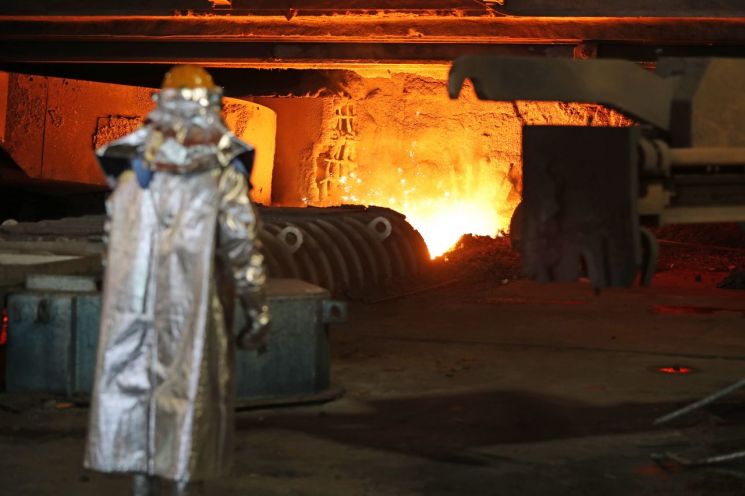 An employee working at the blast furnace to produce molten iron at POSCO Pohang Steelworks Blast Furnace No. 2 in Jecheol-dong, Nam-gu, Pohang-si, Gyeongbuk [Image source=Yonhap News]
There are also differences in positions between the U.S. and the EU regarding the GSSA. Senior researcher Go said, "The U.S. is interested in imposing tariffs of 25% or more if steel-producing countries like China exceed a certain amount of carbon emissions," while "the EU is more focused on encouraging participation in their decarbonization policies rather than regulating overproduction of steel in specific countries like China." Related to this, Professor Jo Yong-jong of Dankook University said, "Because there is a significant difference in positions between the U.S. and the EU, we need to quickly insert ourselves and express our opinions in trade matters."
Domestic companies have expressed that they will first observe the trend regarding China's overproduction. No domestic companies currently plan to file anti-dumping complaints or make proposals to the government concerning the increase in Chinese steel imports. If dumping causes profit losses or damage to domestic industries, the first step is to request dialogue through Korea-China public-private channels, and if no improvement occurs, the producing company files a complaint with the trade commission in its own country. They must submit 1 to 3 years of evidence proving decreased sales volume and market share. Anti-dumping duties have been imposed on Chinese stainless steel flat-rolled products since 2021.
A domestic steel industry official said, "Since China announced production cuts in the second half of the year, we plan to monitor the market situation and respond accordingly," adding, "We are closely watching for unfair practices related to carbon steel." Another official said, "Although imports of Chinese products have increased this year, we have not yet felt the impact directly." He explained, "Due to the economic downturn, the domestic home appliance and construction markets are weak, so domestic steel product prices have fallen significantly," and "Even if Chinese imports increase, large companies like shipbuilders and automakers do not easily change their existing steel suppliers."
China's daily crude steel production began to decline this month, and Baoshan Iron & Steel, China's largest steel producer, also announced it would reduce production this year. Lee Yoo-jin, a researcher at Eugene Investment & Securities, said, "As raw material prices rise sharply, China's blast furnace margins are falling again," and "China is expected to begin substantial production cuts in the third and fourth quarters of this year, similar to average years."
A government official said, "If companies file anti-dumping complaints, the quasi-judicial Trade Commission will actively review them," and "We are also maintaining close communication with companies regarding the GSSA."
© The Asia Business Daily(www.asiae.co.kr). All rights reserved.
![Clutching a Stolen Dior Bag, Saying "I Hate Being Poor but Real"... The Grotesque Con of a "Human Knockoff" [Slate]](https://cwcontent.asiae.co.kr/asiaresize/183/2026021902243444107_1771435474.jpg)












