The three major indices of the U.S. New York stock market showed an upward trend in the early session on the 13th (local time) as they digested the August Consumer Price Index (CPI) data that exceeded expectations. Although inflation concerns have resurfaced due to the recent rise in oil prices causing the August headline CPI to surpass forecasts, it is interpreted that this had little impact on the stock prices as concerns about an oil-driven rebound had already been raised.
At around 10:35 a.m. at the New York Stock Exchange (NYSE), the Dow Jones Industrial Average, centered on blue-chip stocks, was up 15.25 points (0.04%) from the previous close, standing at 34,661. The S&P 500, focused on large-cap stocks, rose 4.01 points (0.09%) to 4,465, and the tech-heavy Nasdaq index increased by 23.46 points (0.17%) to 13,797.
Currently, within the S&P 500, discretionary consumer goods, utilities, technology, and healthcare sectors are rising, while energy, industrials, materials, and real estate sectors are declining. Moderna rose nearly 6% following the recent resurgence of COVID-19 in the U.S. and the CDC’s recommendation for an upgraded vaccine version. Oracle, which fell more than 13% the previous day, is trading slightly higher. Ford rose over 2% as UBS raised its target price amid ongoing negotiations with the United Auto Workers union. On the other hand, oil company BP dropped more than 2% after CEO Bernard Looney resigned after about three years. Apple continued its decline despite unveiling the new iPhone 15 series the previous afternoon.
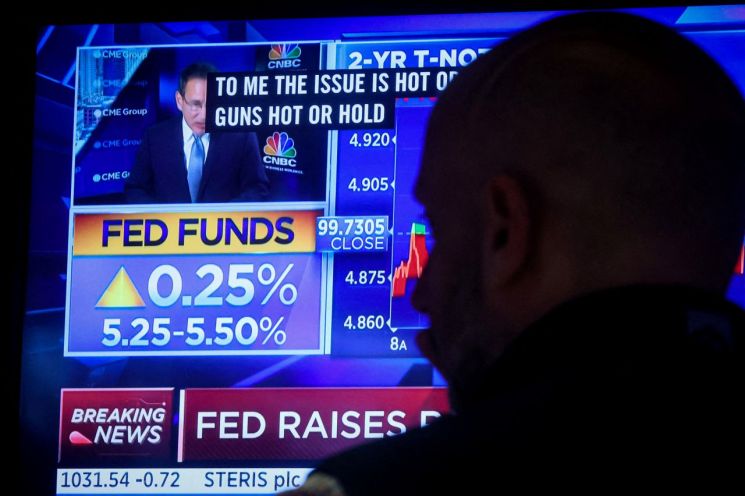
Investors closely watched oil price movements and inflation data ahead of next week’s Federal Open Market Committee (FOMC) meeting of the U.S. Federal Reserve (Fed). The August CPI data released before the market opened confirmed the impact of recent oil price increases. According to the Department of Labor, the August CPI rose 3.7% year-over-year, slightly exceeding Wall Street’s forecast of 3.6%. As initially expected, the pace of increase was steeper than July’s 3.2%. The month-over-month increase was 0.6%, matching expert forecasts but larger than July’s 0.2% rise.
This is analyzed as a result of rising international oil prices leading to consumer price increases, especially in gasoline. Gasoline prices jumped 10.6% compared to the previous month. Particularly, since the upward trend in oil prices is sustained, it is expected to become a factor that intensifies inflationary pressures going forward. West Texas Intermediate (WTI) and Brent crude oil prices, which hit their highest levels since November last year the previous day, are currently trading around $88 and $92 per barrel, respectively.
The rise in oil prices is expected to be a burden on the Fed, which is nearing the end of its tightening cycle. It not only increases inflationary pressure but may also prolong the Fed’s tightening longer than anticipated. Although energy prices are not included in the core Personal Consumption Expenditures (PCE) price index favored by the Fed, they indirectly raise costs across all sectors of the economy.
However, the August core CPI, which excludes volatile food and energy prices, rose 4.3% year-over-year, slowing from July’s 4.7% increase. Month-over-month, it rose 0.3%. Hugh Greaves, fund manager at Premier Milton US, told Bloomberg, "While the headline inflation rate has increased, the Fed will be relieved to see easing core inflation." He added, "The Fed’s concern is that rising energy prices are beginning to spread throughout the economy, reigniting worries about core inflation by year-end and increasing the risk of further rate hikes."
Currently, the market expects the Fed to hold interest rates steady at next week’s FOMC meeting while monitoring additional data and raising rates if necessary. According to the Chicago Mercantile Exchange (CME) FedWatch tool, federal funds futures this morning still reflect over a 97% probability that the Fed will keep rates unchanged in September. Greg McBride, chief financial analyst at Bankrate, told CNBC, "The Fed is prepared to hold rates steady at next week’s FOMC, but today’s CPI report, including gasoline prices and auto insurance, leaves concerns that the Fed may raise rates further," predicting "there will be additional rate hikes before the end of the year." There are three remaining FOMC meetings this year: September, November, and December.
On the following day, the U.S. Producer Price Index (PPI) for August, a wholesale price indicator, will be released. Since wholesale price increases typically pass through to consumer prices, this data is also closely watched. Retail sales for August will also be announced the same day. Wall Street expects retail sales, which had rebounded earlier, to slow this time. On the 15th, the University of Michigan’s consumer sentiment survey will be released.
In the New York bond market, the benchmark 10-year Treasury yield stands around 4.27%, while the 2-year yield, sensitive to monetary policy, is around 5.0%. The dollar index, which shows the value of the U.S. dollar against six major currencies, is steady around 104.7. The Chicago Board Options Exchange (CBOE) Volatility Index (VIX), known as Wall Street’s "fear gauge," has fallen more than 3% to 13.7.
European stock markets are also mixed. Germany’s DAX index is down 0.46%, France’s CAC index is down 0.48%, while the UK’s FTSE index is trading slightly higher.
© The Asia Business Daily(www.asiae.co.kr). All rights reserved.
![Clutching a Stolen Dior Bag, Saying "I Hate Being Poor but Real"... The Grotesque Con of a "Human Knockoff" [Slate]](https://cwcontent.asiae.co.kr/asiaresize/183/2026021902243444107_1771435474.jpg)















