Largest Hydrogen Exhibition 'H2 MEET 2023'
Held at Kintex, Ilsan, Gyeonggi-do from 13th to 15th
Hyundai Motor, POSCO, Hanwha and Other Major Companies
Aiming to Build Complete Hydrogen Value Chain
H2 MEET 2023, the largest hydrogen industry exhibition in Korea, has opened. This year, efforts by companies to approach the 'hydrogen economy,' which has become tangible with domestic liquefied hydrogen production by the end of the year, were evident. Hyundai Motor Company, POSCO, Hanwha Group, and others announced plans to secure the entire hydrogen value chain from production to transportation, storage, and utilization. Hyosung, which will start liquefied hydrogen production by the end of this year, Korea Zinc, which is producing hydrogen overseas based on its eco-friendly energy business, Kolon and SeAH, actively entering the hydrogen supply chain, and Doosan Group also added vitality to the exhibition.
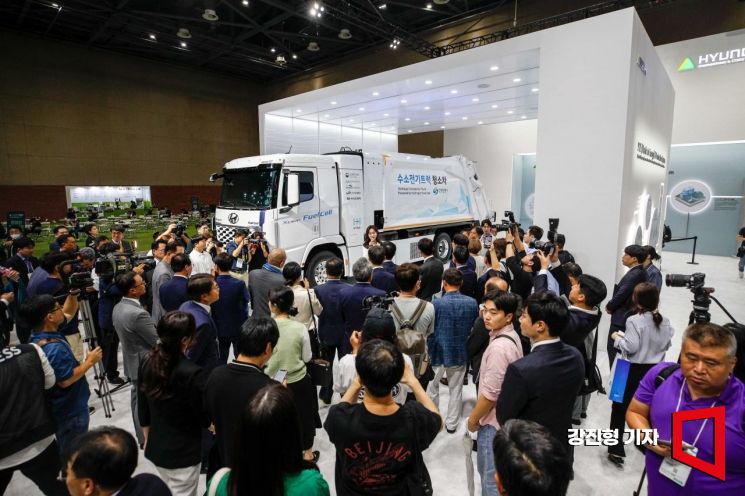 On the 13th, visitors attending 'H2 MEET 2023' held at Kintex in Goyang, Gyeonggi Province, are viewing Hyundai Motor Company's hydrogen electric truck garbage truck. Photo by Jinhyung Kang aymsdream@
Hyundai Motor: "Extracting Clean Hydrogen from Food Waste"
Hyundai Motor Group set up an exhibition hall with a concept covering the entire hydrogen industry value chain from production to utilization. The hydrogen fuel cell cleaning vehicle displayed on one side of the exhibition hall is a model based on Hyundai's hydrogen truck Xcient, the world's first mass-produced hydrogen truck. It was operated as a demonstration project in Changwon. The Xcient was first exported to Europe in 2020 and has been sold domestically since last year. The vehicle on display this time is a compressed garbage truck equipped with a facility that compresses waste at high density to reduce volume, capable of carrying up to 9.3 tons in an 18㎡ volume.
Together with other Hyundai Motor Group affiliates, they introduced a hydrogen toolbox concept with demonstration cases. It is an eco-friendly concept that uses environmentally friendly parts throughout the hydrogen production and supply process and minimizes carbon emissions during transportation. They introduced a resource-circulating hydrogen production method that utilizes waste resources. When biogas is generated from organic waste such as food waste, it is refined and reformed to be used as a raw material to extract clean hydrogen. Along with this, they also introduced a process that produces hydrogen from waste plastics through pretreatment and gasification processes. Hyundai Rotem exhibited extractors needed for hydrogen charging stations. Additionally, they introduced the H Moving Station, a mobile hydrogen charging station currently being piloted in Seoul, and a power unit module concept that expands the power output of hydrogen fuel cell power generation systems.
POSCO, Hanwha, and Others Aim for Full Value Chain... Producing 'Green Hydrogen' through Overseas and Eco-Friendly Energy
POSCO Group is focusing on hydrogen business to produce eco-friendly steel using hydrogen instead of coal, called 'hydrogen reduction steelmaking.' The sustainability of the steel industry, which is the largest emitter of carbon, depends on hydrogen. To this end, they are developing 'HyREX (Hydrogen Reduction Ironmaking),' a hydrogen reduction steelmaking technology based on fluidized bed reduction furnaces, and plan to complete its demonstration by 2030. They also plan to operate large-scale commercial plants to achieve carbon neutrality by 2050.
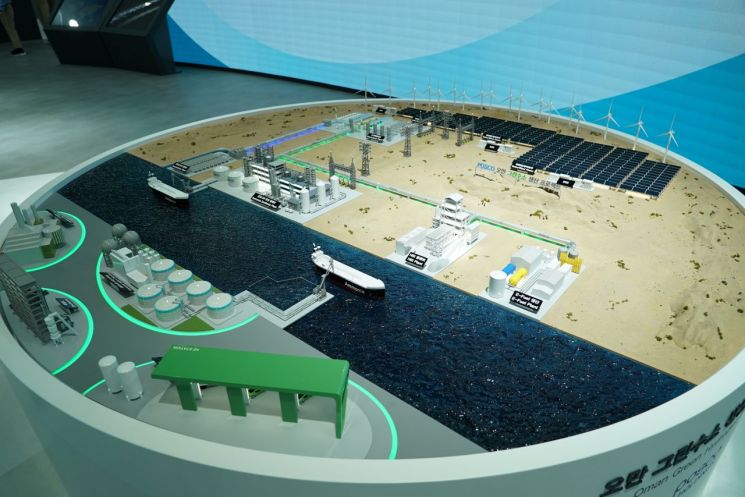
At the exhibition, they introduced clean hydrogen projects underway in nine key strategic countries including Oman, Australia, and the United States. The Oman green hydrogen project is the largest. It involves establishing a 5GW renewable energy complex and producing 220,000 tons of green hydrogen (hydrogen produced from renewable energy) annually. POSCO Holdings secured a large site in the Duqm region of Oman, equivalent to half the area of Seoul, in June.
Core technologies for hydrogen production are also nearing commercialization. Since hydrogen liquefies at -253°C, making storage and transport difficult, it is converted into ammonia for transportation. They unveiled ammonia cracking technology, which extracts hydrogen from ammonia, and 'high-temperature water electrolysis' technology that produces hydrogen by electrolyzing water at 700?900°C. The high-temperature water electrolysis technology, essential for producing clean hydrogen, aims to produce 20 kWh next year. A POSCO official said, "It operates the electrolysis device using waste heat from factories or steam from nuclear power plants," adding, "It is a highly efficient method that saves energy used to produce hydrogen."
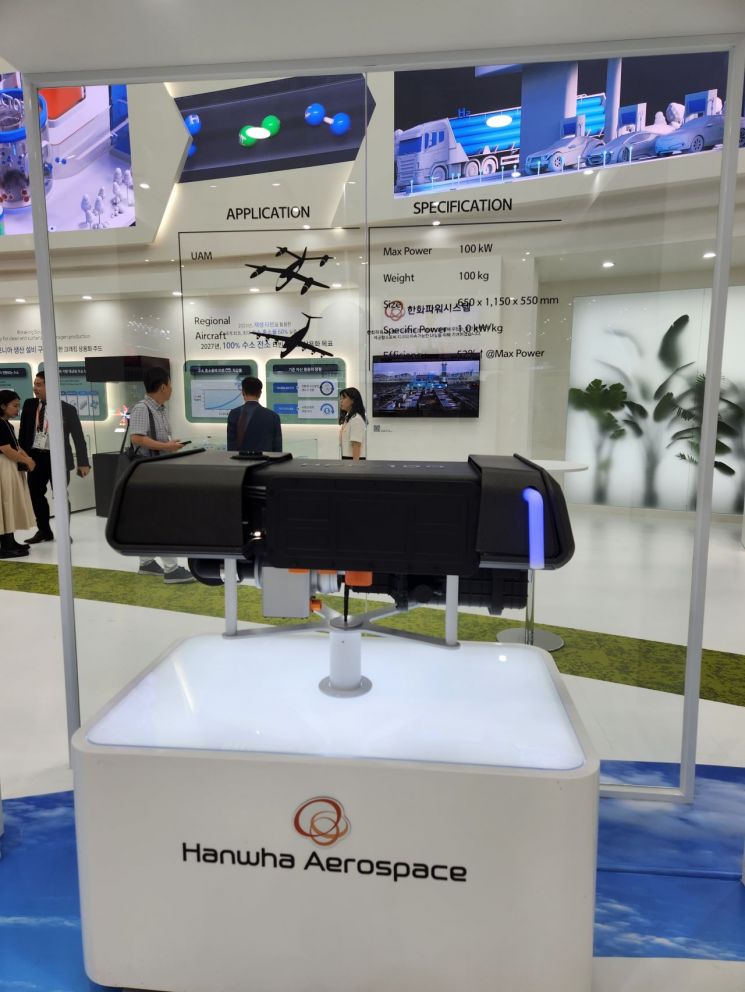
Hanwha Group aims to secure the hydrogen value chain through synergies among its major affiliates. They plan to produce green hydrogen using renewable energy such as solar panels produced by Hanwha Solutions and store and transport it in ammonia form via ships built by Hanwha Ocean. The accumulated hydrogen fuel will then be used as a power source for ammonia-powered ships and submarines, as well as Hanwha Aerospace's UAM (Urban Air Mobility). Hanwha Aerospace also showcased its self-developed hydrogen fuel cell at the event. A Hanwha Aerospace official explained, "Aircraft require high output, and batteries make them heavy, making long-distance flights difficult. Hydrogen fuel cell-powered UAMs are relatively lighter and can fly farther."
Korea Zinc revealed the roadmap including the status and value chain of its new growth engine 'Troika Drive,' which includes renewable energy and green hydrogen businesses. Since 2018, Korea Zinc has operated a 125 MW solar power plant, the largest in Australia at the time, at its Australian subsidiary SMC smelter. The SMC smelter receives 25% of its annual power demand from this solar power plant. They also established a local subsidiary, 'Arc Energy,' to actively enter the renewable energy business in Australia. Last year, Arc Energy acquired Epuron, a company with expertise in renewable energy development and operation, gaining about 9 GW of wind and solar development assets in Australia. They also secured a 30% stake in the MacIntyre Wind Farm, Australia's largest wind power construction project. Korea Zinc plans to link these renewable energy businesses with hydrogen production. In the long term, they plan to import green hydrogen and green ammonia produced in Australia to Korea to address domestic energy security issues and activate the hydrogen economy.
Domestic Liquefied Hydrogen Production Starting Late This Year... Expanding Hydrogen Value Chain
The domestic hydrogen industry is expected to reach a significant turning point with the start of liquefied hydrogen production by the end of this year. SK E&S will operate a liquefied hydrogen production plant with an annual capacity of 30,000 tons in Incheon in November. Hyosung Heavy Industries plans to complete a liquefied hydrogen production line with a capacity of 13,000 tons, and Doosan Enerbility will complete a line with about 1,800 tons capacity. SK E&S also plans to produce 250,000 tons of blue hydrogen (hydrogen produced with carbon capture and storage) near the Boryeong LNG terminal in Chungnam by 2026. The expansion of the domestic hydrogen industry is rapidly approaching.
Liquefied hydrogen has a volume 1/800th that of gaseous hydrogen. It allows transporting large amounts of hydrogen at once and has fast refueling speeds. Liquefied hydrogen production can be a turning point that broadens the range of hydrogen applications such as power generation and transportation and increases hydrogen's industrial influence. However, since the liquefaction temperature is -253°C, close to absolute zero, advanced technology and premium materials are required for storage and transportation.
Steelmaker POSCO showcased a hydrogen fuel tank made by mixing ultra-fine steel wire with a thickness of 0.12 mm and 'basalt fiber' extracted from basalt. Existing hydrogen fuel tanks are made by wrapping high-density plastic containers with expensive carbon fiber, but this is a substitute material. The price was reduced by about 30%. Kim Woo-seok, senior researcher at POSCO Steel Solutions Research Institute, said, "Although it is not yet commercialized, our own experiments through industry-academia-research cooperation showed that POSCO's hydrogen fuel tank withstood pressures up to 1575 bar (1 bar equals atmospheric pressure). Since steel is used, the tank is somewhat heavy and is expected to be used in commercial vehicles."
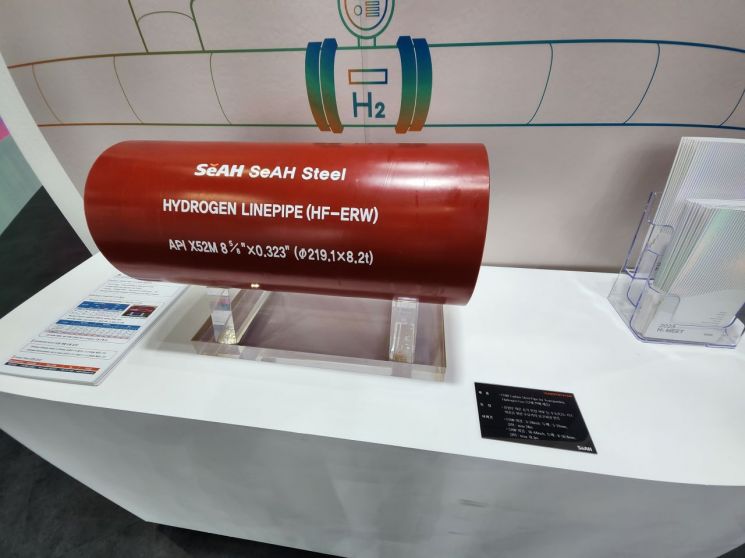
SeAH Steel, which specializes in manufacturing petroleum and LNG (liquefied natural gas) pipelines, exhibited pipes for hydrogen transportation. Gaseous hydrogen easily escapes through even small gaps, so a robust pipeline is necessary. Moon Hwan-cheol, assistant manager of SeAH Steel's sales team, said, "Previously, we imported seamless pipes (without welds) from Japan for hydrogen pipelines, but our product is a welded pipe with welds, making it more versatile."
Kolon Group presented a blueprint to produce green hydrogen through synergies between Kolon Global's wind power business and recycled energy, handling transportation and delivery as well. During the event, Kolon Industries and Kolon Plastics signed a memorandum of understanding (MOU) with 'RWE Renewables Korea,' a subsidiary of Germany's largest power company RWE, regarding renewable energy power supply and usage.
Doosan showcased Doosan Fuel Cell, Korea's top hydrogen fuel cell company. They presented clean energy solutions including the 'Fuel Cell Model 400 H2,' a zero-emission fuel cell powered by hydrogen, and a small power pack that can be easily attached to drones and other mobility devices. A Doosan Fuel Cell official said, "Doosan has installed fuel cells with a total capacity of 440 MW for power generation at over 40 locations domestically."
© The Asia Business Daily(www.asiae.co.kr). All rights reserved.
![Clutching a Stolen Dior Bag, Saying "I Hate Being Poor but Real"... The Grotesque Con of a "Human Knockoff" [Slate]](https://cwcontent.asiae.co.kr/asiaresize/183/2026021902243444107_1771435474.jpg)

















