As concerns over prolonged high interest rates persist, bond and deposit interest rates are rising, deepening borrowers' worries. The increase in funding costs is causing various loan interest rates, such as mortgage loans and long-term card loans (card loans), to gradually trend upward.
According to the Korea Financial Investment Association on the 14th, as of the 12th, the bond yield for 5-year bank bonds (AAA rating) was recorded at 4.441%. This represents an increase of 14.1 basis points (1bp=0.01%) compared to the end of the previous month (4.300%) and a rise of 35.7 basis points compared to the end of January (4.084%).
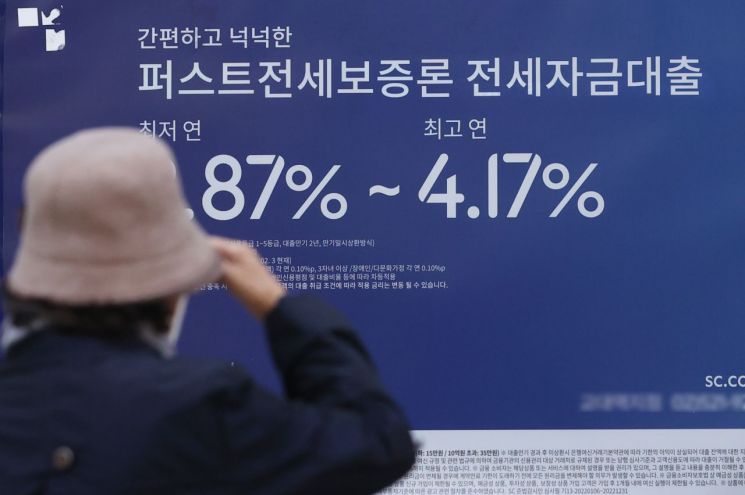
Typically, the 5-year bank bond yield is used as a benchmark interest rate for fixed (mixed) mortgage loans. An increase in bond yields directly leads to higher interest rates. The COFIX (Cost of Funds Index), which is the basis for calculating variable mortgage loan rates, is also affected since it reflects the weighted average interest rates of deposits and bonds handled by banks.
The deposit interest rates, another funding source for banks, are similarly rising. According to the Korea Federation of Banks, the one-year fixed deposit interest rates at the five major commercial banks (KB Kookmin, Shinhan, Hana, Woori, NH Nonghyup) have risen to the high 3% range, between 3.70% and 3.85%, with some banks offering deposit products in the 4% range. On the same day, K Bank raised the interest rate on its fixed deposit product, 'CodeK Fixed Deposit,' to 4%. For deposit terms between one year and less than two years, a 4% interest rate is applied without any special preferential conditions.
As funding costs rise, loan interest rates in the banking sector are also fluctuating. On the previous day, the variable mortgage loan interest rates (based on COFIX) at the four major banks ranged from 4.30% to 7.03%, with the upper limit rising by 10 basis points from 6.93% on the 22nd of last month, breaking into the 7% range.
The reason for the rise in bank bond yields is the growing concern that the U.S. Federal Reserve (Fed) will maintain its tightening stance for the time being, potentially prolonging the high interest rate environment. The U.S. 10-year Treasury yield surpassed the 4% mark at the end of last month, and the 3-year Korean government bond yield is also approaching the 4% range.
The situation is similar for specialized credit finance companies (card and capital companies), which are known as quick cash sources for ordinary people. Since these companies do not have deposit functions and raise funds through bond issuance, the rise in bond yields inevitably increases the burden on borrowers. Currently, the 3-year card bonds (AA+ rating) yield 4.584%, and the 3-year capital bonds (AA- rating) yield 4.926%. These represent increases of 70 to 100 basis points compared to their yearly lows (3.821% and 4.204%, respectively).
Accordingly, there is a strong possibility that card loan interest rates will also rise. According to the Credit Finance Association, as of last month, the average card loan interest rates at seven major card companies (Shinhan, Samsung, KB Kookmin, Hyundai, Lotte, Woori, Hana) ranged from 12.74% to 14.60%, showing a slight decline from the previous month but still remaining at high levels.
A financial industry official stated, "Recently, government bond yields have approached the 4% range, and the issuance of bonds by public enterprises aimed at policy financial supply is also increasing, which seems to be driving up financial bond yields," adding, "Even if the base interest rate remains unchanged for the time being, an increase in loan interest rates appears inevitable."
© The Asia Business Daily(www.asiae.co.kr). All rights reserved.
![Clutching a Stolen Dior Bag, Saying "I Hate Being Poor but Real"... The Grotesque Con of a "Human Knockoff" [Slate]](https://cwcontent.asiae.co.kr/asiaresize/183/2026021902243444107_1771435474.jpg)















