Diversifying Sales with Display, Semiconductor, and Solar Power
Subsidiary Phil Energy Targets 700 Billion KRW in Sales by 2027
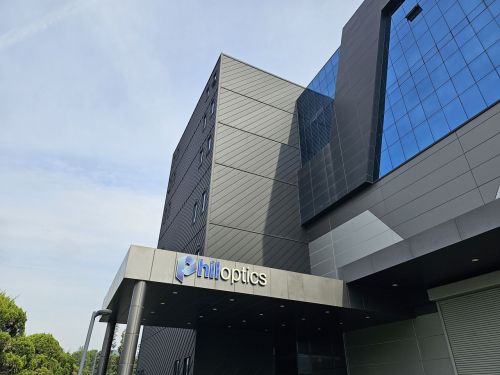
"We will diversify our business and strive to achieve sales of 300 billion KRW by 2027," said Kang Sang-gi, Vice President of Philoptics, during an investor relations (IR) meeting hosted by the KOSDAQ Association at the company's headquarters in Osan, Gyeonggi Province.
Philoptics was established in 2008. Initially, it started as a specialized display equipment company developing and producing equipment such as laser application devices, exposure machines, and laminators used in mobile device manufacturing. Recently, the company has expanded its business areas to semiconductors and solar energy. In the first half of this year, on a separate basis, sales reached 84.7 billion KRW, and operating profit was 700 million KRW. Compared to the same period last year, sales increased by 22.35%, but operating profit decreased by 83.64%.
At the IR held on the 4th floor of the headquarters, Vice President Kang emphasized that Philoptics is continuously striving to diversify its business. First, in the display business, the company expects to benefit from the increasing adoption of organic light-emitting diode (OLED) products. Philoptics owns numerous OLED devices for foldable and IT products utilizing laser technology. With the full-scale investment in 8.6-generation OLED for IT use, Philoptics has completed the development of core new process equipment. In June, the company received orders worth approximately 80 billion KRW for related equipment, some of which will be supplied within this year. Vice President Kang said, "Company A is continuously increasing its adoption of OLED," adding, "We expect this to be the inaugural year of OLED expansion."
Philoptics has identified the semiconductor packaging business as a new growth engine. With the recent increase in demand for high-performance computers driven by technologies like Chat GPT, there is expected to be a greater need for advanced packaging equipment capable of meeting these demands. Glass is becoming the mainstream material in packaging due to its advantages in cost reduction and power efficiency compared to silicon.
The equipment developed by Philoptics includes three types: TGV (Through Glass Via), which drills holes in substrates, DI exposure machines, and ABF UV drilling. Vice President Kang explained, "Initially, TGV had a high defect rate and took a long time, but we succeeded in improving it," adding, "Currently, the defect rate has been reduced to around 5%, and the processing time has been shortened from 10 hours to about 1 hour."
Finally, the company is preparing for a new business in solar energy. Utilizing its laser application technology, Philoptics is developing new equipment capable of supporting next-generation solar cells such as Perovskite. He emphasized, "The global trend is moving toward renewable energy, and as solar energy demand is expected to increase further, we will actively pursue related businesses."
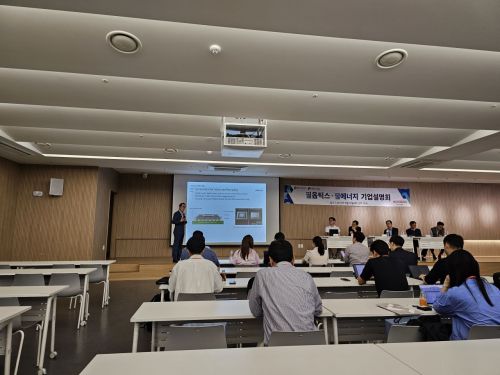
Philenergy, a subsidiary of Philoptics, also participated in the IR. Philenergy specializes in supplying integrated equipment that combines notching and stacking and entered the KOSDAQ market this year. Philenergy highlighted its greatest strength as the ability to smoothly supply products that customers want and need. Lee Hyung-no, Vice President of Philenergy, said, "Our products have faster production speeds compared to existing equipment and are automated and intelligent," adding, "This reduces labor costs for customers and improves productivity."
In addition to existing products, Philenergy is preparing 46XX battery winding equipment. The 46XX battery is a product adopted by Tesla and other automakers. The company expects significant growth potential. Vice President Lee emphasized, "Market interest in 46XX is growing, and it is expected to replace existing products rather than being a new growth product," adding, "We can operate according to customer specifications."
Philenergy is also preparing equipment suitable for next-generation batteries, including lithium-metal batteries and high-performance 3D batteries. Vice President Lee explained, "We expect to complete verification of lithium-metal batteries by the second half of next year and then make them public," adding, "We are preparing for high-performance batteries with a mid- to long-term market outlook rather than short-term." Through this, Philenergy aims to achieve sales of 700 billion KRW on a separate basis by 2027.
After concluding the IR, the team visited the company's production plant and research facilities. On the first floor, equipment for Philoptics and Philenergy was being manufactured. The first floor is divided into two factories, with one side filled with Philenergy's products. The company expects production volume to increase further once the second factory is completed.
Currently, construction is underway at Philoptics' headquarters. The second factory is being built next to the first factory, which is the headquarters. This factory will enhance the production capacity of Philenergy, a subsidiary of Philoptics. The company expects production capacity to increase from the existing 200 billion KRW scale annually to 500 billion KRW.
© The Asia Business Daily(www.asiae.co.kr). All rights reserved.
![Clutching a Stolen Dior Bag, Saying "I Hate Being Poor but Real"... The Grotesque Con of a "Human Knockoff" [Slate]](https://cwcontent.asiae.co.kr/asiaresize/183/2026021902243444107_1771435474.jpg)
















