Musk Biographer Isaacson Reveals Anecdote
"Ignored Warnings, Moved Server Himself
Regretted Experiencing Unstable Twitter Server"
Elon Musk, CEO of Tesla, revealed an anecdote about how he personally moved a large number of servers within days to cut costs after acquiring Twitter (now X) last year.
Despite Objections, Moved Servers Personally with Cousins and Close Associates
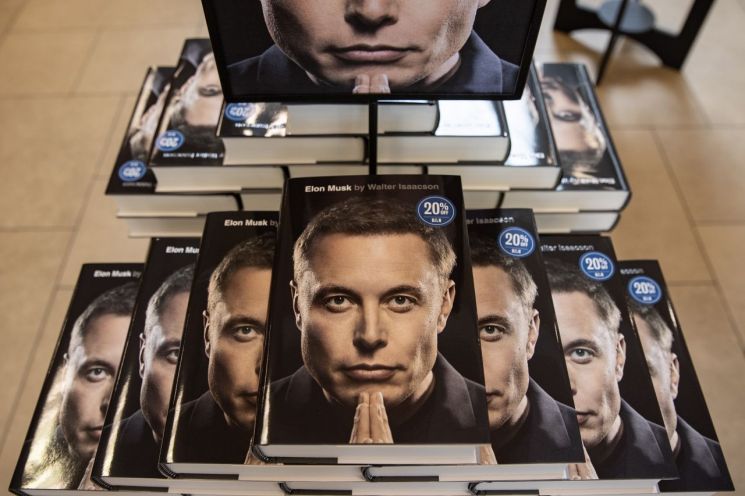 The biography of Elon Musk, written by American author Walter Isaacson, was displayed on the 12th (local time) at the Barnes & Noble store in Glendale, California, USA.
 [Image source=EPA·Yonhap News]
On the 12th (local time), U.S. financial media CNBC introduced an anecdote from a book excerpt by author Walter Isaacson, who wrote Musk's biography. The story took place on December 22 last year, when Musk received a report at Twitter's office that employees were discussing lease extension issues with the data center company managing and operating the servers.
After receiving the report, Musk did not want to entrust the servers to this data center in Sacramento, California, which charged $100 million annually (about 133 billion KRW). To save costs, he wanted to move the servers to Twitter's own facility in Portland, Oregon.
However, the person in charge of the task said that moving servers containing sensitive data required several complicated procedures and that "it would take about 6 to 9 months to safely relocate."
Upon hearing this, Musk threatened, "If you can't do it within 90 days, I want your resignation." Even though employees continued to oppose, he insisted, "If we hire a moving company, it takes one week to move the computers and another week to connect them, so two weeks in total."
The next day, Musk flew to the Sacramento data center with his cousins James and Andrew to inspect the servers. He then said, "It doesn't look that difficult to move," and proceeded with the plan to move the servers himself.
On Christmas Eve, the following day, Musk, along with his cousins and close staff members, personally purchased tools such as tracking devices for the server moving route and wrenches, then hired a moving van and began moving some servers themselves.
Although the task seemed simple, it actually involved moving about 5,200 racks, each weighing 2,500 pounds (1.13 tons) and standing 8 feet (2.4 meters) tall.
Upon hearing this, the data center company president advised that servers should be handled carefully and recommended hiring a professional company charging $200 per hour (about 270,000 KRW). However, Musk and his team found a company that could be hired immediately at one-tenth of that cost.
From the day after Christmas, they had workers from this company move about 700 server racks over three days.
Simple Move Without Protective Measures... Proved Fast Relocation but Regretted Server Instability
 This photo is not directly related to the content of the article. The photo is an example of the inside of a data center. [Image source=Yonhap News]
Isaacson reported, "Although many servers still remained at the facility, Musk personally proved that servers could be moved quickly."
However, Musk's server relocation was not entirely successful. Isaacson pointed out that Twitter's servers were unstable for two months after Musk moved them.
Musk himself reportedly admitted in March, "In hindsight, the Sacramento (data center) service outage was a mistake," acknowledging that his hasty decision caused technical problems with the servers, and that the issues still remain.
Isaacson explained, "This anecdote reveals Musk's maniacal impatience, recklessness, and intimidating style. In this way, he was able to build a car production line in a tent in Fremont and create a rocket launch site with used parts in Cape Canaveral, Florida."
Meanwhile, Isaacson's biography of Musk also included accounts of Musk enduring verbal abuse from his father during childhood, including ridicule that he would "never succeed," and noted that people around him believed Musk inherited some of his father's extreme personality traits.
Isaacson described Musk's father as "an engineer and villain who still torments Elon to this day."
Musk's cousin, Peter Rive, suggested that Musk may have inherited these traits from his father, saying, "When Elon is in a good mood, he seems like the coolest and most fun person in the world, but when he's in a bad mood, he becomes really dark, and those around him feel like they're walking on thin ice."
© The Asia Business Daily(www.asiae.co.kr). All rights reserved.
![Clutching a Stolen Dior Bag, Saying "I Hate Being Poor but Real"... The Grotesque Con of a "Human Knockoff" [Slate]](https://cwcontent.asiae.co.kr/asiaresize/183/2026021902243444107_1771435474.jpg)
















