Bank of Korea Releases August Monetary Policy Meeting Minutes
"Mixed Upward and Downward Factors... Need for Economic Structural Improvement"
"Corporate Debt and Non-bank Sector Must Be Managed"
At the meeting on the 24th of last month, the Monetary Policy Committee of the Bank of Korea agreed that while the base interest rate should be held steady at 3.5% for the fifth consecutive time, the possibility of a rate hike should remain open to reduce the accumulated household debt.
According to the minutes of the Monetary Policy Committee released by the Bank of Korea on the 12th, committee members voted to maintain the base rate considering the persistent financial imbalances and downside growth risks. One member explained, "Going forward, inflation is expected to generally follow the initial forecast path, but with increased downside risks to growth and expanding financial imbalances, the conflict between policy objectives appears to have intensified. Therefore, it is necessary to maintain the base rate at the current level and closely monitor changes in domestic and international conditions such as growth and inflation trajectories, financial stability, major countries’ monetary policies, and economic fluctuations."
Another member also judged that "there are mixed upward and downward factors surrounding the base rate decision." This member stated the reason for maintaining the rate freeze, saying, "Although inflation is on a downward trend, it is expected to remain above the target level for a considerable period, and risks in vulnerable areas such as real estate project financing (PF) have not been resolved." He added, "By the next meeting, we need to review core inflation trends, the won-dollar exchange rate and other financial market developments, the extent of household debt increase, the recovery speed of the real economy including the real estate market, and monetary policy decisions of major countries such as the U.S., to decide whether additional rate hikes are necessary."
Concerns about the expansion of household debt were clearly expressed again following the Monetary Policy Committee meeting on July 13. One member assessed that household debt is ultimately acting as a constraint on monetary policy. Another member said, "Housing prices have turned upward mainly in the Seoul metropolitan area, and household loans, especially those related to housing, have increased in scale," adding, "Given this situation, it is time to be cautious about the possibility of renewed accumulation of household debt due to delayed deleveraging."
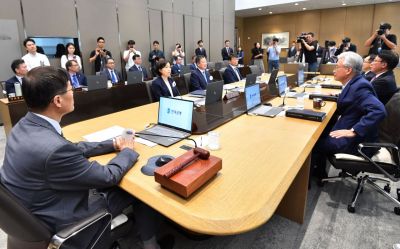 Lee Chang-yong, Governor of the Bank of Korea, is presiding over the Monetary Policy Committee meeting held at the Bank of Korea in Jung-gu, Seoul, on the morning of the 24th. / Photo by Joint Press Corps
There were also remarks about the need to manage the increasing corporate debt. One member said, "Corporate loans increased by 8.7 trillion won in July, continuing the upward trend, so management of corporate debt, along with household debt which is at the world’s highest level, is also required." Another member emphasized, "Along with domestic real estate price movements, the scale of household loan increases is growing, and the increase in corporate loans is also expanding, which are aspects that need to be carefully monitored."
Monetary Policy Committee members also pointed out the need to improve management of non-bank financial institutions. One member noted, "The rapid outflow of funds from some non-bank financial institutions appears to be calming down," but added, "The delinquency rate of non-bank financial institutions is still rising, so thorough preparation is necessary to prevent problems in vulnerable sectors from leading to instability in the financial system." Another member said, "As the Saemaeul Geumgo incident enters a calming phase, discussions on strengthening the soundness management and supervision of the non-bank sector are actively underway," warning, "If effective structural reform measures are not established and only temporary fixes are applied, similar situations could recur in the future."
There was also discussion about the need to improve the economic structure as the outlook for South Korea’s economic rebound remains uncertain amid the decoupling trends of major economies. One member said, "In the U.S. and Japan, growth exceeded expectations supported by recovery in service demand and strong employment, but China faces increased risks of structural growth slowdown due to prolonged export slumps and real estate market instability," adding, "With no clear improvement in export slumps centered on China, weakening consumption propensity due to aging, reduced consumption and investment capacity from debt accumulation, and deterioration in employment quality, structural growth constraints are intensifying, making a rapid rebound unlikely." Another member diagnosed, "It is uncertain whether the Chinese economy, which has served as the world’s factory by supplying cheap goods in large quantities, will continue to play that role. The expansion of trade and globalization trends that led economic growth accompanied by low inflation are also somewhat losing momentum due to changes in the international political and economic environment."
© The Asia Business Daily(www.asiae.co.kr). All rights reserved.
![Clutching a Stolen Dior Bag, Saying "I Hate Being Poor but Real"... The Grotesque Con of a "Human Knockoff" [Slate]](https://cwcontent.asiae.co.kr/asiaresize/183/2026021902243444107_1771435474.jpg)















