The Supreme Court has ruled that an empty water bottle that is not filled with water cannot be considered a 'dangerous object.'
This means that even if a person is assaulted or injured with an empty PET bottle, it cannot be subject to aggravated punishment under special assault or special injury charges.
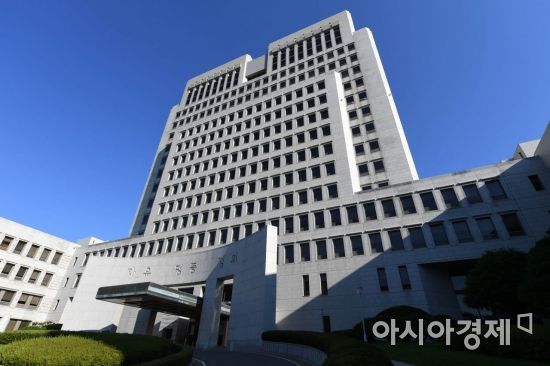
According to the legal community on the 12th, the Supreme Court's 3rd Division (Presiding Justice Lee Heung-gu) affirmed the original ruling that recognized guilt for injury and violation of the Stalking Punishment Act but ruled that special injury charges could not be established in the appeal trial of Jo (47), who was indicted for special injury and violation of the Stalking Punishment Act. Jo was sentenced to a fine of 3 million won.
Jo was indicted on charges of special injury for repeatedly striking the eye area of his girlfriend A (46) with a 2-liter water PET bottle from the laundry room on August 15, 2021, in Busan's Gijang-gun, causing injuries requiring two weeks of medical treatment, during an argument over communication issues.
Afterward, A notified Jo of their breakup and stopped contacting him. Jo continuously sent emails and called A, demanding to maintain their relationship, but A blocked his calls and refused to meet.
However, from October 21 to 25, 2021, Jo sent four emails expressing his desire to meet A, and on November 13 of the same year, he went to A's workplace, waited on the stairs as A was leaving, and watched her get into a car and leave.
The prosecution considered the 2-liter PET bottle a dangerous object and indicted Jo for special injury and violation of the Stalking Punishment Act.
The first trial court found Jo guilty on both charges and sentenced him to two years in prison with a four-year probation. The court also ordered probation, 120 hours of community service, and 80 hours of stalking crime recidivism prevention education.
Jo claimed that although he splashed water from the PET bottle on the table, he did not repeatedly strike A's eye area with the bottle. He also argued that even if he had struck her with the bottle, it was not a dangerous object, so the prosecution's indictment for special injury was incorrect.
The Criminal Act stipulates that carrying a dangerous object and assaulting or injuring a person results in aggravated punishment considering the danger involved.
While the statutory penalty for general assault is 'imprisonment for up to 2 years, a fine of up to 5 million won, detention, or a minor fine,' special assault carries 'imprisonment for up to 5 years or a fine of up to 10 million won.' Injury is punishable by 'imprisonment for up to 7 years, disqualification for up to 10 years, or a fine of up to 10 million won,' whereas special injury carries a statutory penalty of 'imprisonment for 1 to 10 years' with no fine option.
Regarding the stalking charges, Jo argued that although he sent emails and visited A's workplace, it was to apologize, and he did not cause A any anxiety or fear.
The first trial court rejected Jo's claims.
The court found A's testimony, stating that Jo brought three 2-liter PET bottles from the laundry room one after another, splashed water on her, poked her, and that she bled after being hit by the bottle even though she could not recall exactly when, to be quite detailed and credible, including vivid details that would be difficult to fabricate without direct experience.
The court also stated, "There is no reason to believe that A is fabricating false facts to testify unfavorably against Jo despite the risk of perjury punishment, and the credibility is objectively supported by photos taken at the scene and of A's face immediately after the incident."
Regarding the claim that the PET bottle could not be considered a dangerous object, the court stated, "Considering that the bottle likely weighed significantly if filled with water, that repeatedly striking the victim with the hard cap part of the bottle can reasonably cause bodily harm from the perspective of the victim or a third party, that clear wounds caused by the bottle cap were confirmed on the victim's eyelid and eye area immediately after the incident, and that according to the credible testimony of the victim, the intoxicated defendant repeatedly struck and shook the bottle at the victim while repeatedly saying 'die,' it is reasonable to consider the bottle a 'dangerous object' as defined in Article 258-2 of the Criminal Act."
However, the second trial court's judgment differed.
In the appeal, Jo's side argued, "While splashing water from the bottle on A, when most of the water had been emptied, I unintentionally struck A's left eye area once with the bottle cap opening during the motion of splashing water again, but I did not strike her multiple times."
They also emphasized, "An almost empty PET bottle cannot be considered a 'dangerous object' under special injury charges, so assault causing injury or injury charges should apply."
The court accepted these claims.
The court judged, "Based solely on the evidence submitted by the prosecution, it is insufficient to recognize that Jo struck A's eye area with a fully filled water bottle."
The basis for this judgment included: ▲A did not explicitly state to investigators that she was hit by a fully filled water bottle; ▲in the first trial court, when asked by the prosecutor, "Was the bottle that hit you a new one with the cap unopened?" A answered, "I don't know"; ▲and no unopened bottles were visible in the photos of the scene.
The court further stated, "An empty PET bottle that is not filled with water is difficult to consider an object that could cause life or bodily harm to the victim or a third party," and recognized Jo's guilt for simple injury.
The second trial court also found Jo guilty of violating the Stalking Punishment Act.
However, the court took into account favorable sentencing factors such as ▲Jo having no criminal record exceeding a fine, ▲his promise not to contact A anymore, and ▲the amicable settlement reached during the appeal trial by paying A 10 million won, reducing the fine to 3 million won.
The Supreme Court also found no problem with the second trial court's judgment.
© The Asia Business Daily(www.asiae.co.kr). All rights reserved.
![Clutching a Stolen Dior Bag, Saying "I Hate Being Poor but Real"... The Grotesque Con of a "Human Knockoff" [Slate]](https://cwcontent.asiae.co.kr/asiaresize/183/2026021902243444107_1771435474.jpg)















