In the process of restructuring the global semiconductor supply chain, it is diagnosed that the greatest damage is likely to be suffered by Samsung Electronics and SK Hynix, who are subject to the licensing decisions of the United States.
On the 11th, the Korea Institute for International Economic Policy (KIEP) stated in its report on the 'Restructuring of the Global Semiconductor Supply Chain' that Korean companies with factories in China are likely to suffer the most damage during the restructuring process of the global semiconductor supply chain.
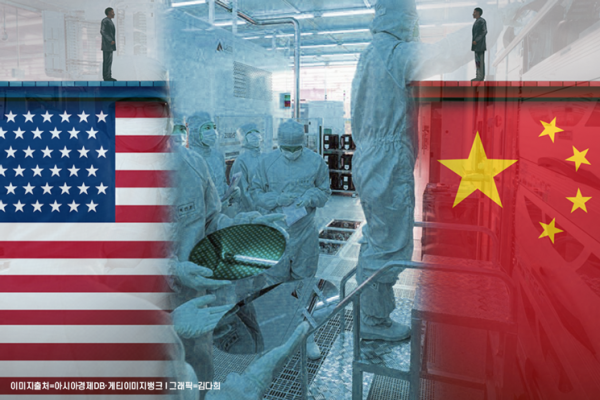
In October last year, the U.S. Department of Commerce announced export controls that effectively prohibit U.S. companies from exporting semiconductor equipment to Chinese semiconductor manufacturers. However, a one-year exemption was granted to Korean and Taiwanese companies such as Samsung Electronics, SK Hynix, and TSMC, and a decision on whether to extend this exemption will be made again in October. Nevertheless, KIEP expressed concerns that "even if the U.S. grants licenses, it can always strengthen sanctions against China, making it difficult for our companies to conduct business in China and increasing uncertainty."
Although TSMC also needs to obtain a license from the U.S., the U.S. sanctions are much stronger in memory production (which accounts for 90% of China's advanced capacity) compared to logic chip production (which accounts for only 10% of China's advanced capacity). Memory fabs need to be regularly upgraded to maintain competitiveness, but since U.S. approval is required, the impact of sanctions is relatively much greater.
Currently, SK Hynix produces about 50% of its total DRAM at its Wuxi plant in China, which began production in 2006. Additionally, in 2010, SK Hynix established a post-processing joint venture with a Chinese company in Wuxi, creating an integrated production system for semiconductor wafer processing (front-end) and post-processing. In 2018, its subsidiary SK Hynix System IC established a foundry plant in Wuxi to perform contract manufacturing of system semiconductors. Samsung Electronics has also built and is operating an integrated production system including a post-processing line producing NAND flash in Xi’an, China.
Jung Hyung-gon, Senior Research Fellow at KIEP’s Center for World Regional Studies, said, "Overseas investment by Korean semiconductor companies was overwhelmingly concentrated in China from 2005 to 2020, but at present, there is serious concern about the impact of sanctions." He added, "The U.S. is considering that early and strong control over memory fabs in China could cause major disruption in the global memory chip market, but it may gradually strengthen controls in the future, so preparation is necessary." He further explained, "Ultimately, to produce advanced chips, Samsung Electronics and SK Hynix will need to build new plants outside China, which will result in preserving the losses of equipment companies including those in the U.S."
Accordingly, the need to strengthen the semiconductor manufacturing hub strategy in Korea is expected to grow. This is because, not only to eliminate future uncertainties in the U.S.-led global semiconductor supply chain restructuring process but also for the survival of our companies, it is necessary to enhance domestic semiconductor production capabilities, such as strengthening support measures for semiconductor company reshoring. Senior Research Fellow Jung said, "The cost of building a new fab in the U.S. can be 30% higher (an average of $6 billion) than building the same fab in Taiwan, Korea, or Singapore, and up to 50% higher than in China," adding, "the U.S.-China semiconductor hegemony war is an ongoing conflict, so it is necessary to increase domestic semiconductor production capacity and strengthen the semiconductor manufacturing hub strategy."
© The Asia Business Daily(www.asiae.co.kr). All rights reserved.
![Clutching a Stolen Dior Bag, Saying "I Hate Being Poor but Real"... The Grotesque Con of a "Human Knockoff" [Slate]](https://cwcontent.asiae.co.kr/asiaresize/183/2026021902243444107_1771435474.jpg)
















