Net Buying Focused on Dividend Stocks This Month After 3 Consecutive Months of Selling Pressure
Bank Stocks Achieved Excess Returns Over KOSPI for 3 Consecutive Weeks Until Last Week
Average Dividend Yield of Banks Around 7.3% Based on Current Stock Prices, Showing High Dividend Appeal
Foreign investors, who had been selling for three consecutive months, have started net buying this month, focusing on dividend stocks. In particular, bank stocks have shown strong performance as foreign investors have steadily purchased them.
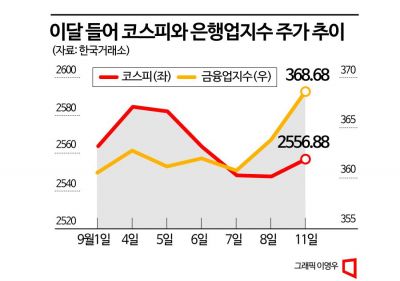
According to the Korea Exchange on the 12th, the KOSPI Financials Index rose 1.75% this month, outperforming the KOSPI, which increased by only 0.02% during the same period. During this time, KB Financial rose 2.03%, Shinhan Financial Group 2.53%, Hana Financial Group 2.91%, and Woori Financial Group 1.60% respectively.
Choi Jung-wook, a researcher at Hana Securities, said, "Bank stocks have shown excess gains compared to the KOSPI for three consecutive weeks until last week," adding, "Although there are no significant special issues, the attractiveness of banks as defensive stocks amid the ongoing rise in market interest rates and the improved supply-demand conditions due to foreign investors’ net purchases of over 30 billion KRW in bank stocks for two consecutive weeks are estimated to be the main reasons behind the strong stock performance."
Foreign investors, who had been net sellers for three consecutive months until last month, have turned to net buying this month and have been steadily purchasing dividend stocks including bank stocks. Foreign investors bought 28.5 billion KRW of Shinhan Financial Group, 21 billion KRW of Hana Financial Group, and 20.7 billion KRW of Woori Financial Group this month.
The biggest reason foreign investors have been steadily buying bank stocks recently is dividends. Lee Jae-sun, a researcher at Hyundai Motor Securities, explained, "September is the time when investors start buying dividend stocks by considering both stock price gains and dividend income, and foreign investors have recently shown interest in high-dividend sectors," adding, "Among the top five sectors in terms of foreign net buying intensity in September are traditional high-dividend sectors such as banking, insurance, and telecommunications."
The dividend appeal of bank stocks is still considered high. Researcher Choi said, "Although there is uncertainty due to the scale of special loan loss provisions and the introduction of stress buffer capital, these factors may suppress the increase in dividend payout ratios but are very unlikely to cause a reduction in dividend payout ratios," and analyzed, "Based on current stock prices, the average dividend yield of banks is about 7.3%, so the dividend appeal remains very strong."
There is also performance expectation as the decline in net interest margin (NIM) is expected to ease. Researcher Choi said, "Due to the increase in low-cost deposits, the repricing of high-interest funding from the second half of last year, and rising loan interest rates, the average NIM decline for banks in the third quarter is expected to be within 1 to 2 basis points (1bp = 0.01 percentage points)," adding, "In the fourth quarter, the quarterly NIM decline trend is expected to stop, and the annual increase in bank NIM for this year is expected to be about 3 to 4 basis points."
Compared to other dividend stocks, the relatively low foreign ownership ratio in market capitalization is expected to attract additional foreign buying. Researcher Lee said, "Since 2000, foreign investors have started increasing their holdings in telecommunications, insurance, and banking sectors from September. This year, the insurance sector’s foreign market capitalization growth rate is similar to the past due to performance improvement expectations from the introduction of the new International Financial Reporting Standard (IFRS17), but telecommunications and banking sectors show slower foreign market capitalization growth compared to the past, suggesting the possibility of additional foreign buying inflows," and added, "In particular, the foreign ownership ratio in banks has decreased compared to the past due to weakened investor sentiment amid global financial risk concerns in the first half of the year, and the increased corporate demand for bank loans due to higher corporate bond yields is expected to positively affect performance outlooks."
© The Asia Business Daily(www.asiae.co.kr). All rights reserved.
![Clutching a Stolen Dior Bag, Saying "I Hate Being Poor but Real"... The Grotesque Con of a "Human Knockoff" [Slate]](https://cwcontent.asiae.co.kr/asiaresize/183/2026021902243444107_1771435474.jpg)
















