Be Cautious of Factors Causing Supply-Demand Volatility as Key Stock Market Variables
Volatility Expected to Increase in Stocks with High Individual Net Buying and Large Short Selling Ratios
Foreign Investor Supply-Demand Trends Also Unstable Due to Strong Dollar, US-China Conflict, and High Oil Prices
As negative investment environments such as a strong dollar and high oil prices continue, the difficulty of investing in the domestic stock market is increasing. In particular, supply and demand are expected to emerge as the most important variables, leading to widespread advice to avoid factors that cause supply-demand volatility. There is a growing voice urging caution regarding stocks with concentrated individual net buying and those with increasing short-selling balances.
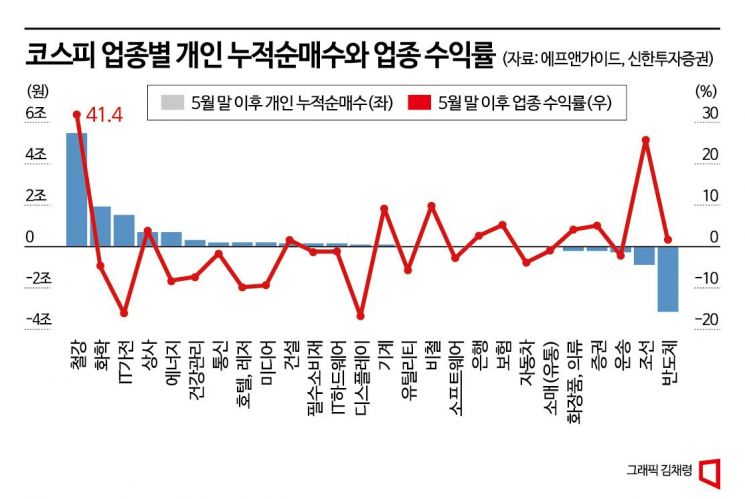
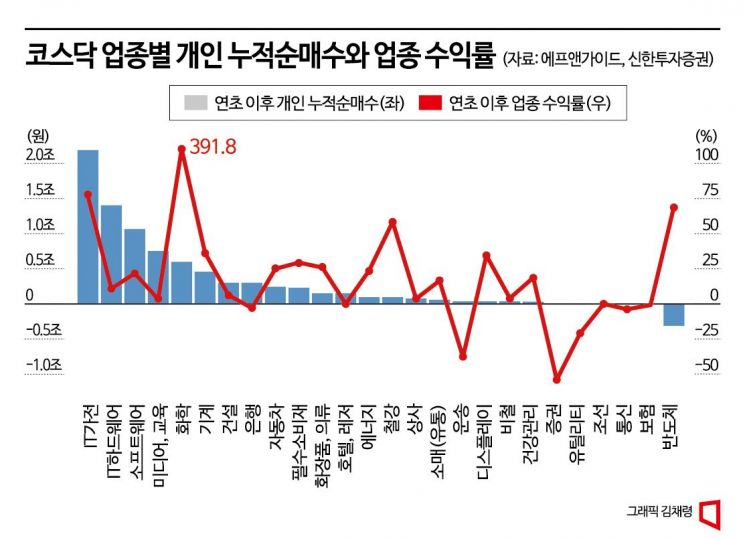
According to the Korea Exchange on the 12th, the average proportion of individual investors' trading in the KOSPI in August was 58.3%, and in the KOSDAQ, it was 80.1%. This is why it is said that individuals are the dominant supply-demand players in the domestic stock market. The previously observed concentration phenomenon and individual stock market trends are also partly the result of the expanded investment share of individuals. Especially as the year-end approaches, there is concern that the volatility of the top individual net buying stocks may increase due to intensified selling pressure from individuals. Labor Gil, a researcher at Shinhan Investment Corp., said, "As the year-end approaches, the emerging variable is individual net selling aimed at avoiding capital gains tax," adding, "Volatility caused by individual net selling this year is expected to be greater than ever."
Increased Year-End Volatility in Top Individual Net Buying Sectors and Stocks
Since 2010, individual supply-demand in the KOSPI during the fourth quarter has been net selling except in 2018 and 2020. The year 2020 was characterized by a clear liquidity-driven market. Considering that new funds were flowing in, individuals effectively showed a selling trend. Researcher Noh said, "Considering the monthly average and cumulative monthly individual net buying in the KOSPI since 2005, clear selling trends can be observed in November and December," and warned, "Sectors and stocks that experienced significant gains relying on individual net buying should prepare for fluctuations as the year-end approaches." Conversely, sectors or stocks with large individual net selling from a supply-demand perspective may be less affected by supply-demand volatility.
Analyzing the cumulative net buying and sector returns of the KOSPI since the end of May, when individual net buying began in earnest, the sector with a large proportion of individual net buying and relatively high returns was steel. Since the end of May, individual cumulative net buying and returns in steel were 5.5 trillion KRW and 41.4%, respectively. Individual net buying was also observed in secondary battery-related stocks such as chemicals and IT home appliances, but sector returns were negative. Researcher Noh analyzed, "The target to prepare for fluctuations caused by individual net selling at year-end in the KOSPI is the secondary battery value chain within the steel sector," adding, "Conversely, semiconductors, shipbuilding, securities, and cosmetics showed positive returns since the end of May but were targets of individual net selling, so they may be outside the influence of year-end net selling."
In the KOSDAQ, the top sectors for individual net buying are IT home appliances, IT hardware, software, media, chemicals, and machinery. Notably, the remarkable returns in IT home appliances, chemicals, and machinery suggest these sectors may be subject to net selling aimed at avoiding capital gains tax. Despite high returns since the beginning of the year, the semiconductor sector in the KOSDAQ experienced individual net selling. Therefore, the influence of individual net selling aimed at avoiding capital gains tax at year-end is likely to be relatively small.
Need for Caution Regarding Stocks with Increasing Short-Selling Proportions
Short selling is also a major variable in supply-demand volatility. Kim Dae-jun, a researcher at Korea Investment & Securities, explained, "Market directionality can be influenced by the inflow and outflow of money," adding, "Especially for stocks included in the KOSPI 200 and KOSDAQ 150, supply-demand trends are very important, and these stocks are exposed to short-selling pressure, which can increase price volatility." He continued, "It is necessary to be cautious about stocks where short-selling balances are increasing or where the short-selling proportion relative to trading volume is expanding."
Among KOSPI stocks with increasing short-selling balances, Hanmi Science, Hyundai Rotem, Kangwon Land, Boryung, and GS Retail were noted. In the KOSDAQ, Classys, EcoPro, POSCO DX, Dongwha Enterprise, and Seongwang ranked accordingly. Stocks with decreasing short-selling balances in the KOSPI included Emart, KCC, Doosan Bobcat, HL Mando, and Hansol Chemical. In the KOSDAQ, Rainbow Robotics, Eugene Tech, SM, Pharma Research, and Maeil Dairies showed significant decreases in short-selling balances.
The reason for caution regarding variables that influence supply-demand volatility stems from the current stock investment environment. Recently, a strong dollar and high oil prices have continued. Researcher Kim pointed out, "The strong dollar directs global liquidity toward the U.S., making it the most critical variable for the Korean stock market, which is sensitive to overseas supply-demand." Rising oil prices are also a negative issue for the domestic stock market, as oil typically acts as a cost variable, negatively affecting most stock prices except for some sectors. Geopolitical risks are also escalating. The sharp confrontation between the U.S. and China, the two pillars of the global economy, is dampening investment sentiment. Uncertain external economic conditions and unstable movements in neighboring countries also impact the domestic stock market. This is why the KOSPI is currently struggling to find a clear direction.
Researcher Kim noted, "Foreign investors, who can be considered the 'big players' in the Korean stock market, are reacting negatively to exchange rate changes," adding, "If the strong dollar continues, foreign investors' trading trends may also turn unfavorable." Therefore, there is a judgment to focus more on stock market supply-demand. Kim advised, "If focusing only on large-cap stocks, it is necessary to look at stocks with moderate short-selling intensity and favorable profit momentum."
© The Asia Business Daily(www.asiae.co.kr). All rights reserved.
![Clutching a Stolen Dior Bag, Saying "I Hate Being Poor but Real"... The Grotesque Con of a "Human Knockoff" [Slate]](https://cwcontent.asiae.co.kr/asiaresize/183/2026021902243444107_1771435474.jpg)
















