One Year After Sindang Station Incident
'Incheon Stalking Murder' and Others Persist
Legal Scope for Stalking Judgment Conservative
Weak Punishment Standards Lead to Many Suspended Sentences
It has been one year since the ‘Sindang Station Incident,’ where a female station attendant was murdered due to stalking on September 14 last year, but stalking-related violent crimes continue unabated, including the recent murder of a woman who was being stalked in Incheon.
On the 8th, the bereaved family of the ‘Incheon Stalking Murder Case’ posted on an online community a message titled “My sister died after being tormented by stalking,” revealing the real name and photo of the victim, Lee Eun-chong. According to the post, Lee Eun-chong was wearing a police-issued stalking prevention smartwatch at all times but returned it following a police request to “return the smartwatch if your movements do not overlap with the perpetrator’s.” Four days after returning the watch, she was murdered by the stalking man. The police denied having requested the return of the smartwatch.
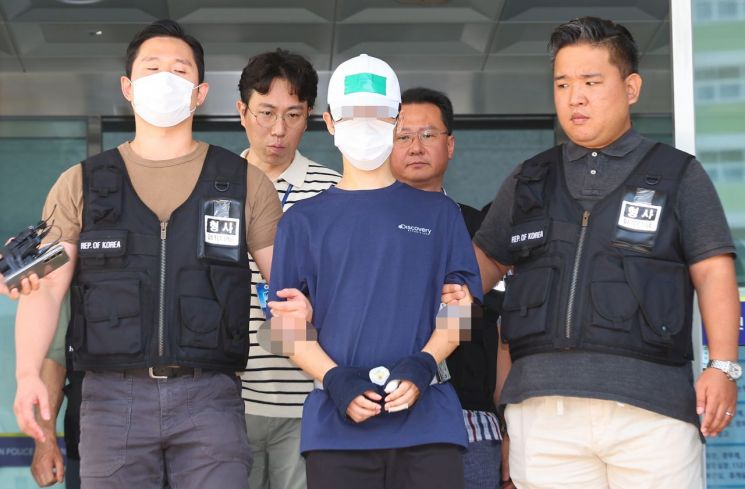 A man in his 30s, Mr. A, who was arrested on charges including stalking and murder in the hallway of an apartment in Incheon, was transferred from Incheon Nonhyeon Police Station to the prosecution on the morning of July 28. [Image source=Yonhap News]
Such incidents are pointed out to be due to the still insufficient system for punishing stalking crimes and supporting victims.
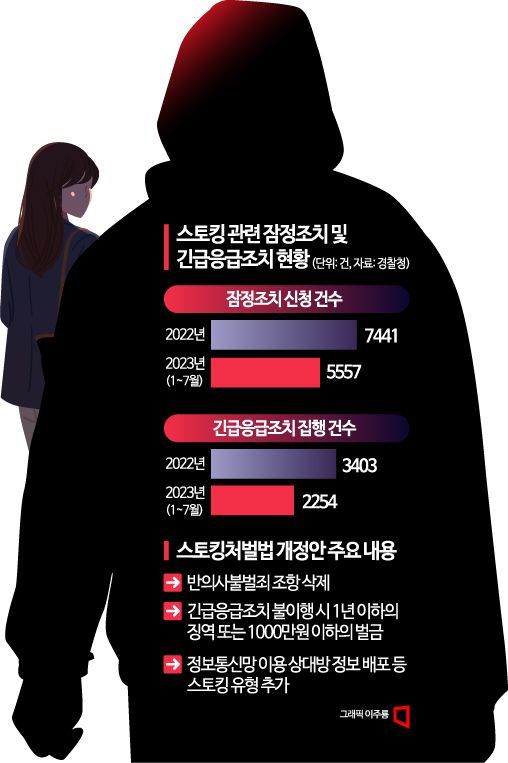
According to the National Police Agency, from January to July this year, the number of emergency protective measures executed and provisional measures requested under the ‘Act on the Punishment of Stalking Crimes (Stalking Punishment Act)’ were 2,254 and 5,557 cases, respectively. If this trend continues, it is expected that by the end of this year, the total number of emergency protective measures executed (3,403 cases) and provisional measures requested (7,441 cases) for last year will be exceeded. Emergency protective measures, such as prohibiting approach within 100 meters and banning communication via mobile phones, are enforced by the police, while provisional measures, including written warnings, attachment of location tracking devices, and detention in a detention center for up to one month, are enforced by court decisions.
Following criticism of the shortcomings in the stalking crime punishment system during the Sindang Station incident, the revised Stalking Punishment Act was implemented on July 11. The ‘non-prosecution upon victim’s withdrawal’ clause was removed, and stalking types were expanded to include acts such as distributing the victim’s information via information and communication networks or making writings, speech, codes, sounds, pictures, videos, or images appear to the victim through information and communication networks or telephone. Penalties for non-compliance with emergency protective measures, which were previously fines of up to 10 million won, were strengthened to imprisonment of up to one year or fines of up to 10 million won. The Act on Prevention of Stalking and Protection of Victims (Stalking Prevention Act), which supports stalking victims, was newly established in January. It focuses on providing protection services to victims of stalking crimes and their families.
However, there are still criticisms that punishment for offenders is weak. An analysis by the Korean Women’s Development Institute and the Sentencing Research Association of 385 single crimes violating the Stalking Punishment Act with first and second trial sentences from January to May this year showed that suspended prison sentences were the most common with 126 cases (32.7%). This was followed by fines in 106 cases, actual prison sentences in 21 cases, and suspended fines in 6 cases. The punishment standards for stalking were not revised during the recent law amendment process. Under the Stalking Punishment Act, a person who commits stalking crimes can be sentenced to imprisonment of up to three years or fined up to 30 million won, and if they violate provisional measures and approach the victim, they can be sentenced to imprisonment of up to two years or fined up to 20 million won. However, if the imprisonment is up to three years, probation can be granted if there are mitigating circumstances. Experts point out that this provision leads to a flood of suspended sentences for stalking crimes.
In June, the Incheon District Court sentenced a 27-year-old man charged with assault, trespassing, and violation of the Stalking Punishment Act to one year in prison with two years of probation. Mr. B stalked his ex-girlfriend, with whom he lived, by calling her eight times and visiting near her workplace in January. Despite receiving a restraining order, he sent over 5,400 text messages to the victim and went to the family home where the victim lived, knocking on the front door and verbally abusing them. However, the court explained the sentencing by considering “the fact that he admitted to his actions.” Legislative researcher Heo Min-sook from the National Assembly Legislative Research Office said, “Probation essentially provides an environment where stalking offenders can immediately retaliate.”
There are also criticisms that the scope of stalking application is too narrow. For example, under current law, stalking offenders cannot be prevented from continuously sending mail or parcels to the victim. Also, threatening the victim’s pets is difficult to classify as stalking. Seo Hye-jin, a lawyer at The Lighthouse Law Firm, said, “The current law, which defines stalking only by specific acts, cannot keep up with new forms of stalking crimes continuously emerging through new information and communication technologies.”
Currently, several related law amendment bills have been submitted to the National Assembly but are all pending. In April, Representative Yoo Jeong-ju of the Democratic Party and Representative Choi Young-hee of the People Power Party proposed amendments to the Stalking Punishment Act to prohibit approaching victims by mail during emergency protective and provisional measures. Representative Noh Yong-ho of the People Power Party also proposed a bill to expand the separation distance for provisional and emergency protective measures from the current 100 meters to 300 meters. However, all are stuck in the Legislation and Judiciary Committee. Park Min-gyu, chief lawyer at Anpak Law Firm, said, “The concept of stalking itself is still abstract and unclear in the current law,” adding, “The types of stalking crimes should be clearly defined through subordinate laws such as enforcement rules or enforcement ordinances.”
© The Asia Business Daily(www.asiae.co.kr). All rights reserved.
![Clutching a Stolen Dior Bag, Saying "I Hate Being Poor but Real"... The Grotesque Con of a "Human Knockoff" [Slate]](https://cwcontent.asiae.co.kr/asiaresize/183/2026021902243444107_1771435474.jpg)
















