Gukgeum Center, Global Risk Watch Report
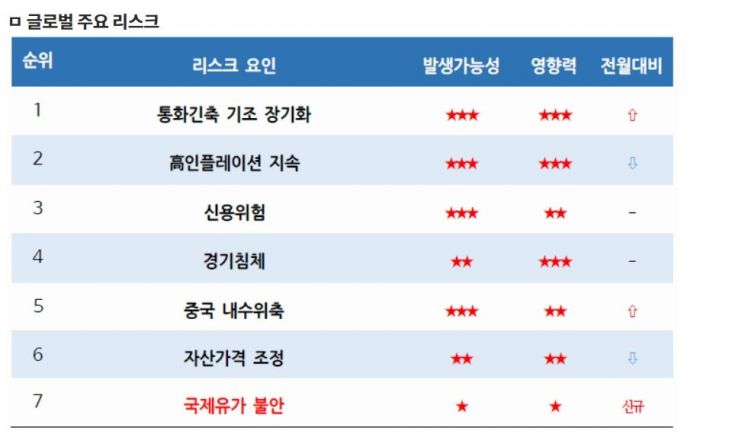
Amid ongoing concerns about the prolonged monetary tightening by the U.S. Federal Reserve (Fed), an analysis has emerged suggesting that the sharp contraction in China's domestic demand will act as a factor intensifying downward pressure on emerging market economies.
The International Finance Center announced on the 10th that, based on its analysis of global risks in September, the prolonged monetary tightening by the U.S. Fed was identified as the biggest risk factor.
While the expectation that the U.S. economy will perform well and achieve a soft landing is positive for the market, there is a view that if the timing of the monetary policy pivot is delayed and the tightening stance is prolonged, it will pose a significant burden on other countries' economies.
China's domestic demand contraction was also highlighted as a risk factor to watch. In China, due to the real estate downturn, aging population, preference for savings, and anticipated decline in commodity prices, households are reducing consumption, and companies experiencing reduced sales are cutting back on employment and investment. The number of new car sales, a representative domestic demand indicator, increased by 26.4% year-on-year in May but sharply dropped to -3.4% in July. The import growth rate, reflecting domestic demand, has also recorded negative figures for six consecutive months since March.
Recently, with the extension of production cut measures by major oil-producing countries, the rise in international oil prices has accelerated, adding "oil price instability" to the list of new risks. Due to production cut policies by Saudi Arabia, Russia, and others, international oil prices have risen by more than 20% since July. This increases the likelihood of gasoline prices rising in advanced countries, which is expected to suppress the decline in inflation rates.
The International Finance Center stated, "In the U.S., unexpected refinery shutdowns, stagnant refining capacity, increased production costs, and inventory shortages are supporting the floor of gasoline prices," adding, "Considering the domestic conditions in Saudi Arabia and Russia, there is a high possibility that production cut policies will be maintained for the time being, and strong U.S. crude oil demand will offset the reduction in China's demand, thereby supporting oil prices."
© The Asia Business Daily(www.asiae.co.kr). All rights reserved.
![Clutching a Stolen Dior Bag, Saying "I Hate Being Poor but Real"... The Grotesque Con of a "Human Knockoff" [Slate]](https://cwcontent.asiae.co.kr/asiaresize/183/2026021902243444107_1771435474.jpg)















