"Whether It Becomes Reality Depends on Xi Jinping"
Amid the Ukraine war and geopolitical turmoil, there is growing analysis that an 'Asian version of the North Atlantic Treaty Organization (NATO)' consultative body is increasingly likely to emerge due to changes in the international security landscape.
On the 7th (local time), Michael Green, senior advisor at the U.S. think tank Center for Strategic and International Studies (CSIS) and director of the Australia Center for American Studies at the University of Sydney, wrote in a Foreign Policy article that "the movement to consolidate alliances among the U.S., its allies, and partner countries in the Indo-Pacific region is reaching its peak."
U.S. President Joe Biden, starting with elevating and regularizing the security consultative body 'Quad' among Japan, Australia, and India to the highest level early in his administration, established the diplomatic and security consultative body 'AUKUS' with the UK and Australia, and last month met with South Korean President Yoon Suk-yeol and Japanese Prime Minister Fumio Kishida to build a trilateral security cooperation system among the U.S., South Korea, and Japan. In addition, efforts to accelerate the establishment of an Indo-Pacific security system are being made through Vietnam, the heart of the Indo-Pacific region.
Following the announcement of a series of economic, energy, and security cooperation measures by the U.S., South Korea, and Japan, interpretations emerged that the U.S. is moving to build a new NATO for the Indo-Pacific region, but the U.S. officially denied this. Green assessed, "The U.S. and partner countries may currently have no intention to pursue an Asian NATO, but the geopolitical developments in the region make this option more plausible than 70 years ago."
He also mentioned the background of why, unlike Europe after World War II, the U.S. created a 'patchwork' system through individual security treaties with countries in Asia rather than a collective security system. He explained that the overwhelming U.S. military superiority in maritime domains, the limitations of Japan's role after World War II, and strong distrust among Asian countries prevented the formation of an environment suitable for collective security agreements.
Green pointed out, "However, currently the U.S. has lost military superiority at sea, and the U.S. and its allies face quantitative threats similar to those NATO faced during the Cold War. The direct military threats from China and North Korea to U.S. allies and partner countries have noticeably increased, which raises the possibility of pursuing an Asian NATO."
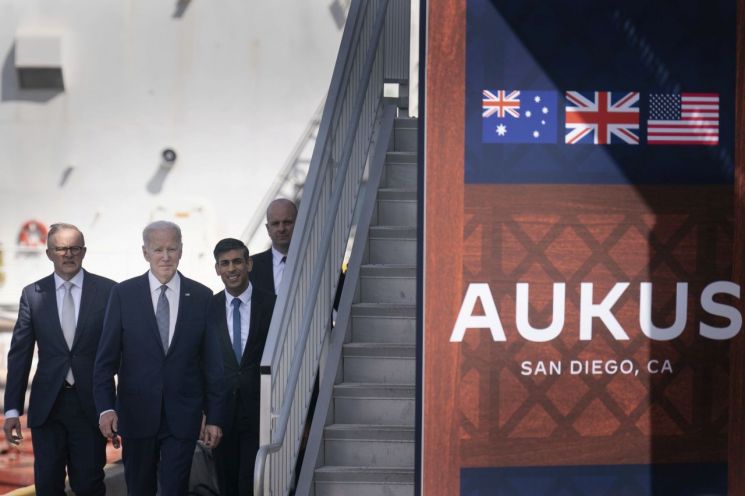
He also highlighted the growing China risk. Due to Chinese provocations, U.S. allies are seen as likely to be drawn into U.S.-China conflicts regardless of their own intentions. Since any conflict could occur across the region without warning, there is a preference for combined command and control and integrated deterrence, which is a structure very similar to NATO.
However, Green noted, "Unlike the Soviet Union during the Cold War, China is the top trading partner for most U.S. allies such as Japan, South Korea, and Australia, and these countries aim to restore productive relations with China." He added, "These countries also view a NATO-style alliance as potentially undermining that future." He further stated, "If the need to deter and block destructive and dangerous regional wars outweighs concerns about trade, regional cohesion, and maintaining strategic autonomy, the direction could shift toward collective security."
He continued, "Even without overt use of force, China's coercive actions toward neighboring countries could lead to this outcome (the creation of an Asian NATO)," adding, "Whether an Asian NATO materializes ultimately depends on Chinese President Xi Jinping."
© The Asia Business Daily(www.asiae.co.kr). All rights reserved.
![Clutching a Stolen Dior Bag, Saying "I Hate Being Poor but Real"... The Grotesque Con of a "Human Knockoff" [Slate]](https://cwcontent.asiae.co.kr/asiaresize/183/2026021902243444107_1771435474.jpg)
















