Comprehensive Coverage of 'IFA 2023' Held from 1st to 5th (Local Time)
Chinese Companies Showcase TVs Targeting Samsung and LG
Products to Resolve Energy Crisis Flood the Market
Smart Home Service War Begins
From the 1st to the 5th (local time), the largest electronics exhibition in Europe, IFA 2023, held in Berlin, Germany, saw fierce competition across various fields including TVs, home appliances, energy-saving technologies, and smart homes. Not only domestic companies such as Samsung Electronics and LG Electronics, but also Chinese companies like TCL and Hisense, as well as European brands like Miele and Bosch, showcased a wide range of products, igniting the battle for dominance in the home appliance market.
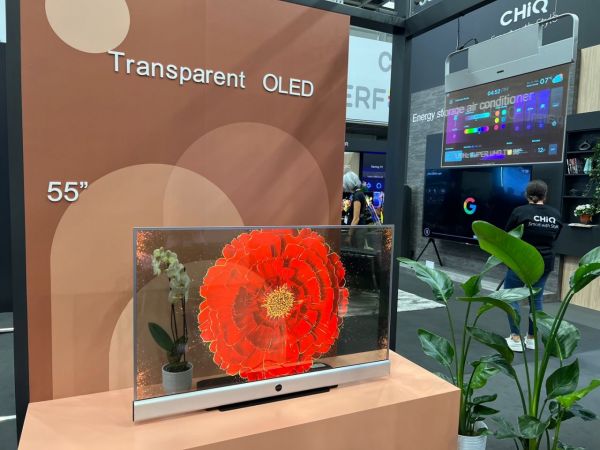
Korea vs China... TV War Intensifies
At IFA 2023, which closed on the 5th, the rivalry between Samsung Electronics and LG Electronics, who lead the premium TV market, and the fierce pursuit by Chinese companies competing against domestic firms stood out.
Samsung showcased a variety of TVs with advanced quality, including Micro LED, Neo QLED, QLED, and OLED. Especially following the trend of "the bigger, the better," Samsung expanded its lineup of 98-inch ultra-large TVs to three models: 8K, Neo QLED, and QLED. At the IFA 2023 venue, the three models were displayed side by side, reaffirming Samsung's commitment to dominate the ultra-large TV market. On the other hand, LG Electronics exhibited only one unit of the world's first wireless OLED TV, the 'Signature OLED M,' once again demonstrating confidence in OLED technology. The two companies hinted at competition for TV market leadership through their different TV strategies.
Unlike domestic companies that reduced the scale of their TV product displays and toned down their presence, Chinese companies showcased a variety of TV lineups to counter Korea.
China's largest TV manufacturer TCL exhibited a massive 163-inch Micro LED 'The Cinema Wall 163-inch 4K' in the center of the exhibition hall. It was the largest TV size displayed at IFA. The QD Mini LED TV was increased up to 115 inches. At the venue, a TCL staff member boasted about their TV technology being world-class, mentioning LG TVs while emphasizing price and performance. Hisense introduced the world's first 8K laser TV, with a diverse lineup ranging from 86 inches to 98 inches and 100 inches. Konka and Changhong focused on mini LED, Micro LED, and OLED TVs targeting the flagship TV lineups of Samsung Electronics and LG Electronics respectively. They attracted visitors' attention by showcasing many TVs over 100 inches, which Samsung and LG do not release in their main product lines.
However, Samsung Electronics and LG Electronics asserted that most Chinese products are for domestic use and have minimal impact on the global market. They especially judged that there is a significant technological gap in the ultra-large and premium product segments, and based on this, they have set a strategy to maintain market superiority.
Jung Kang-il, Executive Director of the Next Generation Planning Group at Samsung Electronics' Visual Display Business Division, said during a TV briefing at IFA, "Chinese companies have been making mini LED TVs for several years, but the fact that the technology name is the same is not a big issue," adding, "With Samsung Electronics' unique know-how, even if the same technology is used, we can produce much clearer and sharper image quality."
Baek Seon-pil, Executive Director of Product Planning at LG Electronics' HE Business Division, also pointed out in a briefing, "Currently, China holds hegemony over LCD panels, but high-end LCDs that require quality image and sound still have a competitive gap," and "Especially for OLED TVs, Chinese companies have almost no production capacity, and their global market share is less than 1%."
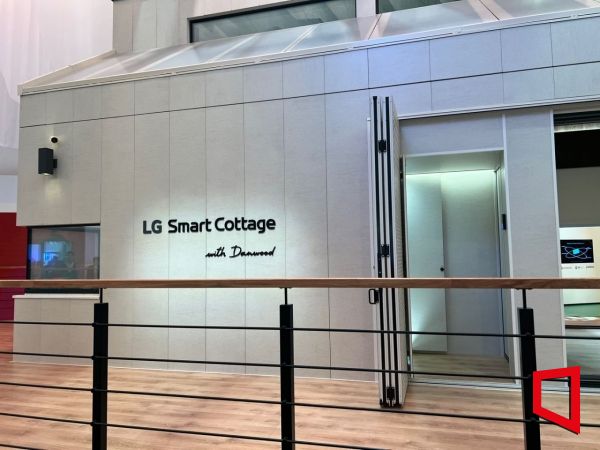 LG Electronics' modular house "Smart Cottage" exhibited features the "Therma V Monobloc," a heat pump heating and cooling system popular in Europe, reducing energy consumption.
 [Photo by Han Yeju]
Targeting Europe's Power Crisis... Eco-Friendly Battle
Products aimed at European consumers, who have become more interested than ever in eco-friendly and high-efficiency products due to the energy crisis caused by the Ukraine situation, also poured out.
The most eye-catching were Samsung Electronics' and LG Electronics' energy self-sufficient residential solutions, 'Tiny House' and 'Smart Cottage.' These products best met Europe's demands for eco-friendly products and energy-saving technologies, attracting visitors eager to explore every corner of the experience spaces.
Samsung Electronics also focused on introducing its unique eco-friendly packaging, solar cell remotes, recycled materials applied to the Galaxy Z Flip5, and microplastic reduction filters applied to washing machines.
Europe's premium home appliance company Miele also exhibited various high-efficiency appliances. They set the standard lifespan for durability testing of all products to a maximum of 20 years to ensure long-term use, and their exhibition booth was designed with a modular structure using eco-friendly materials to minimize waste generation for future reuse.
German premium home appliance brand Bosch introduced the 'Bosch Green Collection' lineup made with an environmentally friendly concept. The Bosch Green Collection refrigerators and freezers emit 33% less carbon dioxide compared to models using conventional production materials.
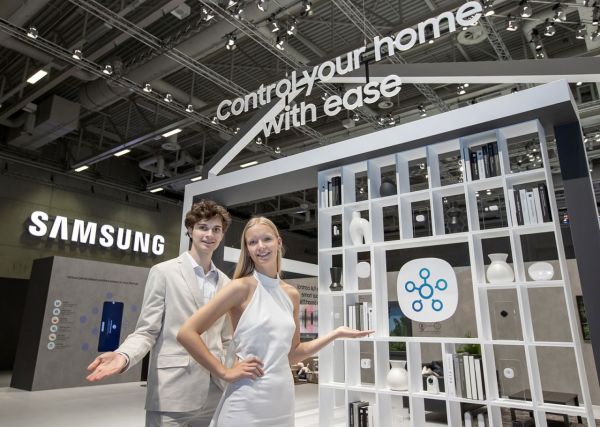 Samsung Electronics and LG Electronics plan to promote mutual interconnection between their products as well as with major global home appliance companies within this year.
 [Photo by Samsung Electronics]
Platform Integration Within the Year... Smart Home War Foreseen
With the planned integration of each company's smart home platforms, competition in the service area is also anticipated. As platform dependency is resolved, companies' efforts to attract customers are expected to intensify.
Samsung Electronics and LG Electronics plan to apply the smart home platform consortium 'Home Connectivity Alliance (HCA)' standard within the year and promote the integration of a total of nine products including refrigerators, washing machines, and air conditioners. The regions where integration services will start this year include eight countries, including Korea and the United States.
Consumers in countries using the 'SmartThings' app will be able to control not only Samsung Electronics' home appliances and TVs but also LG Electronics' and Vestel's home appliances. Samsung Electronics' home appliances can also be controlled via LG Electronics' 'ThinQ' app.
In particular, next year, they plan to add home energy management functions beyond device control and expand connected products such as electric vehicle chargers.
At a briefing held locally, Ryu Jae-chul, President of LG Electronics' H&A Business Division, said, "If customers want, it is right to connect Samsung Electronics products on 'LG ThinQ' as well," adding, "Currently, only basic functions are defined in the protocol, and there are no plans beyond simple function control, but the possibility of evolution is fully open."
While customer convenience has increased, competition among companies is expected to intensify. If global home appliance companies such as Whirlpool and Bosch participate in the future, the battle for dominance is expected to become even fiercer.
© The Asia Business Daily(www.asiae.co.kr). All rights reserved.
![Clutching a Stolen Dior Bag, Saying "I Hate Being Poor but Real"... The Grotesque Con of a "Human Knockoff" [Slate]](https://cwcontent.asiae.co.kr/asiaresize/183/2026021902243444107_1771435474.jpg)

















