Apple, the company with the highest market capitalization, faced negative news from China ahead of the launch of the new iPhone. News related to the 'iPhone ban' in China was reported consecutively, causing Apple's stock price to drop sharply for two consecutive days. The market capitalization lost over the two days is estimated to be close to $200 billion.
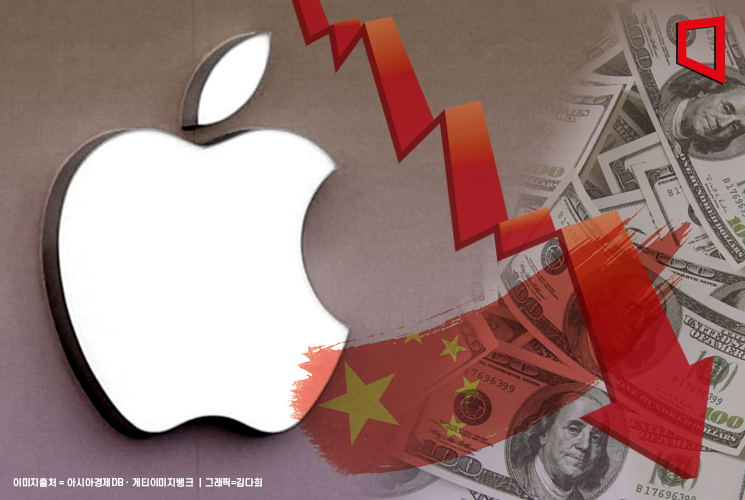
On the 7th (local time) at the New York Stock Exchange, Apple's stock closed at $177.56 per share, down 2.92% from the previous session. Following a nearly 4% plunge the day before when the iPhone ban report first emerged, the decline continued on this day. The two-day drop totaled about 6%, wiping out approximately $200 billion in market capitalization. Apple, which surpassed $3 trillion in market capitalization for the first time this year, recorded a market cap of $2.776 trillion on this day. Apple's weakness, combined with tightening concerns, also caused the tech-heavy Nasdaq index to fall by nearly 1%.
It is unusual for Apple's stock price to fall sharply for two consecutive days just before the launch of a new iPhone. Typically, Apple's stock tends to strengthen ahead of new iPhone releases, but this time, negative news from China had a sensitive impact. The effect came after additional foreign media reports that Chinese authorities plan to expand the iPhone ban, initially imposed on some departments, to state-owned enterprises and other public institutions.
Bloomberg cited sources on the same day, reporting that multiple Chinese public institutions instructed employees not to bring iPhones to work, and that authorities plan to broadly expand this iPhone ban to state-owned enterprises and other public institutions. This followed the Wall Street Journal's (WSJ) initial report the previous day about the iPhone ban on Chinese government officials, indicating that the ban is now extending to state-owned enterprises and public institutions.
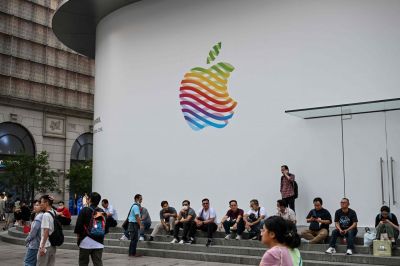
Apple is now on high alert ahead of the new iPhone 15 launch scheduled for the 12th. For Apple, China is both a global production base and a strategically very important market. Currently, about one-fifth of its sales are generated in China. Additionally, most of the iPhone series are produced in China. According to market research firm TechInsights, based on second-quarter shipment volumes, iPhone sales in China are estimated to surpass those in Apple's home market, the United States.
Chinese authorities have not yet issued an official order regarding this measure. It is also unclear how many institutions will be subject to the ban. However, even if the ban is limited to 'workplace prohibition,' analysts suggest that the impact could be relatively significant given China's characteristics. Tony Sacconaghi, an analyst at Bernstein, noted in an investor memo that "the iPhone ban on government officials could reduce iPhone sales in China by up to 5%," adding, "If a signal is sent to the general public to use Chinese companies' electronic products instead of iPhones, it would pose a greater threat to Apple." He also mentioned that this measure "could be part of a broader effort by the Chinese government to encourage the use of domestic technology." Tom Forte, an analyst at DA Davidson, also predicted that "Apple's sales growth in China may slow down," and that "the difficulties will increase."
This move is interpreted as both an effort by Chinese authorities to reduce technological dependence on foreign companies and a form of retaliation against the U.S. government, which is engaged in a technological hegemony battle. Analysts also see it as evidence that despite U.S. Commerce Secretary Gina Raimondo's recent visit to Beijing, no progress has been made in thawing trade relations between the two countries. Previously, the U.S. expanded sanctions against Chinese tech companies such as Huawei citing national security reasons, and China responded with sanctions against U.S. companies like Micron. Edward Moya, senior market analyst at OANDA, pointed out that "Apple's growth story heavily depends on China," adding, "If sanctions intensify, it will also pose significant problems for other major U.S. tech companies reliant on China."
Some experts and foreign media are also paying attention to the timing of the iPhone ban news in China. Despite recent U.S. advanced technology sanctions, Chinese company Huawei attracted attention by releasing a new smartphone, the Mate 60 Pro, equipped with a 7nm (nanometer, one billionth of a meter) process processor. Wamsi Mohan, an analyst at Bank of America (BoA), said that considering Huawei recently launched a 5G smartphone, the "potential timing of the iPhone ban is interesting."
Huawei, which had not been able to release 5G smartphones until now, introduced the Mate 60 Pro at a price much lower than the iPhone, leading to evaluations that Chinese consumers now have an alternative to the iPhone. The Mate 60 Pro starts at $960, cheaper than the iPhone 14 Pro released last year at $999. Apple, which already experienced production disruptions due to China's COVID-19 lockdown policies last year, now faces another test from China. Martin Yang, an analyst at investment firm Oppenheimer, said, "The Chinese government's (iPhone) ban and the new Huawei phone will be significant events for the iPhone," predicting that more Chinese consumers may turn to Huawei.
There are also predictions that Apple's stock price will remain sluggish for the time being. On Wall Street, forecasts of $150 per share have been raised. Barron's expressed concern that "if China's iPhone ban expands, Apple's stock price could be adversely affected for a long time even after the new iPhone launch." The publication cited Citi's analysis showing that since 2016, Apple's stock price has typically risen by an average of 8% between the June quarterly earnings announcement and the September new iPhone announcement, adding, "A miracle would be needed for history to repeat itself this year," and predicted a continued downward trend.
On the other hand, some analysts believe the market is overreacting. Daniel Ives, an analyst at Wedbush, predicted that even if the worst-case scenario of an iPhone ban materializes, the impact on iPhone sales in China next year will be limited. He expects the iPhone 15 to act as a growth driver and overcome the negative news from China. Ives maintained his price target of $230 for Apple. Evercore ISI also reaffirmed its price target of $210 in an investor memo, stating, "Government officials are likely already avoiding Apple products, so the extent of this impact is uncertain," and that "this is more of a headline issue than a problem that could significantly affect financial performance."
© The Asia Business Daily(www.asiae.co.kr). All rights reserved.
![Clutching a Stolen Dior Bag, Saying "I Hate Being Poor but Real"... The Grotesque Con of a "Human Knockoff" [Slate]](https://cwcontent.asiae.co.kr/asiaresize/183/2026021902243444107_1771435474.jpg)

















