1st Anniversary Interview with Kang Gu-young, President of KAI
Korea Aerospace Industries (KAI) plans to establish a foothold for full-scale entry into the European market with the KF-21, following the FA-50, by participating in the 31st Poland International Defence Industry Exhibition '2023 MSPO.' On the 6th, marking the first anniversary of his inauguration, we met KAI President and CEO Kang Gu-young for an interview on-site in Kielce, Poland, where the defense exhibition is held. President Kang stated that, building on last year's export achievements, they intend to promote the excellence of domestically produced aircraft to European countries using Poland as a base at the MSPO exhibition. "We will leverage MSPO to create results that raise awareness of our new products not only in Poland but also in neighboring countries," he said.
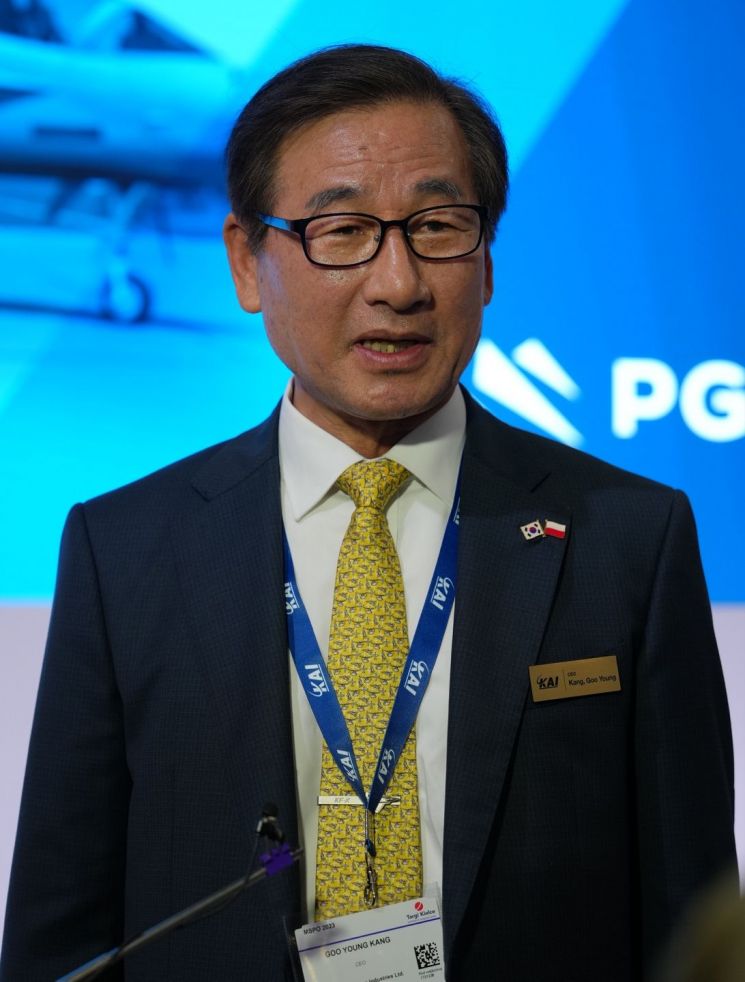
◇ The following is a Q&A session.
- Achievements and significance of participating in the Poland MSPO defense exhibition
△Through the Radom Air Show, we felt a mission to expand our achievements. Although contracts have been fulfilled so far, based on that, since this is an exhibition with many visitors from neighboring countries, we have an opportunity to expand achievements based on the FA-50. Secondly, since the FA-50 was successful, there is a need to shift export targets to the KF-21. We will use MSPO to create results that raise awareness of our new products not only in Poland but also in neighboring countries. The most important thing is the (gratitude) greetings, and secondly, to find opportunities to expand across Europe with the FA-50. Thirdly, it means highlighting the KF-21 as a new product.
- Plans to use Poland as a base for European market expansion?
△Poland also thinks so, and when we expand to Eastern Europe or the whole of Europe, it is sufficient to use it as a hub. Poland is ambitious as well. It is a country that made airplanes 100 years ago. Before World War II, they made airplanes well. They made the P-11 and P-37. The P-37 is a well-known fighter from World War II. They have the will to rebuild that pride through us.
- What was the content of the MOU signed with PGZ?
△The MOU with PGZ was made because although we sold the platform to Poland, the follow-up industry system has not yet been developed. Through this MOU with PGZ, we believe we have created an opportunity to advance follow-up industries related to the FA-50, such as equipment support, logistics support, and other related follow-up industries.
- Possibility of cooperation with local Polish defense industry companies
△Since this place has the pride of the past aviation industry, fortunately, a state-owned defense company called PGZ was established. They do not make airplanes but have maintenance, communication, and armament ammunition technology. The government is fully supporting them. If we cooperate with this company in defense, although there are limits to making airplanes and joint R&D, we initially judged that joint R&D is possible for maintenance, follow-up logistics support, and ground equipment. If this goes well, we believe it can expand to joint R&D, manufacturing, production, and joint sales. Considering the country's will and our technological capabilities, we think we can create a successful model. Since the Polish government is pushing strongly, we believe the chances of success are high.
- Expectations for export effects in maintenance and support
△Life cycle costs: For the 2nd generation, platform sales end there because maintenance is simple. Maintenance in the home country or overseas did not cost much. From the 3rd generation, where software increases, and as I judge, software power becomes stronger than hardware power starting from the 3rd generation. For the 3rd generation, it should be seen as 50-50. The 4th generation is 70% software power. The 5th generation is 80-90%. Later, the 6th generation will be 99%. As generations advance, maintenance and performance upgrades become important. Software changes frequently and must be replaced every five years. Because information technology, AI technology, and big data technology develop rapidly, software must be updated quickly, increasing costs significantly. For the 3rd generation, costs are 2.5 to 3 times per generation. Over a 30-year lifecycle, if the platform costs 100 billion KRW, the life cycle cost is about 250 billion KRW. For the 4th generation, if the platform costs 200 billion KRW, the multiplier is about 3 to 4 times. For the 5th generation F-35, it is 5 to 6 times, sometimes up to 8 times. If you pay about 100 billion KRW for the platform, 800 billion KRW goes to operation and maintenance costs. The F-35 is a representative example where profits come more from follow-up projects than from sales. They sell cheaply but earn profits from follow-up businesses. We can also gain this profit if we have the platform. If we sell the KF-21, we can conduct independent follow-up logistics support businesses.
- Features of the FA-50PL and comparison with the MiG-29 it replaces in Poland
△In terms of size, it is a comparison between large and small. In terms of generation, the MiG-29 is 3rd generation. Our T-50 can also be seen as 3rd generation, but now it should be considered 4th generation. The generation and class difference make them incomparable. But they flew together. In terms of maneuverability, stability, safety, and software power, ours is much better. The FA-50 has an excellent automatic control system, so maneuverability, stability, and safety are all superior to the MiG-29. Regarding air-to-ground capability, the payload capacity is excellent. Many doubt whether it can replace the MiG-29, but it is sufficient. Since Poland tested it, we believe it is fully capable.
△The FA-50 started as a 3rd generation aircraft but can advance to 4th and 4.5 generation. If AMRAAM is integrated, it should be considered 4.5 generation. In terms of performance, it is the strongest in the small group and unmatched in the light class. It moves toward the middle class. With AMRAAM integration, it can reach middle to high class. Its performance is excellent. The greatest advantage is cost-effectiveness. Although not the same class, 4.5 generation fighters like Eurofighter, Rafale, F-16V, or Gripen have operating costs exceeding 20,000 to 30,000 USD per hour. Ours is about one-third of that. The most important thing is availability. No other aircraft can match ours. It has the best cost-effectiveness among fighters worldwide. It is world-class. Our Air Force maintains 85% to 90% availability continuously. Actual performance is important, but from an operational perspective, cost-effectiveness and availability are the best features.
- Future plans to expand exports of domestically produced aircraft
△The most important thing is that KAI must make good products. The FA-50 must expand performance to 4.5 generation through upgrades, and the KF-21 must be successfully developed by 2026, with second performance upgrades in 2028 and third in 2032 to achieve perfect performance. The KUH and LAH must also be delivered to the Army starting next year to build operational know-how. Making competitive aircraft is the most important. Secondly, the export department must work hard and focus regionally. Southeast Asia is already established, so achievements must be expanded. Europe, South America, and the Middle East markets must be expanded. New markets like North America, the US, and Oceania must be created. Efforts are needed to expand exports with well-made products. Thirdly, government support is greatly needed. It is too big for companies alone. For platforms alone, industrial cooperation, technology cooperation, and financial support are necessary, so government-to-government efforts are required. Fortunately, the government is pushing hard now, providing strong policy, organizational, and budgetary support. If we make good products, market actively, and the government supports us, it will succeed. We will strive to become one of the world's top four defense powers. Also, KAI aims to become one of the world's top ten aerospace companies.
- KF-21 export strategy
△We have not yet tested to the maximum, but performance is expanding. Speed, G-force, and maneuverability are being enhanced. Although we have not reached the maximum, it is almost successful. Secondly, the aircraft compared to the KF-21 are 20th-century aircraft. The competitors for our 4.5 generation aircraft, such as F-16V, Gripen, and Rafale, were made 35 years ago. Our aircraft is a 21st-century aircraft. It is the only 4.5 generation aircraft made in the 21st century. The fundamentals are different, and it is the aircraft of the future. Competitors cannot be expanded. Their lifespan ends at 4.5 generation. Our aircraft can advance to 5th and 6th generation manned-unmanned complex systems. Considering expandability, it can be used for 30, 50, 60, even 100 years. By the mid-2030s when this aircraft is released, there will be no competitors. They will all be discontinued. Since all will move to 6th generation, this is the only 4.5 generation aircraft. Countries wanting to buy non-5th generation aircraft have no choice but this. It will inevitably sell, so we must sell it with the nation's dream.
- Status of the US trainer aircraft project
△We are currently putting our life on the line. We are playing all-around. Looking at the current situation, it seems the RFI or RFP process and contract will be delayed.
Instead, we have more time to prepare. We can do it in detail. The government held a one-team kickoff ceremony. Activities are actively underway domestically. We now need to proceed with collaboration with Lockheed Martin in the US, and both sides are in agreement. Next week, we will go to the US to start the one-team process between Lockheed Martin, the US, and Korea. Once this proceeds, the government plans to send the Black Eagles team to the US next year to activate the atmosphere there. We aim to establish a certain level by next year and make a decisive effort in 2025. It seems there will be some delay.
- Status of Polish pilot and maintenance personnel training in Korea
△Training people who can operate the aircraft is as important as delivering the aircraft. When these people went to our Air Force and saw pilots operating, flying, training, and maintenance personnel maintaining, they were surprised. Although they operated Russian aircraft for decades, they saw very efficient aspects and deep technical skills they had never seen before and had a strong will to learn. Their desire to copy pilot training systems, aircraft operation systems, and maintenance operation systems is very strong. Expectations for training were high. So far, it is going smoothly. Poland has a strong will to learn in detail. Of 32 pilots, 4 have completed training, and 4 are currently being trained. Of 156 maintenance personnel, 75 completed the first phase, and the second phase is about to start. We are teaching well, and their willingness to learn is strong, so overall progress is smooth. The FA-50PL will be delivered at the end of 2025, so maintenance personnel training must be completed by then. Pilot training is a bit delayed but will be completed for all 32 by the following year.
© The Asia Business Daily(www.asiae.co.kr). All rights reserved.
![Clutching a Stolen Dior Bag, Saying "I Hate Being Poor but Real"... The Grotesque Con of a "Human Knockoff" [Slate]](https://cwcontent.asiae.co.kr/asiaresize/183/2026021902243444107_1771435474.jpg)
















