Increase in Female Employment Rate Since 2000
However, 'M-Shaped' Pattern in 30s to 40s Age Group
Employment Rate Declined Immediately After COVID-19 (2020)
Last year, the female employment rate entered the 60% range for the first time. However, the employment rate of women in their late 30s, a period prone to career interruptions, was relatively low.
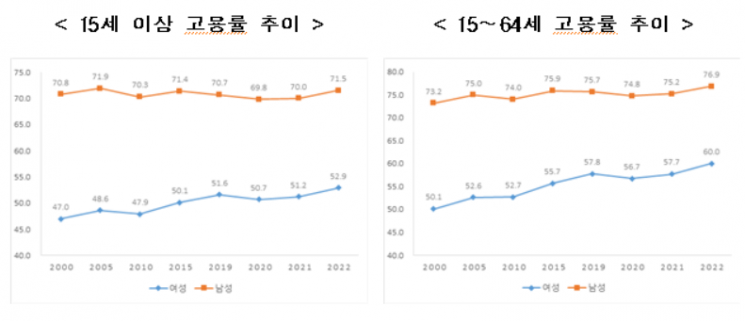
According to the '2023 Life of Men and Women in Statistics' data released by the Ministry of Gender Equality and Family on the 6th, the employment rate of women aged 15-64 last year was 60%, an increase of 7.3 percentage points compared to 52.7% in 2010.
The employment rate gap between men and women aged 15-64 decreased from 21.3 percentage points in 2010 to 16.9 percentage points in 2022.
The female employment rate showed a steady upward trend since 2000 (50.1%) but slightly declined after the outbreak of COVID-19 in 2020 (56.7%). It then rose again from 2021 (57.7%).
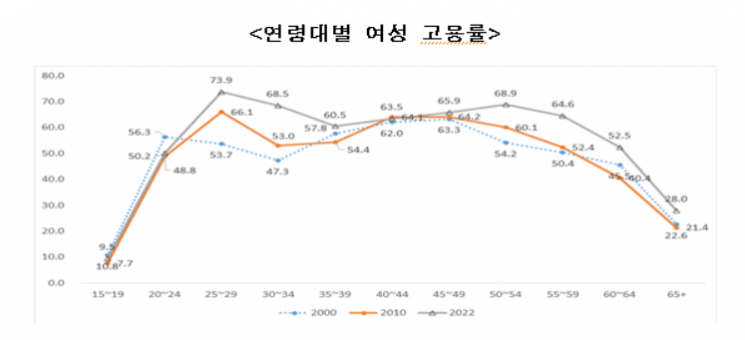
However, women in their 30s showed a decrease in employment rate due to career interruptions caused by marriage, pregnancy, childbirth, and childcare. Last year, the female employment rate was highest in the late 20s (73.9%), early 50s (68.9%), and early 30s (68.5%), while it was relatively low in the late 30s (60.5%).
Because of this, the female employment rate exhibits an 'M-shaped' pattern, decreasing due to career interruptions in the 30s and re-entering the labor market in the 40s. However, there is a difference in that the lowest employment rate shifted from the early 30s (53%) in 2010 to the late 30s (60.5%) last year. This is interpreted as a result of the rising age of first marriage and childbirth.
Last year, the economic activity participation rate was 73.% for men and 54.6% for women, a decrease of 0.3 percentage points for men and 5 percentage points for women compared to 2010. The female unemployment rate (3.1%) also decreased by 0.2 percentage points compared to 2010, and the male unemployment rate (2.7%) decreased by 1.3 percentage points. However, while the male unemployment rate (5%) was higher than the female unemployment rate (3.6%) in 2000, since 2020, after the outbreak of COVID-19, the female unemployment rate (4%) has been higher than the male rate (3.9%).
© The Asia Business Daily(www.asiae.co.kr). All rights reserved.
![Clutching a Stolen Dior Bag, Saying "I Hate Being Poor but Real"... The Grotesque Con of a "Human Knockoff" [Slate]](https://cwcontent.asiae.co.kr/asiaresize/183/2026021902243444107_1771435474.jpg)


















