Launch of the 'Young Scientists Innovation Advisory Committee' on the 9th
Minister Lee Jong-ho and Director Joo Young-chang Engage in On-site Discussions
The Ministry of Science and ICT will strengthen communication with young researchers to soothe the sentiments of the scientific community, which is protesting against the reduction of the national research and development (R&D) budget.
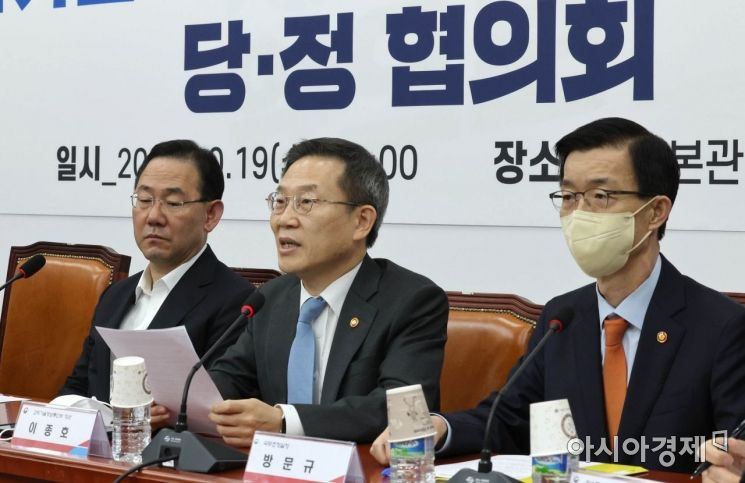 Minister Lee Jong-ho of the Ministry of Science and ICT is delivering opening remarks at the 'Ruling and Opposition Party Meeting on the Kakao Data Center Fire' held at the National Assembly on the 19th. Photo by Yoon Dong-joo doso7@
On the 3rd, the Ministry of Science and ICT announced that Minister Lee Jong-ho and Joo Young-chang, head of the Science and Technology Innovation Headquarters, will directly communicate with young scientists in the research field regarding the 'Government R&D System Innovation Plan' and the '2024 National R&D Project Budget Allocation Adjustment Results' announced at the end of last month.
First, Joo Young-chang, head of the Science and Technology Innovation Headquarters, plans to hold a kickoff meeting for the 'Young Scientists Innovation Advisory Committee' on the 7th. The Ministry of Science and ICT plans to focus discussions through this advisory committee, composed of young scientists in their 30s and 40s, on support measures for future generations such as helping outstanding early-career researchers settle, institutional improvements for nurturing young scientists including evaluation centered on potential and possibilities. Minister Lee will also travel to Indonesia this week to attend the 'Korea-ASEAN Artificial Intelligence Youth Festa,' but after returning, he plans to visit research sites to communicate directly with young scientists.
Previously, the government reduced next year’s national R&D budget by 10.9% compared to this year. However, the budget for supporting young scientists was significantly increased by 41.8%, from 534.8 billion KRW in 2023 to 758.1 billion KRW. Specifically, support for postdoctoral training at excellent domestic and overseas research institutions was greatly expanded from 600 projects in 2023 to 1,100 projects. For those newly appointed as regular employees at universities or government-funded research institutes, a budget of 60 billion KRW was allocated for laboratory establishment, increasing the previous maximum support from 100 million KRW to up to 500 million KRW. Additionally, research funding for early-career researchers was significantly increased from 450 projects in 2023 to 800 projects, and the research funding per project was more than doubled from 150 million KRW to up to 300 million KRW. For student researchers participating in research projects at universities and government-funded research institutes, measures were prepared to secure stable student labor costs so that they can balance their studies and research in a stable environment. The project for training high-level researchers in core strategic technology fields such as secondary batteries and quantum technology was also greatly expanded by 51.1%, from 169.3 billion KRW in 2023 to 259.9 billion KRW.
Minister Lee said, "We have adjusted inefficient parts and expanded R&D that is truly R&D, as well as investments for future generations. We will listen carefully to the vivid voices of junior scientists who will lead the future of our science and technology."
© The Asia Business Daily(www.asiae.co.kr). All rights reserved.
![Clutching a Stolen Dior Bag, Saying "I Hate Being Poor but Real"... The Grotesque Con of a "Human Knockoff" [Slate]](https://cwcontent.asiae.co.kr/asiaresize/183/2026021902243444107_1771435474.jpg)















